Houseplant · Orchidaceae
Slipper Orchid
Paphiopedilum
Because it stores little water, a slipper orchid depends on steady warmth, diffuse light, and evenly moist compost, and repays that with months of bloom.
Medium indirect
Every 5–7 days
55–81°F · 13–27°C
USDA 10–12
Overview
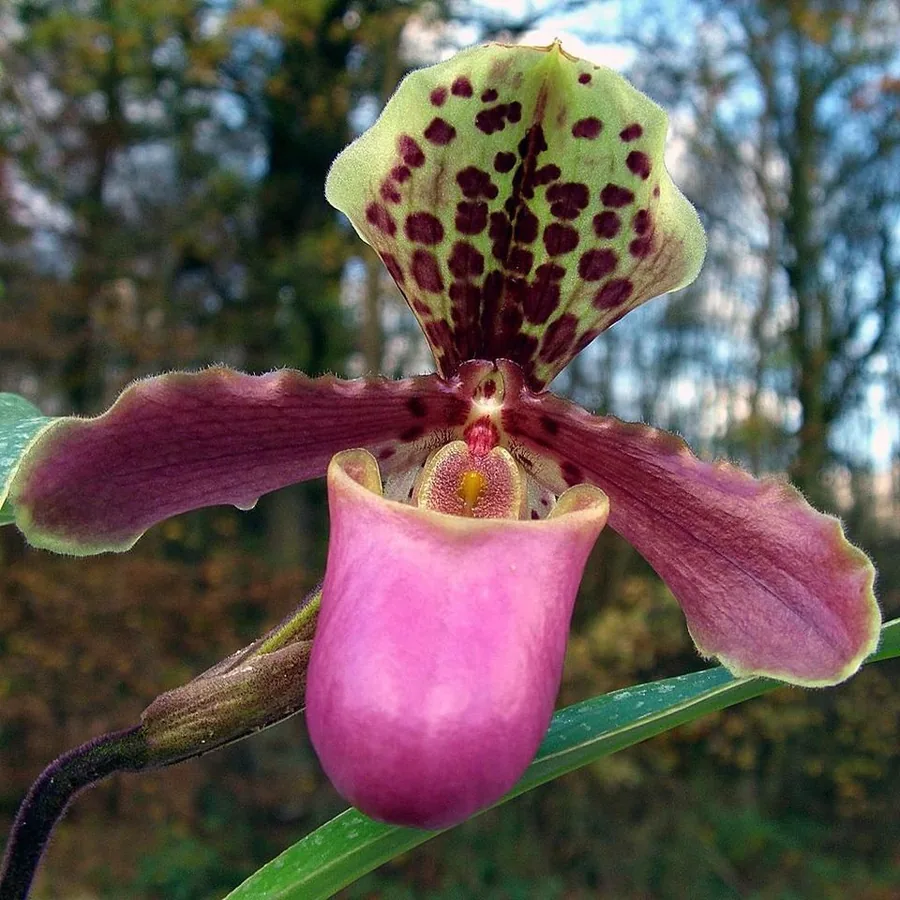
The common name traces to the flower's pouch-shaped lip, a modified petal that gives each bloom its slipper outline. The genus is Paphiopedilum. Unlike the epiphytic orchids that grow perched on tree bark, these are terrestrial, rooting into the ground, and that habit governs their mix, their watering, and their intolerance of drought.
The defining trait is a lack of pseudobulbs, the swollen storage organs many orchids use to bank water. Without them, a slipper orchid holds little reserve and cannot survive a dry interval, which is why constant moisture is not optional. The reward for supplying it is a single waxy flower that persists up to three months, unusually long for a houseplant bloom.
Growth is slow and the mature plant stays compact, reaching 6 to 18 inches (15 to 45 cm) tall. Diffuse light suits it because the foliage scorches under direct sun. Supply even moisture, warmth, and humid air, and the plant persists for years.
Care
The short version: medium indirect light, compost held evenly moist through the year, temperatures of 55°F to 81°F (13°C to 27°C), relative humidity near 50% to 70%, and dilute feeding across the growing season.
Light
Provide medium indirect light; direct sun scorches the foliage, which is adapted to shaded, understorey conditions. An east window, or a position set back from a brighter exposure, meets the requirement, and the mottled-leaved forms tolerate lower light than most orchids. Pale, lax growth signals a deficit, while bleached patches signal excess.
Water
Hold the compost evenly moist year-round and never allow it to dry out, since the absence of pseudobulbs leaves no water reserve to draw on. A cycle of every 5 to 7 days generally maintains that state, reduced somewhat in winter as demand falls. Apply water at compost level and keep it out of the crown, where standing moisture invites rot.
Soil
Use a free-draining terrestrial orchid mix, fine-grade bark amended with perlite or crushed bark. The structure has to retain moisture while admitting air to the roots, which respire and decline if the medium turns dense and airless. A slightly acidic pH of 5.5 to 6.5 matches the plant's preference.
Temperature
Maintain 55°F to 81°F (13°C to 27°C), the range of a normally heated room. Consistency outweighs any precise figure, and abrupt cold draughts are the trigger for bud drop, so a stable position matters more than warmth alone.
Humidity
Target relative humidity of 50% to 70%, above the level most interiors hold. Grouping plants, a tray of damp pebbles, or a nearby humidifier all raise ambient moisture. Combine this with air movement, since still humid air over wet foliage encourages fungal problems.
Feeding
During the growing season, spring to autumn, feed weekly with a balanced orchid fertilizer at quarter to half strength. Applying it after watering is deliberate: dilute feed on already-moist roots avoids the salt concentration that damages dry root tissue. Reduce feeding through winter as growth slows.
Pruning
Structural pruning is minimal. Once a flower spike is exhausted, cut it back to the base, and remove dead or yellowed leaves as they occur. No further shaping is needed or beneficial.
Repotting
Repot every 1 to 2 years, preferably in spring after flowering, into fresh medium. The cues are roots crowding the rim, a compost that has decomposed, or a plant that has worked loose. Old mix collapses into a dense, water-retentive mass, precisely the condition the roots cannot tolerate.
Size & spacing
The plant is small in stature, 6 to 18 inches (15 to 45 cm) tall with a spread of 8 to 16 inches (20 to 40 cm). Its restrained dimensions suit a windowsill or shelf, provided air can circulate around the foliage to keep it dry.
Troubleshooting
Nearly every disorder of a slipper orchid comes down to water management, since the plant sits between two failure points: a root zone that must stay moist yet aerated, and a crown that must stay dry. Identify the fault early and most are reversible. Compare the signs below, then correct the cause before decay advances.
Soft brown decay at the centre of the fan
The disorder is crown rot, caused by water trapped between the leaves at the growing point. The base of the fan softens, browns, and often emits a foul odour, and the infection is lethal if left unchecked. Cut out all affected tissue with sterile tools, dry the crown, and thereafter water only at compost level so the centre stays dry.
Fix:
- Cut away all affected tissue with sterile tools
- Allow the crown to dry and keep water out of the centre
- Improve air movement around the plant
Foliage yellowing
The primary cause is root rot arising from a compost kept saturated, though yellowing confined to the lowest leaf reflects normal senescence. Unpotting settles the question: soft, blackened roots confirm rot, whereas firm, pale roots indicate the plant is sound. Excise the decayed roots, repot into fresh free-draining medium, and re-establish even, non-waterlogged moisture.
Fix:
- Remove the plant from its pot and cut away soft, rotten roots with clean tools
- Repot into fresh, free-draining terrestrial orchid compost
- Resume even moisture without letting the mix become waterlogged
Buds aborting before opening
This is bud blast, and it typically follows a relocation, a cold draught, or a lapse in moisture, each of which stresses the developing buds. The buds yellow and abscise while the foliage remains unaffected. Return the plant to a stable, draught-free position, raise humidity to 50% to 70%, and keep the medium evenly moist through the budding period.
Fix:
- Move the plant to a stable, draught-free spot
- Raise humidity to 50-70%
- Keep the compost evenly moist
Toxicity
For a household with pets or children, the assessment is straightforward: the slipper orchid is non-toxic. No toxic principle is recorded for Paphiopedilum, and ingestion causes at most a mild, self-limiting gastrointestinal upset rather than poisoning. The single documented irritant is the fine glandular hairs on the leaves and stems, which can inflame sensitive skin, so hands are best rinsed after handling.
Safe for
People · Cats · Dogs · Horses · Rabbits · Livestock · Birds
Cats None
Non-toxic to cats. Ingested leaf tissue may provoke drooling or slight regurgitation through simple irritation, but no toxin is present and no treatment is warranted.
Dogs None
Non-toxic to dogs. A chewed leaf may produce mild gastrointestinal upset, yet the plant contains no poisonous constituent.
Horses Safe
No toxicity in horses. The leaves and flowers hold no poisonous compound, so an incidental mouthful has no systemic effect.
Rabbits Safe
Harmless to rabbits. The foliage carries no toxin, though any unfamiliar green is best introduced in small quantity.
Livestock Safe
No toxic effect on grazing stock. Cattle, goats, and sheep may contact or sample the plant without consequence.
Birds Safe
Non-toxic to pet and wild birds alike. No constituent of the plant is poisonous to them.
People Safe
Safe to handle and to keep around children. The one qualification is that the fine glandular hairs on the leaves and stems can irritate sensitive skin, so rinsing the hands after repotting is prudent for susceptible individuals.
Non-toxic, but ingesting plant material may cause mild gastrointestinal upset, so it is still best kept out of reach.
Varieties
The genus runs to thousands of species and hybrids, but a small number account for most plants grown indoors. The following are the reference points worth knowing.
Paphiopedilum Maudiae gx
A widely grown hybrid distinguished by mottled foliage and crisp green-and-white striped flowers.
Paphiopedilum insigne
A cool-growing species with plain green strap leaves, regarded as among the most forgiving Paphiopedilum for cultivation indoors.
Paphiopedilum spicerianum
Recognised by a white dorsal sepal bearing a central purple stripe and by its folded margins.
How to propagate
Home propagation is by division of an established clump rather than seed, and the limiting factor is the slow rate at which divisions re-establish.
DivisionModerate
At repotting in spring, after flowering · 1-2 years to re-establish and resume blooming
Propagate by dividing an established clump at repotting, in spring once flowering has finished. Each division should retain at least 3 to 4 fans, because a smaller piece carries too little reserve to recover quickly and may need 1 to 2 years to re-establish and flower again.
Myths
Orchids are poisonous to cats and dogs.
The record does not support this. The ASPCA lists orchids such as the Phalaenopsis orchid as non-toxic to cats, dogs, and horses, and no toxic principle is documented for the slipper orchid. Ingestion produces at most a transient stomach upset, not systemic poisoning.
Slipper orchids should be dried out fully between waterings, as a cactus is.
The physiology rules this out. Lacking pseudobulbs, Paphiopedilum store almost no water and cannot endure the drought interval that succulents and many epiphytic orchids withstand. Keep the compost evenly moist and never let it dry out completely.