Houseplant · Orchidaceae
Brazilian Pansy Orchid
Miltonia
Give it warmth, steady moisture, and humid air, and the Brazilian pansy orchid returns star-shaped blooms.
Bright indirect
Every 5–7 days
55–84°F · 13–29°C
USDA 10–12
Overview
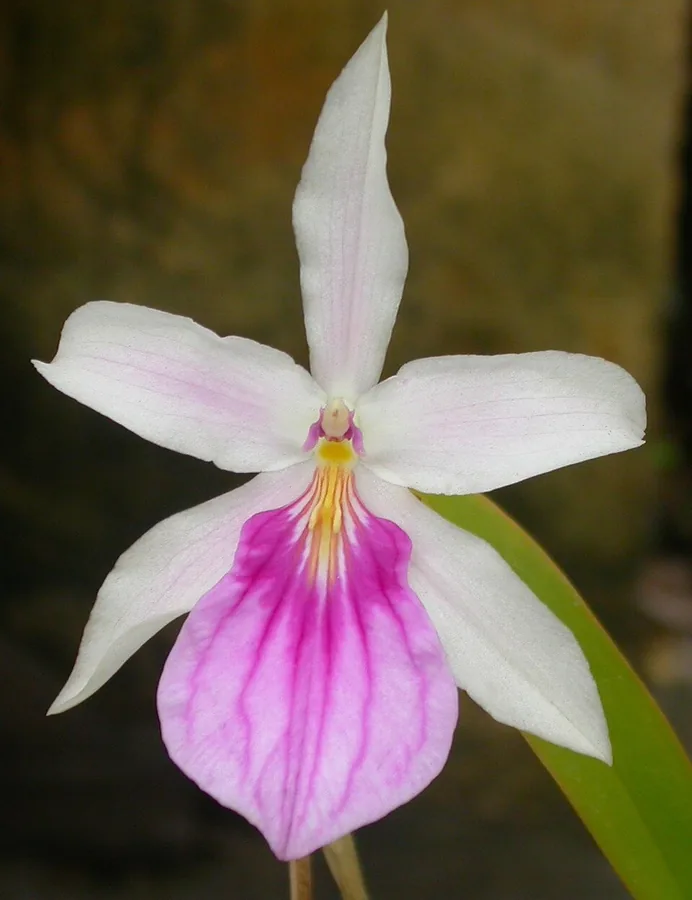
The Brazilian pansy orchid, catalogued botanically as Miltonia, is a warm-growing epiphyte native to the forests of Brazil. In habitat it anchors to tree branches rather than rooting in soil, taking its water from rainfall and humid air. Under cultivation indoors it remains compact at roughly 8 to 18 inches (20 to 45 cm) tall, and consistent care draws out sprays of flat, showy flowers.
Growers routinely mistake it for Miltoniopsis, the cooler flat-faced pansy orchid of the florist trade. True Miltonia demand more warmth and brighter light and bear more star-shaped flowers. Correct identification matters, because it governs watering frequency and the position the plant should occupy.
Its moderate rating rests on a single demand made twice over: even moisture at the root zone and humid air around the canopy, maintained together. Meet both and the plant proves forgiving and long-lived. Allow the bark medium to alternate between bone-dry and saturated and the stress registers as pleated leaves and shriveled pseudobulbs.
Care
The short version: supply bright indirect light, tepid water as the bark mix approaches dryness, and humid air around 50% to 70%, all held between 55°F and 84°F (13°C to 29°C) with a half-strength orchid feed across the growing season.
Light
Site it in bright indirect light, such as an east-facing window or a position set back from a brighter one. It tolerates medium light and partial shade, but unfiltered direct sun scorches the foliage and yellows it.
Water
Apply tepid, low-mineral water as the bark mix approaches dryness, on the order of every 5 to 7 days, without ever letting the roots dry out completely. Allow full drainage afterward, because roots left standing in water rot quickly.
Soil
Grow it in an open, free-draining orchid bark mix, fine to medium grade, amended with a little sphagnum or perlite. Aim for a slightly acidic pH of 5.5 to 6.5, and keep the medium loose so air reaches the roots.
Temperature
It is a warm grower, most productive between 55°F and 84°F (13°C to 29°C). Ordinary room temperatures suit it, provided it is kept clear of cold drafts and chilled windowsills through winter.
Humidity
The plant requires humid air, ideally 50% to 70%. Typical indoor air is too dry, so a pebble tray, grouping with other plants, or a humidifier keeps the leaves from crimping.
Feeding
Through the growing season, from spring into early autumn, feed every two weeks with a balanced water-soluble orchid fertilizer diluted to half strength. Taper feeding as growth slows toward the end of the year.
Pruning
Once the blooms fade, cut the spent flower spike back to its base. Remove shriveled or dead pseudobulbs and roots with sterile tools, and leave healthy green leaves intact.
Repotting
Repot every 1 to 2 years, ideally just after flowering as new growth begins. Move it on when new growth crowds over the rim, roots grow densely out of the pot, or the bark has broken down and stays soggy.
Size & spacing
A compact orchid, it reaches 8 to 18 inches (20 to 45 cm) in height and spreads 6 to 12 inches (15 to 30 cm) across. That modest footprint suits a windowsill or a humid bathroom shelf.
Troubleshooting
Most Miltonia disorders originate at the root zone and the moisture governing it. Pleated leaves, wrinkled pseudobulbs, and yellowing each point to watering or humidity out of balance. Match the symptom below, then examine the roots, because they carry the definitive evidence.
Black, soft, mushy roots
Blackened, collapsing roots are root rot, the most serious disorder these orchids face, and it develops where the medium stays waterlogged or has broken down and lost the air spaces the roots depend on. Unpot the plant and press each root, since sound tissue stays firm while rotted tissue collapses and turns brown or black. Excise every dead root with sterile scissors, repot into fresh open bark that restores aeration, and water sparingly until new roots anchor.
Fix:
- Remove all dead roots with sterile scissors
- Repot into fresh, open bark mix
- Resume careful watering as new roots develop
Pseudobulbs shriveling and wrinkling
Pseudobulbs serve as the plant's water reservoir, so wrinkling signals that stored water is being drawn down faster than the roots replace it. Two mechanisms produce that deficit: outright dehydration from too little water, or roots lost to rot that can no longer take water up. Unpot the plant to distinguish them. Firm white or green roots indicate simple dryness, calling for more frequent watering and higher humidity, whereas soft brown roots confirm root rot and require trimming, fresh medium, and restrained watering until replacement roots form.
Fix:
- If roots are healthy, increase watering frequency and humidity
- If roots are rotted, trim dead roots, repot in fresh mix, and water carefully while new roots form
Leaves turning yellow
A single yellowing leaf at the base reflects ordinary senescence of the oldest tissue, but yellowing across several leaves usually traces to overwatering and root rot or to direct sun scorching the foliage. Feel the roots for waterlogging and note whether the plant sits in unfiltered light. Reduce watering and improve drainage, repotting where the roots have begun to rot, and relocate the plant into bright indirect light away from hot direct sun.
Fix:
- Reduce watering and improve drainage; repot if roots are rotting
- Move to bright indirect light away from hot direct sun
New leaves opening pleated like an accordion
Concertina growth appears when water reaching an expanding leaf falls short of what the tissue needs to inflate evenly, a shortfall that traces to a mix allowed to dry too far or to air too dry around the plant. Because the pleats set as the cells mature, the leaf stays crimped, though the plant is otherwise unharmed. Hold the bark evenly moist, raise humidity into the 50% to 70% band, and repot if the roots have declined or the medium has collapsed.
Fix:
- Establish a consistent watering schedule keeping the mix evenly moist
- Raise humidity to 50-70%
- Repot into fresh bark mix if roots are unhealthy or medium is broken down
Toxicity
For a household with pets or children the verdict is reassuring: the Brazilian pansy orchid is non-toxic throughout. No part of the plant carries a poison, so a curious nibble from a cat, dog, or child presents no real danger. The likeliest outcome is mild gastric upset from ingesting material that is not food.
Safe for
People · Cats · Dogs · Horses · Rabbits · Livestock · Birds
Cats None
A cat can live alongside this orchid without hazard. The foliage holds no toxin, so a chewed leaf produces nothing beyond possible mild gastric upset from ingesting non-food material.
Dogs None
No toxic compound is present, so a dog that chews leaf or flower faces no poisoning. Keeping the bark medium out of reach remains sensible, since a swallowed piece can abrade the digestive tract.
Horses Safe
The plant poses no chemical threat to horses. Contact is unlikely with an indoor orchid, but an incidental mouthful would clear without consequence.
Rabbits Safe
A rabbit can browse the leaves without toxic effect. The tissue contains no poison, though it holds no nutritional value worth offering deliberately.
Livestock Safe
Goats, sheep, and cattle encounter no toxin in this orchid. As a tropical houseplant it seldom reaches grazing animals, and an accidental mouthful causes no harm.
Birds Safe
A pet bird may perch on or peck the plant without risk. Leaves and blooms carry no toxins, so incidental chewing warrants no concern.
People Safe
Cultivation and handling present no toxic risk to adults or children. The plant is not grown for consumption, yet no part poisons a child who mouths a leaf.
No special handling precautions for toxicity; wash hands after handling fertilizer or wet potting media as general practice.
Varieties
Several Brazilian species stand behind the Miltonia name, separating chiefly by the color and form of their flowers. These are the ones most often encountered in cultivation.
Miltonia spectabilis
The type species of the genus produces large, flat, markedly fragrant flowers with a broad lip grading from deep pink through to purple.
Miltonia regnellii
It carries several pale white-to-pink flowers per spike over a rose-veined lip and establishes readily outdoors in mild climates.
Miltonia clowesii
Its star-shaped flowers are barred in chestnut-brown and yellow above a fiddle-shaped lip marked with white and purple.
Miltonia flavescens
This species produces a tall arching spike densely set with numerous narrow, pale-yellow, star-shaped flowers.
How to propagate
Miltonia is increased by dividing an established plant rather than by seed under home conditions. The process is slow, but it yields genetically identical copies of the parent.
DivisionModerate
Just after flowering, as new growth begins (typically spring) · 1-2 years to re-establish and reach flowering size
Divide an established clump just after flowering, timed to the flush of new growth in spring so each division can root while actively growing. Sever the rhizome so every piece retains at least three to four healthy pseudobulbs together with an active new growth, use sterile tools to limit disease, and pot each into fresh bark mix. Allow for a slow return, as the divisions need a year or two to re-establish and reach flowering size.
Myths
The flat-faced pansy orchid sold in shops is a Miltonia.
The cool-growing, flat pansy-faced plants most people picture belong to Miltoniopsis, a genus segregated from Miltonia. True Miltonia are warm-growing Brazilian species bearing more star-shaped flowers, and they require the warmer, brighter conditions that separate them from those look-alike relatives.
Orchids are parasites that feed off the trees they grow on.
Miltonia and most cultivated orchids are epiphytes that use a tree only as physical support. They manufacture their own food through photosynthesis and obtain water and nutrients from rain, air, and the organic debris collecting around their roots, drawing nothing from the host.
Watering with ice cubes is the proper way to water these orchids.
As warm-growing tropical plants, they respond poorly to cold, and meltwater can shock and injure the roots. They require regular watering with tepid water that holds the bark mix evenly moist.