Houseplant · Orchidaceae
Dendrobium Orchid
Dendrobium
Supply bright light and a cool, dry winter rest, and the dendrobium responds with canes full of flowers.
Bright indirect
Every 5–7 days
50–84°F · 10–29°C
USDA 9–12
Overview
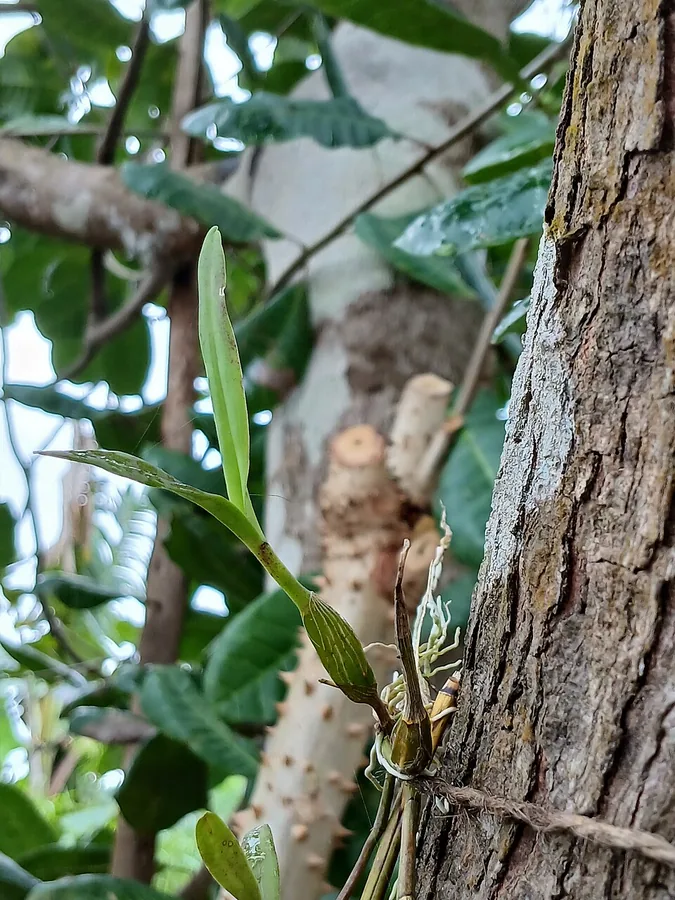
Dendrobium is among the largest genera in Orchidaceae, with hundreds of species distributed across Asia and the Pacific. Nearly all are epiphytes, growing anchored to tree bark rather than rooted in soil, and that ecology dictates almost every cultural decision indoors. The plants store water and carbohydrate in upright stems called canes, which is precisely why an old, leafless cane retains value and should not be removed.
Two cultivated groups dominate the houseplant trade, and they behave differently. The noble types, led by D. nobile, are deciduous and require a cold, dry winter spell before they will flower. The Den-Phal hybrids remain evergreen and bloom more readily with less intervention. Establishing which type you own therefore governs winter watering and, ultimately, whether the plant blooms at all.
The culture is straightforward once the seasonal cycle is in place. A dendrobium needs bright light, a chunky bark medium that drains rapidly, and a defined transition between its growing phase and its rest. Meet those conditions and a single healthy cane can support dozens of flowers that persist for weeks.
Care
The short version: abundant bright indirect light, a fast-draining bark mix, watering about weekly through active growth, and a cool, dry rest in late fall to initiate the blooms.
Light
Dendrobium require bright indirect light, roughly twice the intensity Phalaenopsis prefers, and tolerate a little direct morning sun without scorch. Use leaf color as your gauge and aim for a healthy mid-green. Dark, overly lush foliage indicates insufficient light, and because light drives flower initiation, that shortfall typically explains a failure to bloom.
Water
During active growth water about once a week, allowing the bark to dry slightly between applications so the roots are not held wet. In late fall the regime changes: deciduous types like D. nobile have their water cut back sharply for a cool, dry rest. That imposed dry spell is the cue that initiates the flower buds.
Soil
Garden soil suffocates these epiphytic roots and must never be used. Pot instead into a coarse, bark-based epiphyte mix with horticultural charcoal, which retains modest moisture while keeping air at the root surface. The plants prefer a slightly acidic medium, in the 5.5 to 6.5 range.
Temperature
Dendrobium are comfortable across a broad band, roughly 50°F to 84°F (10°C to 29°C). The cooler end of that range in late fall contributes to bloom initiation in many types, so a natural seasonal drop in winter is an asset rather than a stress.
Humidity
Hold humidity in the 40% to 60% range, a target most homes meet. Where winter air is dry, stand the pot on a tray of pebbles and water or group it with other plants to raise local humidity, and keep air moving across the foliage, since stagnant air invites both rot and pests.
Feeding
Fertilize from spring through early fall, the active growth period, with a balanced orchid fertilizer diluted to half strength. Apply it monthly and only after watering, so a fertilizer charge never contacts dry roots and risks burning them. Reduce feeding as growth slows toward winter.
Pruning
Pruning demands are minimal. Remove the spent flower spikes and excise only canes that are fully dead, brown, and shriveled. Leafless green or yellowing old canes continue to function as water and nutrient stores and should be retained, since cutting them discards reserves.
Repotting
Repot every 2 to 3 years, or earlier once the bark decomposes and begins holding water against the roots. Roots climbing over the rim and canes pressed against the pot edge are corroborating signs. Increase pot size only marginally, because dendrobium flower most freely when slightly root-restricted.
Size & spacing
Mature height ranges from about 6 to 47 inches (15 to 120 cm) according to type, with a spread of 6 to 18 inches (15 to 45 cm). Allow each plant enough spacing for free air movement around the canes, which helps suppress fungal problems and pests.
Troubleshooting
Nearly every dendrobium complaint resolves to one of three inputs: light, water, or the condition of the bark medium. The canes and roots record what went wrong, so read them before acting. Identify the case below, then correct the underlying cause rather than the symptom it produces.
Yellow, soft, mushy canes at the base
Canes that yellow, soften, and turn mushy at the base indicate root and crown rot driven by excess water. Unpot and examine the roots, since firm white or green roots are sound whereas brown, soft, hollow ones have rotted, and soggy decomposed bark confirms the cause. Repot into fresh coarse bark, excise all rotted roots, and reduce watering frequency in a pot that drains freely.
Fix:
- Repot into fresh coarse bark, trimming away all rotted roots and tissue
- Water less often and ensure the pot drains freely
Vigorous growth without flowering
A dendrobium producing ample foliage but no flowers is, in nearly all cases, light-limited. Because the genus needs roughly twice the light of Phalaenopsis, relocate it to a bright position with strong indirect light or a little morning sun. Deciduous types such as D. nobile additionally require a cool, dry rest of 4 to 6 weeks in late fall to initiate buds, and dark, lush foliage is the diagnostic that light remains too low.
Fix:
- Move to a brighter spot with strong indirect or some direct morning sun
- Provide a 4-6 week cooler, drier rest in late fall/early winter for deciduous types
Sticky residue, cottony tufts, or small bumps on the leaves
Sticky deposits and unusual growths typically signal mealybugs, scale, or spider mites. Cottony white masses denote mealybugs, brown limpet-like bumps denote scale, and fine webbing with stippled leaves denotes mites, so inspect the leaf axils and undersides where these pests shelter. Wipe them away with a cloth dipped in diluted rubbing alcohol, then treat with insecticidal soap or horticultural oil and repeat the application as directed.
Fix:
- Wipe pests off with a cloth dipped in diluted rubbing alcohol
- Treat with insecticidal soap or horticultural oil, repeating as directed
Toxicity
For animal households the dendrobium is safe. The ASPCA lists it as non-toxic to cats, dogs, and horses, and the family Orchidaceae carries no compounds known to poison. A pet that chews a leaf may show a brief, mild stomach upset from the plant fiber itself, not from any toxin, so placement out of easy reach remains sensible, yet nothing here will poison.
Safe for
People · Cats · Dogs · Horses · Rabbits · Livestock · Birds
Cats None
Non-toxic to cats per the ASPCA listing for dendrobium. A cat that samples a leaf may drool or develop a brief gastric upset, with no lasting effect.
Dogs None
Dogs are not at risk from this orchid. A determined chewer faces at most mild, transient gastrointestinal upset attributable to the plant fiber itself.
Horses Safe
No constituents present here are toxic to horses, so dendrobium carries no poisoning risk should one take a bite.
Rabbits Safe
Rabbits may share space with the plant safely. It contains no toxic compounds, though it is not a foodstuff and should not be offered as forage.
Livestock Safe
Grazing animals face no toxic hazard from dendrobium, which lacks the compounds responsible for poisoning in pasture species.
Birds Safe
Pet birds are safe in proximity to these orchids. No part of the leaves, canes, or flowers is poisonous to them.
People Safe
No part of the plant is poisonous to people, and the flowers of certain species are even used as a garnish. It is cultivated as an ornamental, not as food.
Although non-toxic, chewing more than a bite or two of any houseplant can cause mild, transient stomach upset, so it is still best kept out of easy reach.
Varieties
The genus runs to hundreds of species, but only a few enter cultivation as houseplants. The ones below are worth distinguishing, because their needs diverge.
Dendrobium nobile
A deciduous, cool-growing species that requires a cold dry winter rest and then opens flowers in clusters along the length of its leafless canes.
Dendrobium phalaenopsis / Den-Phal hybrids
Evergreen, warm-growing hybrids that flower in arching sprays from the tops of the canes and need far less winter rest than the noble types.
Dendrobium kingianum
A compact Australian pink rock orchid that tolerates cold readily and produces keikis, the small plantlets, freely along its canes.
How to propagate
Dendrobium propagate vegetatively, without seed, by either of two routes: dividing a crowded clump, or growing on the keikis the plant produces on its own canes.
DivisionModerate
Spring, at repotting just as new growth begins · 1-2 years to a flowering-sized clump
Divide an established clump in spring at repotting, timed as new growth begins, ensuring each division retains several healthy canes and an active growing point. Divisions made too small, with too few canes, stall and recover slowly, and a viable piece needs 1 to 2 years to rebuild into a flowering-sized clump.
Offsets & pupsEasy
When a keiki on a cane has several roots 3-5 cm long · 1-2 years
Dendrobium commonly form keikis, small plantlets, directly on their old canes. Once a keiki has developed its own roots of about 3 to 5 cm long, sever it and pot it separately, after which it matures into a flowering plant over the following 1 to 2 years.
Myths
Orchids are parasites that steal nutrients from the trees they grow on.
This misreads their biology, because dendrobium are epiphytes rather than parasites. They use bark only as an anchor and draw their water and nutrients directly from rainfall and the surrounding air. They take nothing from the host tree.
Cut every cane back hard once the flowers fade.
Hard cutting is counterproductive. Those old leafless canes, the pseudobulbs, serve as the plant's storage organs, holding water and food and frequently reblooming or producing keikis later. Remove only the canes that are fully dead, brown, and shriveled, and leave the remainder intact.