Houseplant · Orchidaceae
Moth Orchid
Phalaenopsis
Supply bright indirect light and a genuine dry-down between waterings, and a moth orchid holds bloom for months.
Bright indirect
Every 7–14 days
64–82°F · 18–28°C
USDA 11–12
Overview
The moth orchid is the genus Phalaenopsis, an orchid nearly everyone encounters first, sold in flower on a supermarket shelf and undemanding on a windowsill. In habitat its relatives grow as epiphytes, anchored to tree bark in the tropics rather than in soil, and that single fact accounts for most of its cultural requirements. It explains the coarse bark mix it occupies and the thick aerial roots that photosynthesize and grip as they wander over the pot rim.
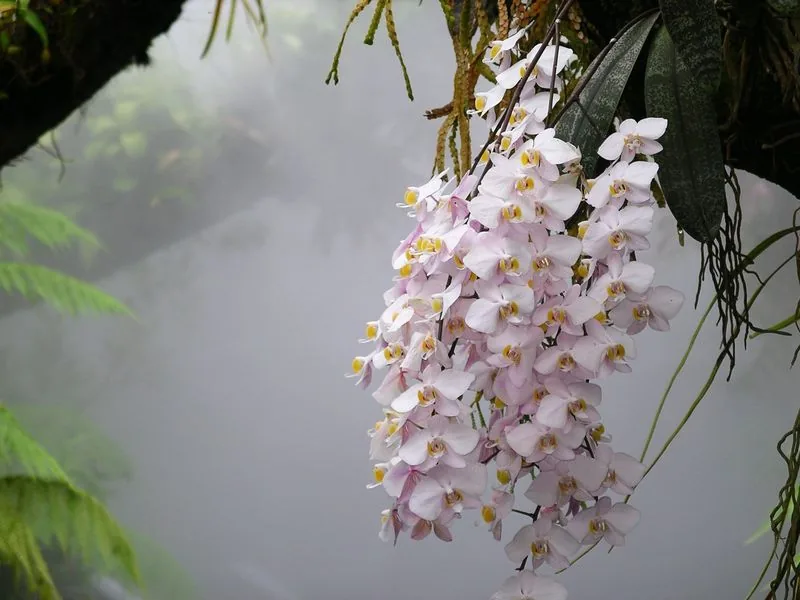
The flowering is the point of the plant. A mature specimen extends an arching spike of flat, rounded flowers that persist for weeks and often months, in white, pink, or patterned forms. Vegetatively it remains small and slow, forming a low rosette of broad, leathery leaves, which is why it occupies a bright shelf or counter without outgrowing the position.
It also tolerates the errors of a beginner. Correct light, a thorough watering followed by a dry-down, and little else is asked of the grower. The great majority of problems reduce to one cause, roots held too wet, and the sections that follow address how to prevent it.
Care
The short version: bright indirect light, a thorough soak taken only once the bark mix nears dryness, a coarse bark-based medium that drains fast, and warm, humid air. Feed weakly across the year and it will rebloom.
Light
Provide bright indirect light, as from an east window or a position set back a few feet from a brighter one. The plant persists in medium light or light shade, but direct midday sun scorches the foliage, so exclude it from the hot beam.
Water
Irrigate the bark thoroughly until water runs from the drainage holes, then withhold until the mix nears dryness, generally every 7 to 14 days. Never let the pot stand in water, and empty any that collects in the central crown, since standing moisture there induces crown rot.
Soil
Grow it in a coarse, bark-based orchid mix, not ordinary potting soil. Fir bark, at times combined with sphagnum or charcoal, supplies the aeration and rapid drainage the roots require, at a slightly acidic pH of 5.5 to 6.5.
Temperature
Ordinary room warmth suffices, ideally 64°F to 82°F (18°C to 28°C). A modest nighttime drop can help initiate a new flower spike, provided the plant is shielded from cold drafts and hot vents.
Humidity
The plant favors elevated humidity, optimally 50% to 70%. Because indoor air typically runs drier, group it with other plants or stand the pot on a tray of damp pebbles, and maintain gentle air movement to suppress rot.
Feeding
Fertilize every two weeks with a balanced water-soluble feed diluted to about a quarter or half strength, the 'weakly, weekly' regime. Continue year-round, reducing slightly through the darker months as growth slows.
Pruning
Remove each spent flower as it fades. Once a spike finishes, cut a still-green one just above a lower node to encourage a secondary bloom, or remove it at the base after it turns brown and woody. Trim dead or rotted roots at repotting with sterile tools.
Repotting
Repot every 1 to 2 years, ideally following flowering, once the bark has degraded to a fine, soggy consistency or the roots overrun the rim. Fresh, coarse medium restores the drainage on which the roots depend.
Size & spacing
The plant stays compact, reaching roughly 12 to 35 inches (30 to 90 cm) in height when in bloom and spreading 12 to 24 inches (30 to 60 cm) across. Allow clearance from neighboring plants so air circulates freely around the leaves.
Troubleshooting
Most disorders in moth orchids originate at the root, out of sight, and only later register as limp foliage or aborted buds. Inspect the roots first whenever the plant looks wrong. Match the sign below to its cause, and intervene before a saturated medium becomes an unrecoverable loss.
Soft brown roots leaving the plant unanchored in its pot
The disorder is root rot, driven in nearly every case by a saturated, decomposed medium rather than by drought. The reason is simple: a broken-down bark mix holds water against the roots, excludes air, and the starved tissue dies and collapses. Unpot and read the roots, since firm green to silvery ones remain viable while brown, hollow ones fail under a pinch. Cut those away with sterile scissors, repot into fresh dry bark, and extend the interval between waterings.
Fix:
- Unpot and trim away all soft, brown rotted roots with sterilized scissors
- Repot into fresh, coarse, dry bark mix in a pot with drainage
- Reduce watering frequency and let the medium approach dryness between waterings
- Increase humidity and air movement to support remaining healthy roots
An old lower leaf yellowing evenly and then shedding
A single basal leaf yellowing on a firm, well-rooted plant is natural aging, the routine shedding of the oldest tissue, and warrants no intervention. The signal that matters is several leaves discoloring together while the roots feel soft, which redirects attention to the root system. Verify the roots first, then correct exposure by shifting the plant off harsh direct sun and away from cold drafts.
Fix:
- Confirm whether root health is the cause by checking the roots
- Adjust watering and repot if roots are rotting
- Move the plant out of harsh direct sun and away from cold drafts or heat sources
- Remove fully yellowed leaves once they detach easily
Buds yellowing and aborting before they open
The failure is bud blast, and it typically traces to an abrupt environmental shift the plant cannot buffer, most often relocation, a draft, or a temperature swing. Low humidity contributes, and so does nearby ripening fruit, because the ethylene such fruit emits acts as a signal that triggers bud drop. Hold a budding orchid in place, keep watering and humidity constant, and the remaining buds on the spike should open normally.
Fix:
- Keep the plant in a stable spot while in bud, away from drafts and heat vents
- Maintain consistent humidity and watering
- Keep the plant away from ripening fruit and other ethylene sources
Leathery, wrinkled foliage that persists despite watering
Limp, creased leaves on a plant you water regularly point to a supply failure: the roots can no longer take up water. Rot has destroyed the absorbing tissue, so added water is not reaching the leaves and only worsens the rot. Read the roots to decide, since rotted roots call for trimming and a repot, whereas sound roots in bone-dry bark indicate underwatering, which resumes with thorough, well-spaced irrigation and higher humidity.
Fix:
- Inspect and correct root health, repotting and trimming rot as needed
- If roots are sound but dry, resume thorough but properly spaced watering
- Raise humidity to reduce moisture loss from the leaves
Toxicity
For a household with pets and children, the record is straightforward: the moth orchid is non-toxic across the board. The ASPCA lists it as safe for cats and dogs, and nothing in the foliage or flowers poisons horses, rabbits, livestock, or birds. A chewed petal may cause minor digestive upset from the fiber alone, but no toxic principle is present.
Safe for
People · Cats · Dogs · Horses · Rabbits · Livestock · Birds
Cats None
No toxic principle threatens cats. The ASPCA classifies the moth orchid as non-toxic, so an exploratory nibble carries no risk of poisoning.
Dogs None
Dogs face no toxin here either. A leaf or flower a dog chews may cause transient stomach upset from the fiber, but the tissue itself is not poisonous.
Horses None
No compound in the plant poses a hazard to horses. Nothing in it would harm them, although a houseplant is one they seldom encounter.
Rabbits None
Rabbits are unaffected. The foliage and flowers contain no toxic constituents, so an incidental bite does no damage.
Livestock None
The plant presents no danger to livestock. It carries no toxins capable of affecting cattle, goats, or sheep.
Birds None
Birds share a room with it safely. The foliage and blooms hold nothing poisonous to place pet birds at risk.
People None
The plant is harmless to people, children included. It is not cultivated as food, yet a chewed petal or leaf will not produce poisoning.
Generally safe around pets and children; as with any plant, discourage chewing to avoid mild stomach upset and keep the bark medium from being eaten.
Varieties
Most moth orchids reach the market as unnamed hybrids, though a few defined groups are worth recognizing before purchase.
Standard large-flowered hybrids
These dominate supermarket sales, presenting a few large, flat, rounded blooms in white, pink, or patterned shades borne along arching spikes.
Miniature / multiflora Phalaenopsis
Compact selections that exchange individual flower size for count, producing many smaller blooms on branched spikes suited to a crowded windowsill.
Phalaenopsis amabilis
A white-flowered wild species that functions as a key parent behind a large share of modern hybrids.
How to propagate
Moth orchids propagate slowly under home conditions, and neither route is rapid, but both succeed with patience and sterile technique.
Offsets & pupsModerate
When a keiki (plantlet) on a flower spike or at the base has developed several leaves and roots a few centimeters long, usually in spring or summer · Several months to a year or more before it grows into a flowering-size plant
A moth orchid occasionally produces a plantlet, termed a keiki, on the flower spike or at the base of the plant. Allow it to form 2 to 3 leaves and roots roughly 3 to 5 cm long, then sever it with sterile tools and establish it in bark mix. Reaching flowering size takes several months to a year or more, so expect a long grow-on period.
DivisionModerate
At repotting time, for large mature plants that have formed multiple growths · Several months to re-establish and resume strong growth
A mature specimen that has generated more than one growth can be divided at repotting, provided each section retains healthy roots. Because most moth orchids develop as a single stem, the opportunity is uncommon in cultivation. Each division then requires several months to re-establish before it resumes strong growth.
Myths
The best way to water a moth orchid is to drop a few ice cubes on the bark.
As tropical epiphytes, these plants gain little from a few ice cubes, which wet the bark unevenly and never saturate it. Water it thoroughly with room-temperature water until it drains through, then allow the mix to approach dryness before the next application.
Once a moth orchid finishes flowering you should always cut the spike off at the base.
A spike still green and healthy retains dormant nodes, so cutting just above a lower node can prompt a secondary flush of bloom. Reserve a basal cut for a spike that has turned brown and woody.
Moth orchids must be grown in regular potting soil like other houseplants.
Their roots require aeration and rapid drainage, the reason coarse bark-based orchid mix is standard. Dense potting soil retains too much water and induces root rot.