Houseplant · Orchidaceae
Oncidium Orchid
Oncidium
Provide bright indirect light and a bark mix that drains fast, and the dancing lady orchid rewards you with sprays of fall flowers.
Bright indirect
Every 2–10 days
55–84°F · 13–29°C
USDA 9–12
Overview
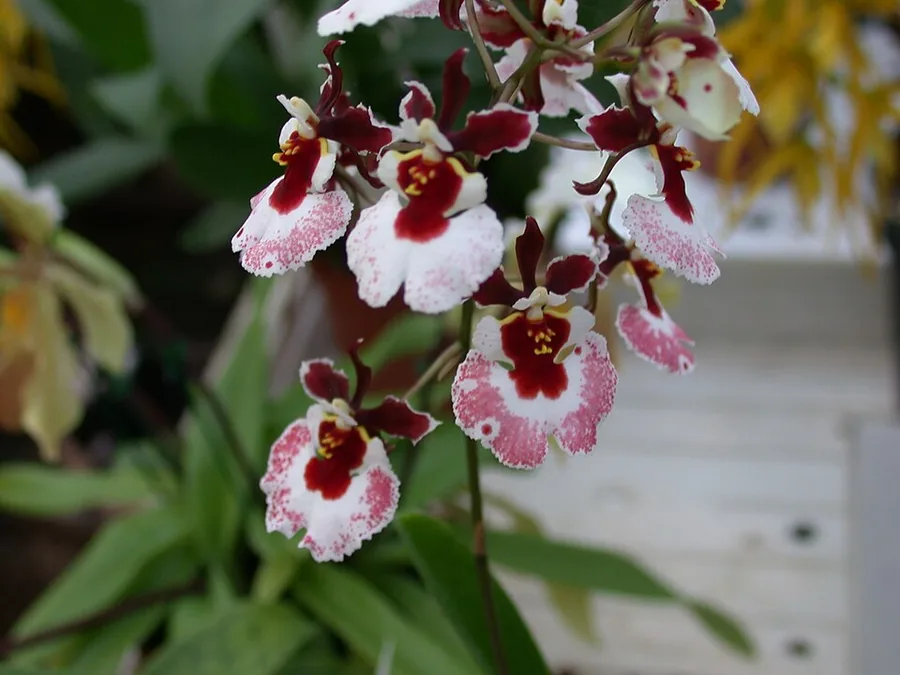
The oncidium, known in cultivation as the dancing lady, takes its common name from the flaring ruffled lip on each flower, which reads as a skirt caught in motion. The genus originates in the warm forests of the Americas, where it lives as an epiphyte anchored on tree bark rather than rooted in soil. That native habit dictates the growing conditions it needs indoors.
In place of soil, an oncidium is grown in an open bark mix engineered to drain the instant it is watered. Its swollen stem bases, the pseudobulbs, function as water reservoirs that carry the plant through dry intervals, which is precisely why the roots must not remain saturated. Most species flower in fall, producing branching sprays that bear dozens of small flowers simultaneously and hold them for three weeks or longer.
The moderate difficulty rating reflects a requirement for specific conditions rather than any inherent fragility. Provide the correct light, bark, and watering rhythm and the plant establishes for years, generating a fresh flush of bloom each season.
Care
The short version: supply bright indirect light, grow it in a fast-draining orchid bark mix, and water only after the bark has dried about halfway, reducing the frequency in winter.
Light
Oncidiums perform best in bright, indirect light across most of the day. An east-facing window supplying gentle morning sun meets that requirement, whereas direct midday sun scorches the foliage and deep shade yields dark leaves and suppressed flowering.
Water
Water thoroughly with room-temperature water once the bark mix has dried roughly halfway, an interval that ranges from every few days in summer heat to as long as every 10 days in cool conditions. Reduce watering through winter. The governing constraint is that the fine roots must never remain soggy, since saturation drives rot.
Soil
Standard potting soil is unsuitable; use a well-drained epiphytic orchid bark mix instead. It reproduces the loose bark substrate of the plant's native perch, sustains a slightly acidic pH near 5.0 to 6.0, and drains freely to keep the root zone aerated.
Temperature
The plant tolerates ordinary household temperatures spanning 55°F to 84°F (13°C to 29°C). Its range is fairly broad, so the main precaution is to keep it away from cold drafts and the drying output of heating vents.
Humidity
This orchid favors elevated humidity in the range of 50% to 70%. In a dry interior, set the pot on a tray of moist pebbles or operate a nearby humidifier, and maintain air movement so the foliage does not stay wet.
Feeding
Across the spring-to-summer growing season, feed weekly with a balanced orchid fertilizer diluted to quarter or half strength. Apply it immediately after watering so the diluted solution never contacts dry roots.
Pruning
After the flowers fade, cut the spent flower spike back to its base. Otherwise the plant requires only the removal of dead or rotted roots and yellowed leaves.
Repotting
Repot approximately every 2 years in spring, when new growth is about half mature. The signals to act are roots extending over the rim, pseudobulbs pressing against the edge, or bark degraded into fine particles that no longer drain.
Size & spacing
Mature size varies substantially across the genus, from compact miniatures near 6 inches (15 cm) tall to large specimens reaching 10 feet (3 m) in bloom, with spread ranging from 3 to 48 inches (8 to 122 cm). Select a variety scaled to the intended location.
Troubleshooting
Most oncidium disorders originate below the surface in the root zone or register first as a change in leaf color. Detecting these early indicators usually allows a full recovery. Match the observed symptom below, then intervene before it advances.
Soft brown roots with wilting that persists after watering
The pattern points to root rot, driven by excess moisture rather than drought. As bark decomposes it loses its air spaces and holds water against the roots, and the fine root tissue then suffocates and collapses. Unpot the plant, excise every brown, hollow root with sterile tools, repot into fresh bark, and delay the next watering until the medium approaches half-dryness.
Fix:
- Remove the plant from the pot and trim away all rotted roots with sterile tools
- Repot into fresh, well-drained orchid bark
- Resume watering only when the mix approaches half-dryness
Cottony white masses or brown bumps accompanied by sticky residue
Sticky residue paired with white fluff or hard brown specks confirms mealybugs or scale, which favor the sheltered leaf axils and the pseudobulbs. Remove each insect with a cotton swab charged with isopropyl alcohol, then apply horticultural soap or oil to catch survivors. Hold the plant apart from the rest of the collection until no live insects remain.
Fix:
- Wipe insects off with a cotton swab dipped in isopropyl alcohol
- Treat with horticultural soap or oil
- Isolate the plant until the infestation clears
Reddish, bleached, or abnormally dark foliage
Foliage color acts as a gauge of light intensity. A reddish or bleached cast indicates the sun is too strong and is scorching leaf tissue, whereas limp, very dark green leaves signal the reverse, a light deficit. Relocate the plant to bright, indirect light and screen it from direct midday sun, and the pigment recovers to a healthy mid-green.
Fix:
- Move the plant to bright, indirect light
- Shield from harsh midday direct sun
Toxicity
For households with pets and children, the assessment is favorable: the oncidium is non-toxic throughout, from root to flower. The ASPCA lists the dancing doll orchid as safe for cats, dogs, and horses, and the family Orchidaceae carries no recognized poisons. A pet that chews a leaf may drool or turn briefly queasy, yet nothing in the tissue will cause lasting harm.
Safe for
People · Cats · Dogs · Horses · Rabbits · Livestock · Birds
Cats None
The orchid contains no toxins that would affect a cat. Chewed foliage may provoke a little drool or a single episode of vomiting, a mechanical reaction that resolves without treatment.
Dogs None
Dogs can ingest the foliage without toxic effect. Stripping a leaf may produce a brief digestive upset, but no poisoning follows because the tissue holds no harmful compounds.
Horses None
The plant presents no toxic hazard to horses. Consumption of plant material yields at most a mild, self-limiting stomach upset.
Rabbits None
No part of this orchid carries a toxic risk to rabbits. As with any unfamiliar green introduced in quantity, a large single serving may loosen the gut for a day.
Livestock None
Browsing animals such as goats, sheep, and cattle can consume the leaves safely. The tissue contains nothing capable of making them ill.
Birds None
Pet birds may perch on or peck at the plant without harm, since no part of it is poisonous to them.
People None
The orchid is harmless to people, including children who handle the flowers. It is not cultivated as food, so there is no reason to consume it.
No toxic compounds, but ingested fertilizer or pesticide residue on leaves could cause mild stomach upset, and eating plant material may cause transient vomiting.
Varieties
The genus spans thousands of species and hybrids, but a limited set recurs in shops and on windowsills. The following are the ones worth identifying by name.
Oncidium 'Sharry Baby'
This widely grown hybrid is prized for a strong chocolate-and-vanilla fragrance that carries across a room.
Oncidium 'Twinkle'
A compact miniature that produces numerous small fragrant flowers on a plant sized to occupy a single windowsill.
Oncidium sphacelatum
The popcorn orchid produces long branching inflorescences densely set with bright yellow-and-brown flowers.
How to propagate
An oncidium accumulates growths into a clump over successive seasons, and the most reliable method of increase is to separate that clump at repotting.
DivisionModerate
At repotting in spring, when new growth is about half mature · About 1-2 years to re-establish and bloom
Propagate an oncidium by division, carried out at repotting in spring once new growth is about half mature. Separate the clump so each section retains at least three pseudobulbs and a proportion of sound roots, because divisions below that threshold lack the stored reserves to flower and tend to stall. Anticipate a lag, since each new section requires 1 to 2 years to re-establish and resume blooming.
Myths
Orchids are parasites that feed off the trees they grow on.
An oncidium is an epiphyte, which is a distinct strategy from parasitism. It uses a tree solely as an anchor and derives its water and nutrients from rainfall, atmospheric moisture, and the organic debris that accumulates around its roots. It draws nothing from the host tree's own tissues.
Watering any orchid with ice cubes is the right way to do it.
Oncidiums occupy intermediate-to-warm conditions, and a slow release of cold meltwater fails to saturate the bark as their root systems require. Water thoroughly with room-temperature water once the medium has dried partway, and dispense with the ice entirely.