Tree · Sciadopityaceae
Japanese Umbrella Pine
Sciadopitys verticillata
A living fossil whose soft needles borne in whorls repay steady moisture and a patient hand.
Full sun
Every 5–10 days
USDA 5–8
25–30 ft · 7.6–9.1 m
Overview
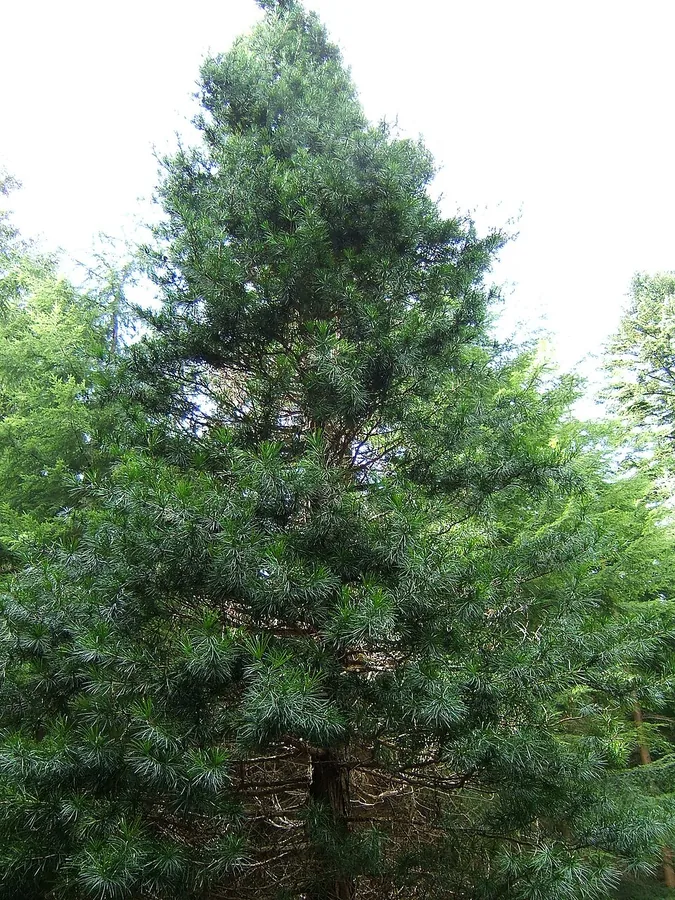
Sciadopitys verticillata is a slow, columnar conifer whose glossy needles radiate in whorls that recall the ribs of a parasol, the source of the umbrella name. Taxonomically it is no pine. It persists as the sole living member of the family Sciadopityaceae, a monotypic lineage whose record extends more than 200 million years to the age of the dinosaurs.
In cultivation the tree develops a dense, narrow pyramidal habit, attaining 25 to 30 feet (7.5 to 9 m) only across decades because its growth rate is genuinely slow. The needles are thick and soft, deep and lustrous in color, and evergreen, so the canopy holds its green through every season. The species is native to the humid montane forests of Japan, where it has long been cultivated, and it now appears in temple plantings and specialist collections throughout cooler temperate regions.
Because the plant increases in size so slowly, nurseries carry it for years before sale, which explains its higher price relative to common conifers. Sited correctly, it offers decades of stable, low-maintenance performance. Provide rich, moist soil and shelter from drying wind, and the tree establishes for the long term.
Care
The short version: full sun to part shade, a rich and slightly acidic medium held evenly moist, and protection from drying winter wind, all within zones 5 to 8.
Light
Provide full sun to partial shade. The species tolerates full exposure in cooler climates, but under high summer heat the needles are prone to scorch, so light afternoon shade reduces that thermal stress.
Water
Maintain consistently moist soil, irrigating every 5 to 10 days and deeply during drought. The species has no drought tolerance, so allowing the root zone to dry, particularly on young, unestablished plants, quickly compromises the tree.
Soil
Grow it in rich, well-drained loam on the acidic side, at a pH of 5.5 to 6.5. Drainage is the critical variable, because the roots are intolerant of saturation and standing water is the most common cause of loss.
Temperature
Cold hardiness spans -20°F to 90°F (-29°C to 32°C), equivalent to zones 5 to 8. Low temperature itself seldom injures the tree; the real agent of winter damage is drying wind, which pulls water from the foliage faster than frozen roots can replace it.
Humidity
Ambient outdoor humidity is adequate, so no target figure applies. As a native of moist montane forest, the tree objects far more to hot, dry, exposed positions than to high atmospheric moisture.
Feeding
One spring application suffices. Use a balanced or acidic slow-release fertilizer formulated for evergreens, and apply modestly, since a slow grower has limited capacity to use a heavy feed.
Pruning
Structural pruning is minimal. Remove only dead or damaged wood and preserve a single central leader. Time the work for late winter to early spring so wounds close as growth resumes.
Repotting
Container specimens require potting on every 2 to 3 years. Roots circling the rootball, roots emerging at the drainage holes, and rapid drying of the medium all indicate the plant has exhausted its current volume.
Size & spacing
Allow for a mature height of 25 to 30 feet (7.5 to 9 m) and a spread of 15 to 20 feet (4.6 to 6 m). Growth is slow, but allocate the full footprint at planting so the broad pyramidal crown can develop without later crowding.
When to plant
Timing the planting matters even for so slow a tree. Establish it in spring or early fall, when soil warmth and reliable moisture let the slow-developing root system extend before summer heat or hard frost imposes stress it cannot yet buffer.
Northern hemisphere
Southern hemisphere
Typical months for a temperate climate: start earlier in warm zones, later where spring frosts linger.
- Plant: Spring or early fall
- Harvest: May to June (inconspicuous)
Hardiness
USDA hardiness zones: 5–8
Temperature: down to -29°C
Troubleshooting
This conifer hosts no serious pests or diseases, so almost every disorder is cultural, a response to the site rather than to a pathogen. The needles register that stress first, and their pattern of discoloration usually identifies the cause. Match the sign below, then correct the underlying conditions.
Needle yellowing, thinning, and progressive decline
Decline in this species is almost always root-driven. The two usual causes are waterlogged, poorly drained soil that leaves the roots dark and soft, and a hot, dry, exposed position that dehydrates them. Excavating a little may reveal that softened, discolored root tissue where drainage has failed. Correct the drainage, mulch to stabilize soil moisture, and supply afternoon shade in hot-summer climates.
Fix:
- Improve drainage and avoid waterlogging
- Provide afternoon shade in hot-summer regions
- Maintain even soil moisture and mulch the root zone
Needle browning and bronzing through winter
The disorder is winter burn, a desiccation injury. Cold, dry wind removes water from the needles faster than the frozen root system can replace it, so the bronzing concentrates on the wind-facing or sun-exposed aspect. The damage is cosmetic, and new growth resumes normally in spring. Reduce recurrence by screening the tree from wind, irrigating before the ground freezes, or selecting a color-stable cultivar such as Wintergreen.
Fix:
- Shelter the plant from harsh winter winds with a barrier or screen
- Water thoroughly before the ground freezes
- Choose a winter-color-stable cultivar such as Wintergreen
Toxicity
For animal-keeping households the verdict is clear: this species is non-toxic. Unlike the true yews it superficially resembles, Sciadopitys verticillata contains no recognized toxic compounds and appears on no poisonous-plant listing. Cats, dogs, horses, and grazing livestock may share its space safely.
Safe for
People · Cats · Dogs · Horses · Rabbits · Livestock · Birds
Cats None
Non-toxic to cats. Ingesting a needle carries no poisoning risk, and the stiff, resinous foliage offers little to attract feline browsing in any case.
Dogs None
Non-toxic to dogs. A dog chewing a shed branch may show transient, mild gastrointestinal upset from the fibrous material, with no systemic effect.
Horses Safe
Non-toxic to horses; it lacks the toxins that make true yews and comparable conifers dangerous.
Rabbits Safe
No poisoning risk to rabbits, which generally reject the tough, leathery needles in favor of more palatable growth.
Livestock Safe
Grazing cattle, goats, and sheep can browse the foliage without toxic consequence.
Birds Safe
Harmless to birds, which may roost within the dense, whorled branching without hazard.
People Safe
Non-toxic to people. The tree is ornamental and yields no part intended for eating, but handling and pruning present no risk.
No special handling precautions for toxicity; an outdoor landscape conifer rather than a houseplant.
Varieties
The straight species predominates in the trade, but several named cultivars merit a search where you want dependable winter color, a narrower habit, or a reduced size suited to a small garden.
Wintergreen
Selected for foliage that retains a dark, glossy green through winter while the species bronzes under cold.
Joe Kozey
A narrow, upright column whose sturdy branching withstands heavy snow load.
Sternschnuppe
A vigorous selection bearing long, lustrous deep-green needles on a broad pyramidal frame.
Mr. Happy
A compact dwarf scaled for a rock garden or container, contexts the full-size tree cannot occupy.
Picola
A slow dwarf that matures into a tidy, rounded globe suited to confined plantings.
How to propagate
Propagation demands patience more than technique. Both methods progress slowly and suit growers prepared to wait several years, a constraint that keeps the plant a premium nursery subject.
SeedDemanding
Sow when cones ripen; seed is slow and germination can be erratic · Several years; extremely slow early growth
Seed propagation is the slower and more exacting route. The cones require 18 to 20 months to mature before viable seed can be collected, and germination is erratic. Resulting seedlings grow very slowly, frequently reaching only 4 to 5 feet within their first 10 years.
Stem cuttingsDemanding
Take cuttings from semi-hardwood growth · Months to root; slow to develop
Cuttings of semi-hardwood growth root over a span of months rather than weeks. This remains the standard means of propagating named cultivars, since it preserves the precise habit of the parent that seed-raised plants would not reproduce.
Myths
The Japanese umbrella pine belongs among the true pines.
The resemblance and the vernacular name mislead, because the species is not a pine. It is the only surviving representative of its own family, Sciadopityaceae, an ancient lineage that diverged well before the true pines evolved. In strict terms it has no close relatives among the pines at all.