Ornamental · Saxifragaceae
Foamflower
Tiarella cordifolia
A woodland saxifrage that raises frothy white flower spikes in spring and holds the ground as a low, spreading cover.
Partial shade
Every 3–7 days
USDA 3–9
5–12 in · 13–30 cm
Overview
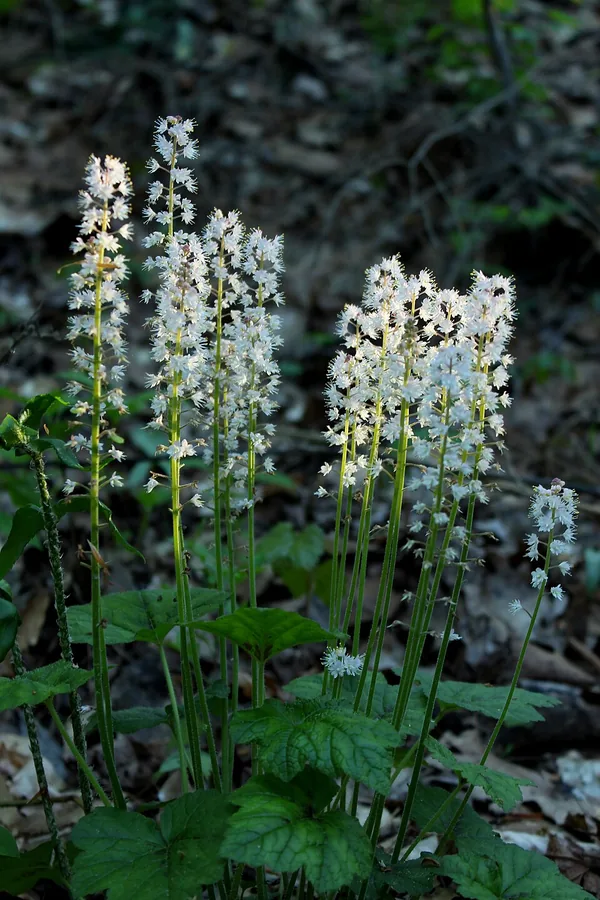
Foamflower, Tiarella cordifolia of the saxifrage family, is a woodland ground cover native to eastern North America. Its common name comes from the spring inflorescence: slender racemes of small flowers, white to pink, held above the foliage in a foam-like froth. Spreading by rhizomes and stolons, it colonizes the forest floor and does the same in cultivation, closing into a low, leafy carpet.
The heart-shaped, often lobed leaves are the plant's main asset, persisting as semi-evergreen foliage that carries color through winter; in many selections the cold triggers a bronze or deep-red flush along the veins. Rated for USDA zones 3 to 9, it tolerates the dense, dry shade that suppresses flowering in most perennials, which explains its value in difficult understory sites.
Its requirements track its native habitat: shade, consistent moisture, and an organically rich, humus-laden soil. Meet those and the plant is effectively self-sufficient, widening incrementally each season. It reads as deer resistant in practice, has few serious pests, and an established clump can be lifted and divided every other spring to yield new plants at no cost.
Care
The short version: grow it in part to full shade in rich, humusy soil held evenly moist, ensure drainage through winter to protect the crown, and feed sparingly, since good woodland ground supplies most of what it needs.
Light
Site foamflower in part shade to full shade, consistent with its woodland origin under a tree canopy or along a shaded north aspect. It ranks among the few flowering ground covers that continue to perform in heavy shade, where reduced light limits most bloomers.
Water
This species has no drought tolerance, so hold the soil consistently moist and do not let it dry; desiccation quickly scorches the foliage. Irrigating every 3 to 7 days suits most sites, but reduce it in winter, because saturated cold soil promotes crown rot that can prove fatal.
Soil
Provide rich, humusy soil that retains moisture yet drains freely, replicating the leaf-litter horizon of a forest floor. A pH of 6.0 to 7.0, slightly acidic to neutral, is optimal, so incorporate compost or leaf mold before planting to build organic content and structure.
Humidity
Ambient outdoor humidity is sufficient, with no target range to manage. For foamflower, soil moisture is the operative variable, not atmospheric humidity, so direct your effort to the root zone.
Feeding
As a light feeder adapted to fertile woodland soil, foamflower needs little supplemental nutrition. A single topdressing of compost or balanced fertilizer during the growing season is adequate, and heavier feeding confers no benefit.
Pruning
Maintenance pruning is minimal. At the onset of the growing season, remove tattered or winter-damaged leaves; the crown responds by pushing a fresh flush of foliage to replace them.
Size & spacing
Mature plants are low, 5 to 12 inches (13 to 30 cm) in height, spreading slowly to 12 to 24 inches (30 to 60 cm). Space them at roughly one spread apart so the clumps coalesce into a continuous ground cover as they fill in.
When to plant
Foamflower's schedule mirrors the deciduous woodland. Establish plants in spring or early fall, when cool, moist soil favors root growth before heat or hard frost. Flowering follows in spring and peaks in May, after which the foliage carries the display for the balance of the season.
Northern hemisphere
Southern hemisphere
Typical months for a temperate climate: start earlier in warm zones, later where spring frosts linger.
- Sow: Late winter; seed germination can be slow and plants are largely self-incompatible.
- Plant: Spring or early fall in shaded, moist sites.
- Harvest: Blooms in spring, peaking in May, with spikes of small white to pink flowers.
Hardiness
USDA hardiness zones: 3–9
Temperature: down to -40°C
Troubleshooting
Foamflower is largely problem-free, and the disorders that do appear nearly all trace to soil moisture at one extreme or the other. Because the plant signals stress early in the leaves and crown, close observation lets you intervene before damage compounds. Match the symptom below to identify the underlying cause.
Crown and root rot with winter collapse
Winter losses stem from waterlogging rather than low temperature: saturated, poorly drained soil induces crown and root rot, and an affected crown turns soft and discolored where healthy tissue is firm. A rotted crown is not recoverable, so excise and discard the affected tissue, amend the bed with organic matter to improve drainage, or relocate the plant to a site that does not hold standing water.
Fix:
- Improve drainage by amending with organic matter
- Relocate to a better-drained site
- Remove and discard rotted crowns
Foliage wilting and browning during hot, dry conditions
Wilting and marginal browning under heat and drought reflect drought stress, since foamflower lacks drought tolerance and declines once the root zone dries. Confirm by testing soil moisture a few centimeters down, then irrigate deeply to re-establish even moisture. A mulch of leaf mold or compost buffers the root zone against moisture loss, and additional shade through the hottest hours of the day eases the strain.
Fix:
- Water deeply to restore even moisture
- Apply a layer of leaf-mold or compost mulch to retain moisture
- Provide additional shade in hottest part of day
Notched leaf margins with weakening, collapsing plants
Clean, C-shaped excisions along the leaf margins are diagnostic of the black vine weevil. Nocturnal adults notch the edges, but the significant injury is subterranean, where the white legless larvae consume the roots and undermine the plant. Verify by inspecting the margins and excavating for grubs, then drench the soil with beneficial nematodes to target the larvae and hand-pick or trap adults after dark.
Fix:
- Remove and destroy affected debris
- Apply beneficial nematodes to soil for larvae
- Hand-pick or trap adult weevils at night
Toxicity
For animal-keeping households the assessment is straightforward: foamflower is classed as non-toxic to pets and people. It is recorded on neither the ASPCA toxic plant list nor the Cornell University poisonous plants database, so a shaded planting poses no ingestion risk to cats, dogs, or children.
Safe for
People · Cats · Dogs · Horses · Rabbits · Livestock · Birds
Cats Safe
Foamflower is non-toxic to cats. It appears on neither the ASPCA toxic list nor the Cornell poisonous plants database, so incidental nibbling presents no risk.
Dogs Safe
No canine toxicity is documented. A dog that disturbs or ingests foliage should be unaffected, although consuming a large volume of any plant material may cause transient gastric upset.
Horses Safe
No cases of equine poisoning by foamflower are on record, and the plant contains no compounds known to affect horses.
Rabbits Safe
Rabbits may browse the foliage without adverse effect. The plant holds no toxins, so grazed rosettes amount to nothing worse than cosmetic damage.
Livestock Safe
Ruminant livestock including cattle, goats, and sheep are at no risk from this woodland ground cover.
Birds Safe
The plant presents no hazard to birds foraging on its foliage or bloom stalks.
People Safe
The species is considered non-toxic to humans. It is not cultivated as an edible, but ingestion of a leaf by a child would not be expected to cause harm.
Varieties
Beyond the type species, several named selections merit attention, distinguished chiefly by cut-leaf foliage or a pink cast to the flowers.
Oakleaf
Its foliage is deeply lobed in the manner of an oak leaf, separating it from the heart-shaped leaves of the species.
Montrose 13
It is selected for flowers carrying a pink tint in place of the species' plain white.
Cygnet
It is a named selection valued for finely divided, distinctly cut foliage.
How to propagate
Foamflower propagates readily, and division of an established clump outperforms seed on both speed and consistency because it bypasses the species' slow, uneven germination.
DivisionEasy
Spring or early fall; benefits from being divided or transplanted at least every other year. · One growing season
Division is the most efficient and dependable method of increase. Because the plant naturally offsets via rhizomes and stolons, a clump lifted in spring or early fall separates into rooted rosettes, each an independent plant. Regular division also maintains vigor, so lift and split at least every other year; a division reestablishes over one growing season.
SeedModerate
Sow in late winter to spring. · Multiple seasons to flowering size
Seed propagation is slower and less certain. Sow from late winter into spring and anticipate slow, irregular germination, with plants requiring several seasons to attain flowering size. Note also that the species is largely self-incompatible, so cross-pollination between two or more individuals is necessary for seed set.
Myths
Foamflower requires full sun to bloom well.
Incorrect; as a woodland species it flowers best in part to full shade. It performs as an excellent ground cover for heavy shade, the low-light situations in which most flowering perennials fail to establish.
Foamflower is toxic to cats and dogs.
It is listed on neither the ASPCA toxic plant list nor the Cornell University poisonous plants database. The species is regarded as non-toxic, making it a sound choice for shaded plantings accessible to pets.