Ornamental · Saxifragaceae
Rodgersia
Rodgersia aesculifolia
Meet its need for moisture and shade, and rodgersia builds broad, sculpted foliage that anchors a damp border.
Partial shade
USDA 5–7
3–5 ft · 0.9–1.5 m
Overview
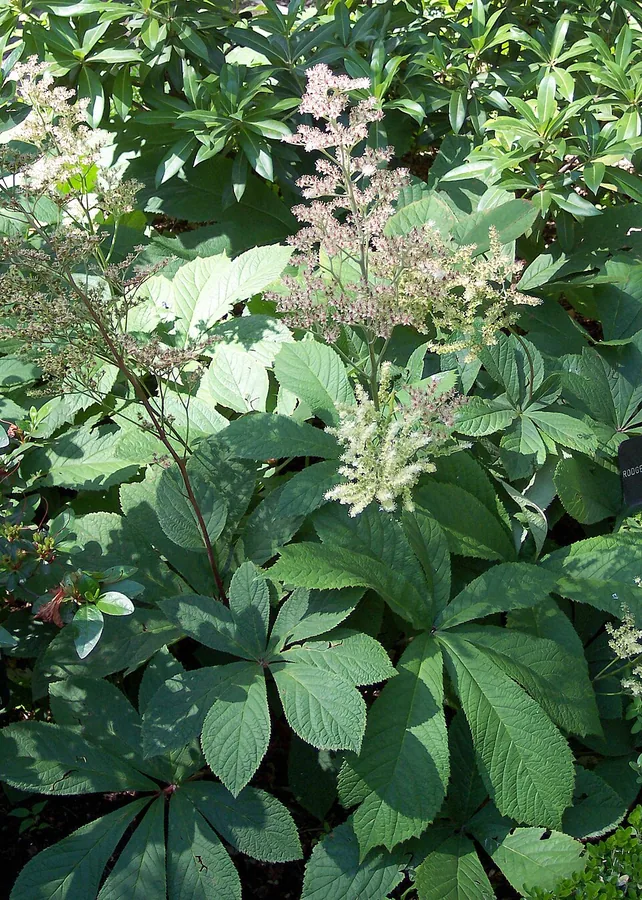
Rodgersia aesculifolia is grown chiefly for foliage, with flowers a secondary draw. Each leaf is deeply divided in a palmate, horse-chestnut pattern, broad enough to hold structure in a shaded, moist planting. Through summer the crown lifts branched panicles that resemble those of an astilbe.
Its requirements point straight to the wet, shaded ground that defeats most perennials. Bog gardens, pond and stream margins, and the cool north side of a building all hold the root zone damp and shaded, matching its needs. Hardy and long-lived, it forms a persistent clump once established.
The one critical failure is dry soil. Let the ground dry or expose the foliage to strong sun, and the leaf margins scorch and brown. Hold the root zone cool and moist, and rodgersia proves otherwise undemanding.
Care
The short version: site rodgersia in part to full shade in rich, humusy soil held moist to wet, never allowing it to dry, and supply compost through the growing season.
Light
Rodgersia performs best in part to full shade, and deeper shade is preferable where summers are hot, because strong light drives the water loss that scorches the margins. Harsh afternoon sun in particular browns the leaf edges.
Water
Moisture is the governing factor. The soil must remain consistently moist to wet and never dry, which is why the plant excels in bog gardens and along pond and stream banks where water is constant. Once the soil dries, the margins brown within days.
Soil
Use a rich, humusy soil high in organic matter, chosen for its capacity to hold water at the roots. It should stay moist to wet yet not stagnant, so a degree of drainage or gentle water movement keeps it from turning into standing muck.
Temperature
The species is fully cold hardy, enduring winter lows near -20°F (-29°C) and tolerating summer warmth to about 75°F (24°C). It is adapted to cool, temperate gardens and fares poorly in hot, dry climates.
Humidity
Ambient outdoor humidity is adequate and no target level applies. The plant responds to moisture at the root zone rather than atmospheric humidity, so effort belongs in the soil, not the air.
Feeding
Incorporate compost or a balanced fertilizer into the rich soil during the growing season. An annual organic mulch does double duty, feeding the plant as it breaks down and conserving soil moisture at the surface.
Pruning
Deadhead the spent flower stalks after bloom to tidy the crown, and remove tattered or browned foliage through the season as it declines. Neither operation is essential to plant health.
Size & spacing
Expect a substantial clump reaching 3 to 5 feet (91 to 152 cm) in height and an equal spread. Allow the full 3 to 5 feet (91 to 152 cm) between plants so the large leaves develop without crowding.
When to plant
Set plants out in spring once frost has cleared, into a cool, moist, partly shaded position. Flowering runs June to August on branched panicles, after which the clump continues to build over successive seasons.
Northern hemisphere
Southern hemisphere
Typical months for a temperate climate: start earlier in warm zones, later where spring frosts linger.
- Sow: Sow seed in late winter to early spring; seed may need cool stratification.
- Plant: Plant outdoors in spring after frost in a moist, partly shaded site.
- Harvest: Blooms June to August with branched, astilbe-like panicles.
Hardiness
USDA hardiness zones: 5–7
Temperature: down to -29°C
Troubleshooting
Rodgersia carries few problems, and nearly all of them register on the foliage. The common triggers are moisture stress from dry soil, slug and snail grazing, and powdery mildew. Identify the symptom below and correct the underlying condition.
Scorched, browning leaf margins
The browned edges are leaf scorch, a moisture-stress disorder driven by dry soil, strong sun, or both. Because rodgersia depends on a cool, wet root zone, the remedy is cultural: hold the soil moist, relocate the plant into deeper shade, and mulch the crown to buffer moisture loss.
Fix:
- Keep soil consistently moist
- Provide partial to full shade
- Mulch to conserve moisture
Irregular holes rasped in the foliage
The ragged holes are the work of slugs and snails, which favor the same damp shade the plant needs and feed after dark, confirmed by slime trails on the leaves. Control them by hand-collecting at night, setting out bait or a copper ring, and clearing the daytime shelter of debris around the crown.
Fix:
- Hand-pick at night
- Use slug baits or barriers
- Reduce excess debris around plants
Powdery white bloom on the leaf surface
The dusty coating is powdery mildew, a fungal problem that intensifies where plants are crowded or checked by drought. Remove the most affected leaves, thin the clump to raise air movement through the canopy, and maintain steady soil moisture so the plant is never checked by drought.
Fix:
- Improve air circulation
- Avoid drought stress
- Remove affected foliage
Toxicity
For animal-keeping households the record is reassuring: rodgersia is not known to be toxic. It does not appear on the ASPCA list of plants hazardous to cats and dogs, and no poisoning is reported in other animals or people. It can be planted without concern for browsing pets or children.
Safe for
People · Cats · Dogs · Horses · Rabbits · Livestock · Birds
Cats Safe
Rodgersia is absent from toxic-plant listings for cats, so ingestion should not cause real harm. At most, a cat that chews the foliage may show a mild, transient digestive upset.
Dogs Safe
There is no recognized toxin in rodgersia that affects dogs, and it is considered safe around them. Consuming a large quantity of the coarse leaf tissue may produce a brief, self-limiting stomach upset.
Horses Safe
No poisoning of horses by rodgersia has been documented. Animals may graze in its vicinity without recognized risk.
Rabbits Safe
Rodgersia holds no toxin harmful to rabbits. Its large, coarse-textured leaves are not palatable to them, so most rabbits decline it.
Livestock Safe
Cattle, sheep, and goats are unaffected by rodgersia, which contains no toxin relevant to them, and may graze a damp pasture or pond edge where it grows.
Birds Safe
Neither wild birds nor poultry are endangered by rodgersia, whether they take the foliage or forage the moist soil surrounding the crown.
People Safe
Grown as an ornamental for foliage and bloom rather than for consumption, rodgersia presents no poisoning risk to people, and children need not be kept away from it in the garden.
Varieties
Only a few rodgersia selections are grown, each chosen for a distinct leaf form or flower color. Two are worth knowing in detail.
Rodgersia pinnata 'Superba'
A featherleaf selection whose emerging foliage is bronze-purple before maturing to green, followed by rose-pink to red panicles through summer.
Rodgersia podophylla
Distinguished by bold palmate leaves of 5 lobes, occasionally 7, spanning up to 16 inches across and coloring bronze-red in autumn.
How to propagate
Rodgersia increases readily, chiefly by division of an established clump and, more slowly, from seed.
DivisionModerate
Divide thick rhizomes in spring or early fall. · One to two growing seasons
Division is the most dependable method of increase. Lift an established clump in spring or early fall and cut the thick rhizomes into sections, each retaining a bud and a portion of root. Reset the divisions in rich, moist soil, where they take one to two growing seasons to establish fully. Seed is also viable, and a vigorous plant expands on its own as the rhizomes creep laterally.
Myths
Rodgersia is a true aquatic and must grow submerged in standing water.
It is strongly moisture-loving, thriving in the moist to wet soil of pond and stream margins, but it is not an aquatic and does not grow submerged. The root zone should stay dependably moist while never becoming stagnant, waterlogged mud.