Ornamental · Saxifragaceae
Coral Bells
Heuchera sanguinea
Valued for its bold, year-round foliage as much as for its airy spring flowers, coral bells performs where shade rules.
Partial shade
USDA 3–8
8–20 in · 20–50 cm
Overview
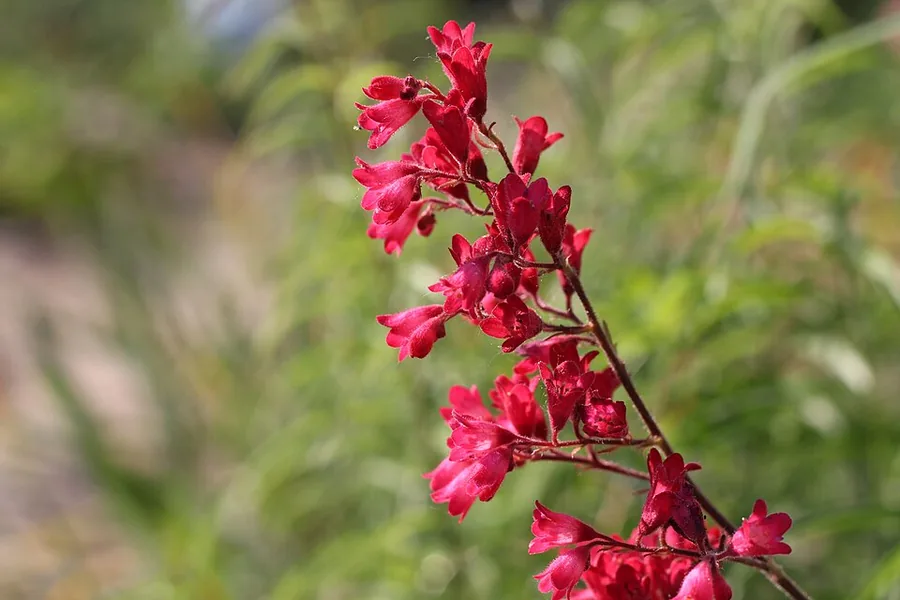
Coral bells is grown principally for its foliage, with the flowers a secondary attraction. The mounded clumps span an unusual foliage range, from deep purple and bronze through lime green to peach, and that pigmentation persists from spring into fall. In late spring, slender wiry scapes rise above the mound bearing small bell-shaped flowers that attract hummingbirds.
As a perennial it is undemanding once established, a trait that follows from its origins: it belongs to the saxifrage family and occurs wild across much of North America, which accounts for its tolerance of a broad range of conditions. In the landscape it functions as edging, as a filler within shaded borders, or as a compact mound set toward the front of a bed.
Match its light and soil requirements and it performs for years. Three conditions govern success: even moisture, sharp drainage, and shelter from harsh afternoon sun. Fail on any of them and the plant answers with scorched margins and, where drainage is poor, rotting crowns.
Care
The short version: site coral bells in part shade in rich, well-drained soil, hold the moisture even so the roots never sit saturated, and deadhead the spent scapes to sustain bloom.
Light
Coral bells performs best in partial shade, though it tolerates partial sun and full shade. Some direct light intensifies foliage pigmentation and increases flowering, but in hot regions afternoon sun scorches the leaves, so screen the plant from it.
Water
Provide medium, even moisture, which is most critical in full sun because the canopy scorches once soil moisture falls short of transpirational demand. The plant becomes drought tolerant once established, yet saturated soil must be avoided, since it induces root rot.
Soil
Establish coral bells in humus-rich, well-drained soil amended with ample organic matter. The optimal pH falls between 6.0 and 7.0, and heavy clay is unsuitable because it retains water around the crown.
Humidity
Average humidity satisfies the plant, so no target figure applies. Air movement matters more than ambient moisture, since stagnant, humid air is the condition that favors powdery mildew and other foliar pathogens.
Feeding
Coral bells is a light feeder. A single spring application of balanced fertilizer, or a compost topdressing during the growing season, meets its nutrient demand and maintains full foliage.
Pruning
Deadhead the spent scapes to prolong the bloom across the season. In spring, remove old or winter-damaged foliage to make way for new growth.
Size & spacing
Mature mounds reach 8 to 20 inches (20 to 50 cm) in height and 9 to 18 inches (23 to 46 cm) in spread. Space each plant to accommodate the full mound so the canopy stays open and the foliage dries.
When to plant
Coral bells establishes most readily under cool conditions, when root growth outpaces top growth. Set out divisions or nursery stock in late fall or early spring, and expect the bell-shaped flowers from May into June, frequently extending through early fall where spent scapes are removed.
Northern hemisphere
Southern hemisphere
Typical months for a temperate climate: start earlier in warm zones, later where spring frosts linger.
- Sow: Late winter to early spring; surface-sow seed as it needs light to germinate
- Plant: Late fall or early spring
- Harvest: May to June, often through early fall if deadheaded
Hardiness
USDA hardiness zones: 3–8
Temperature: down to -40°C
Troubleshooting
Most disorders in coral bells trace to a single stress: water, sun exposure, or winter cold. Reading the early symptoms on foliage and crown lets you intervene before the problem advances. Match the presentation below, then act while intervention still changes the outcome.
Wilting clump with a blackened crown and collapse
A wilting clump with a blackened, softened crown points to root rot, frequently the water mold Phytophthora, which colonizes tissue once the soil stays saturated or drains poorly. Excavate the base and the roots and crown read dark and mushy, the hallmark of oxygen-starved, waterlogged tissue. Because the pathogen has already destroyed the vascular base, discard a badly affected plant, work in generous organic matter to restore drainage, and reduce irrigation.
Fix:
- Improve drainage and amend with organic matter
- Avoid overwatering
- Remove and discard severely affected plants
Powder, rust pustules, or spotting on the leaves
Coral bells can carry several foliar diseases, among them powdery mildew, rust, and bacterial leaf spot. These pathogens establish where prolonged leaf wetness and stagnant air let spores germinate and infect the surface. Open the planting so air circulates and dries the canopy, deliver water at the base to keep the leaves dry, and remove already-infected foliage to cut the inoculum.
Fix:
- Improve air circulation
- Avoid overhead watering
- Remove affected foliage
Crown pushed above the soil line over winter
A crown lifted clear of the soil is frost heaving, the product of repeated freeze-and-thaw cycles that expand and contract the soil and work the plant upward. Once elevated, the exposed roots desiccate and chill in the open winter air. Reset the crown to its original depth in spring, and apply mulch only after the ground has frozen, since a mulch laid down then holds the soil frozen and blunts the temperature swings that drive the heaving.
Fix:
- Gently press or replant the crown back into the soil in spring
- Apply winter mulch after the ground freezes
Browned, crisped margins on the foliage
Crisped brown margins signal leaf scorch, which develops when transpiration outpaces water uptake on sun-exposed plants during hot, dry spells. The damage concentrates on the most exposed foliage because those leaves lose water fastest. Site the plant in afternoon shade where summers run hot, which lowers the evaporative load, and hold the soil at even moisture so the roots can keep the canopy supplied.
Fix:
- Provide afternoon shade in hot climates
- Maintain consistent soil moisture
Toxicity
For households with pets or children, the record is unambiguous: coral bells is safe throughout. The ASPCA classifies it as non-toxic to cats, dogs, and horses, and no toxic principle affects rabbits, livestock, birds, or people. It can be sited freely.
Safe for
People · Cats · Dogs · Horses · Rabbits · Livestock · Birds
Cats None
Classified as non-toxic, coral bells present no poisoning hazard to a cat that ingests the foliage.
Dogs None
No part of the plant contains a compound toxic to dogs, so chewed foliage causes no harm.
Horses None
The leaves, stems, and flowers hold no equine toxins, making the species safe around horses.
Rabbits Safe
Rabbits can browse the plant with no toxicological risk.
Livestock Safe
Grazing livestock encounter no toxic principle in this plant in pasture or garden.
Birds Safe
Birds that consume the leaves or seed face no toxic exposure.
People Safe
The plant poses no poisoning risk to people, including children who handle the foliage.
Varieties
Selection has broadened the foliage palette of coral bells considerably, and a few cultivars merit attention. These are the ones to know by name.
Palace Purple
Recognized as the 1991 Perennial Plant of the Year, it is selected chiefly for foliage: deep purple to bronze-green lobed leaves carrying wine-red undersides.
Georgia Peach
Bred for improved tolerance of heat and humidity relative to older selections, it presents peach-to-rose foliage.
Primo 'Pretty Pistachio'
It combines bright lime-green foliage with soft pink flowers.
How to propagate
Coral bells propagates readily, either by dividing an established clump or by sowing the species.
DivisionEasy
Spring, dividing clumps every 3-4 years · One growing season
The most reliable method is vegetative: divide the clumps in spring, lifting and separating the crowns on a 3 to 4 year cycle to renew vigor. Reset each division at its original depth in amended soil, and it re-establishes within a single growing season.
SeedModerate
Late winter to early spring · Bloom typically the following year; named hybrids do not come true from seed
Propagate the straight species by seed sown from late winter to early spring, and surface-sow it because germination is light-dependent. Flowering generally follows in the second year, and note that named hybrids, being selected clones, do not come true from seed.
Myths
Coral bells are toxic to dogs and cats.
ASPCA classification lists coral bells as non-toxic to dogs, cats, and horses. The species can be sited anywhere pets have access without toxicological concern.
Coral bells require full shade and will not flower under sun.
The species performs across a range from full sun to part shade, and many selections develop their strongest color and bloom under some direct light. In hot climates, afternoon shade is the sound siting, while any full-sun planting depends on consistent moisture to prevent foliar scorch.