Ornamental · Caryophyllaceae
Sweet William
Dianthus barbatus
Site Dianthus barbatus in full sun over free-draining ground, allow it to reseed, and it returns dense, clove-scented heads season on season.
Full sun
Every 3–7 days
USDA 3–9
12–24 in · 30–60 cm
Overview
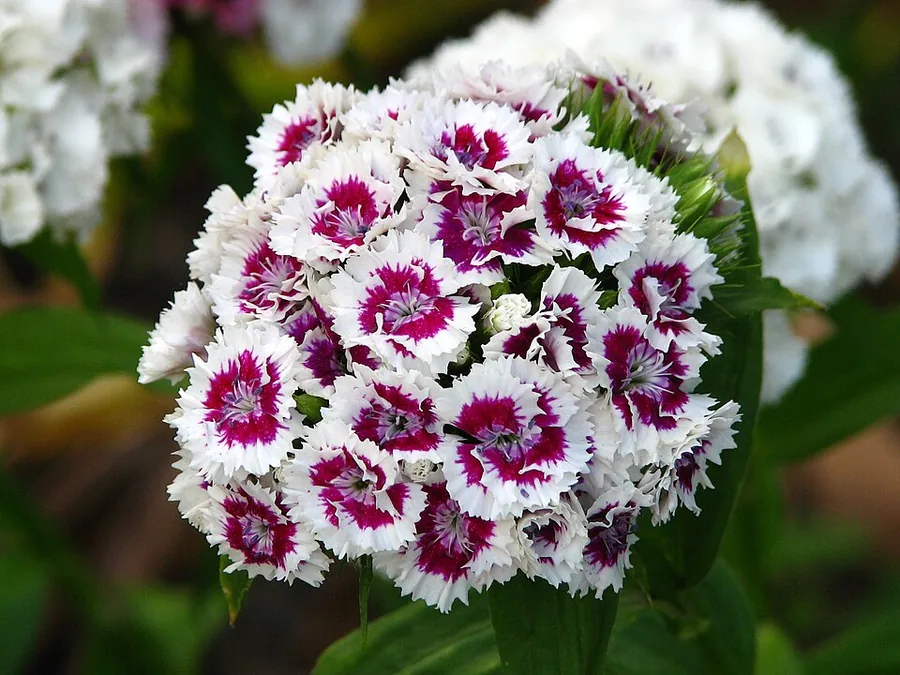
Sweet William, or Dianthus barbatus, is a long-cultivated species in the pink family, grouped with carnations and garden pinks in the Caryophyllaceae and native to the mountains of southern Europe. It bears dense, flat-topped clusters of small flowers in white, pink, red, and bicolored forms, many marked with a contrasting central eye. A light clove scent rises from the blooms and recruits bees and butterflies.
In cultivation it performs as a biennial or short-lived perennial. A seedling spends its first year building a vegetative rosette, flowers the following spring and early summer, then sets seed and declines. Because the fallen seed germinates and replaces the parent plants, a stand persists and reads as perennial even though individual plants are short-lived.
Its requirements are modest once the site is correct: full sun, free-draining soil, and open air movement around the foliage. Drainage is the non-negotiable factor, because saturated soil at the crown drives the crown rot and fungal diseases that shorten the plant's life. Meet that condition and the remaining care is undemanding.
Care
The short version: grow Sweet William in full sun, with light afternoon shade only under heat, in rich free-draining soil held at even moisture and kept off the foliage; deadhead to prolong bloom, but leave some flowers to set seed where you want the stand to return.
Light
Flowering is strongest in full sun, with light afternoon shade tolerated where summers are hot. In deeper shade flowering drops off and the stems grow weak and prone to leaning, so a fully exposed site gives the best display.
Water
Hold the soil at medium, even moisture in a well-draining medium, avoiding both drought stress and saturation. Deliver water at the base through a soaker or drip line so the foliage stays dry, since dry leaves are far less hospitable to fungal infection. Where overhead watering is unavoidable, apply it in the morning so leaves dry before nightfall and the period of leaf wetness that fungi exploit is shortened.
Soil
Establish plants in deep, organically rich, free-draining loam or sandy loam, amended with compost before planting. The species tolerates a broad pH from 6.0 to 8.0, spanning neutral to slightly alkaline ground, so soils that limit acid-preferring plants suit it well.
Humidity
Ambient garden humidity is adequate, and no specific level applies. The operative factor is air movement, since still, humid air around crowded foliage prolongs leaf wetness and creates the conditions that rust and crown rot require to establish.
Feeding
Nutrient demand is low. Incorporate a balanced general-purpose fertilizer into the top 4 to 6 inches of soil during bed preparation, and that base fertility supplies the plants through the season without further feeding.
Pruning
Deadheading spent flowers redirects the plant away from seed set, prolonging bloom and encouraging perennial persistence. With biennial plantings this creates a trade-off: removing every flower also removes the self-sown seed that regenerates the stand, so retain some blooms to ripen if a return is wanted.
Size & spacing
Mature plants stand 12 to 24 inches (30 to 60 cm) tall with a spread of 6 to 12 inches (15 to 30 cm). Space them to that width so air circulates through the clump and foliage dries quickly, limiting fungal pressure.
When to plant
Sweet William follows a slow phenology. Sow in late winter to early spring, or in late summer to early fall, and set transplants out in late spring; most plants reserve flowering for the second year, opening from late spring into summer where temperatures stay cool.
Northern hemisphere
Southern hemisphere
Typical months for a temperate climate: start earlier in warm zones, later where spring frosts linger.
- Sow: Late winter to early spring, or sow in late summer/early fall for bloom the following year
- Plant: Direct sow or transplant in late spring; fall-sown seedlings may be set out for next-year bloom
- Harvest: Late spring to early summer, often continuing into summer in cooler climates
Hardiness
USDA hardiness zones: 3–9
Temperature: down to -40°C
Troubleshooting
Most disorders of Sweet William resolve to two site faults: excess soil moisture and stagnant air. Both favor the fungal pathogens that attack crown and foliage, so early detection at the leaves and crown is what allows intervention before the plant is lost. Identify the symptom below, then act on the underlying condition.
Basal collapse and rot at the soil line
Wilting and decay at the base indicate crown rot, which develops where the crown remains in soggy, poorly drained soil. Infected plants cannot be recovered, so remove and dispose of them. Correct the underlying cause by improving drainage, spacing plants for air movement, and applying water at the base rather than overhead.
Fix:
- Remove and discard affected plants
- Improve soil drainage
- Avoid overwatering and overhead watering
Asymmetric yellowing and wilting with stem rot
One-sided yellowing and wilting indicates fusarium wilt, caused by Fusarium oxysporum, a soilborne fungus that occludes the vascular stem from within, and no cure exists. Remove and destroy affected plants and do not replant Dianthus in the same soil, since the pathogen persists there. Re-establish in clean, free-draining soil using pathogen-free seed or cuttings.
Fix:
- Remove and destroy infected plants
- Avoid replanting Dianthus in the same soil
- Use pathogen-free planting material
Rust-colored pustules on the foliage
The raised rust-red pustules are rust, caused by Uromyces dianthi, which colonizes wet foliage in still air. Remove and destroy the affected leaves, then increase spacing to move air through the planting. Keep the foliage dry, and apply a protective fungicide to healthy plants only if the infection continues to spread.
Fix:
- Remove and destroy infected foliage
- Improve air circulation
- Apply a protective fungicide to healthy plants if needed
Ragged feeding damage with slime trails
Ragged holes and glistening trails are the work of slugs and snails, which feed most after damp weather. Hand-pick them at dusk when they are active, and reduce the moist debris and boards that shelter them. Shift watering to the morning to dry the surface, and deploy baits or barriers where pressure persists.
Fix:
- Hand-pick slugs and snails in the evening
- Remove garden debris that provides shelter
- Use slug baits or barriers as needed
Toxicity
Sweet William is classed as mildly toxic rather than harmless. Like other Dianthus and carnations, it contains saponins that irritate the gastrointestinal tract of pets, while the sap produces contact dermatitis in sensitive people. The petals are edible when grown clean; the foliage is not, so exclude pets and children from the leaves.
Toxic to
Cats · Dogs · Horses · Rabbits · Livestock · Birds · People
Cats Mild
A cat that ingests the leaves typically shows drooling, vomiting, and diarrhea, and dermal contact can produce mild skin irritation.
Dogs Mild
In dogs, ingestion of the foliage commonly causes gastrointestinal upset with vomiting and loose stools, alongside mild dermatitis where the sap contacts skin.
Horses Caution
The saponins that affect cats and dogs can likewise give a grazing horse mild gastrointestinal upset, so clumps are best sited beyond reach.
Rabbits Caution
Regard it as unsuitable for rabbits, whose sensitive digestive tract the foliage can disturb, making the risk unjustified.
Livestock Caution
Grazing livestock seldom select it, but a quantity of the foliage may induce mild digestive upset attributable to the plant's saponins.
Birds Caution
Evidence of avian feeding is scant, yet the irritant compounds make it prudent to keep pet birds away from the leaves.
People Caution
In people the petals are edible when grown clean, whereas the leaves may cause mild gastrointestinal upset if eaten and the sap can provoke itching and skin irritation, so handle with gloves.
Wear gloves when handling, as contact with the plant can cause mild skin irritation in sensitive individuals.
Helpline numbers

United States
ASPCA Animal Poison Control: (888) 426-4435 (fee applies)
Poison Control: (800) 222-1222



Canada
Poison Centres: 1-844-764-7669
Varieties
The species has produced numerous named selections, ranging from compact dwarfs suited to bedding fronts to dark-flowered strains. A representative few follow.
Pinocchio
A compact, dwarf selection well suited to bedding schemes and container culture.
Sooty
Distinguished by very dark flowers in deep maroon approaching black, borne over dark foliage.
Nigrescens
A dark-leaved strain combining deep crimson blooms with bronze-purple foliage.
How to propagate
Sweet William propagates readily, either from self-sown seed or by division of an established clump.
SeedEasy
Direct sow in late spring for bloom the following year, or sow in late summer/early fall; some cultivars bloom the first year if started early. · Germination in about 1 to 2 weeks; plants typically bloom the season after sowing for biennial types
Seed is the standard and easiest method. Direct sow in late spring for bloom the following year, or in late summer and early fall for the same result, though a few cultivars flower in their first year when started early. Germination takes roughly 1 to 2 weeks, and because most types are biennial, flowering follows in the season after sowing. Where seed is allowed to fall each year, the stand regenerates itself and behaves as a long-lived perennial.
DivisionEasy
Divide established clumps in spring or early fall · Several weeks to re-establish roots
For the short-lived perennial forms, dividing an established clump maintains vigor. Lift and split in spring or early fall, replant the divisions immediately, and allow several weeks for root re-establishment before active growth resumes.
Myths
Sweet William is a reliable, long-lived perennial that returns every year.
In practice it is a biennial or short-lived perennial that persists chiefly through self-sown seed. Deadheading every flower removes the seed source and ends the return, so allow some blooms to mature to seed where next-year plants are wanted.
Sweet William flowers are strictly ornamental with no other use.
The petals are edible when the plant is grown clean and are sometimes crystallized in sugar as a cake garnish. The foliage, by contrast, can cause mild gastrointestinal upset if eaten.