Ornamental · Acoraceae
Sweet Flag
Acorus gramineus
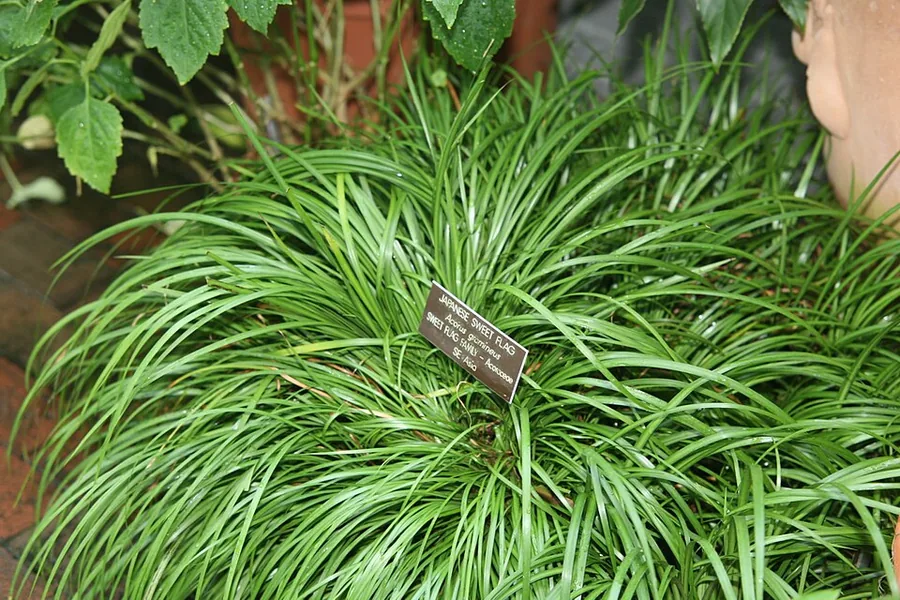
Meet its wetland needs with constantly wet ground and adequate sun, and Acorus carries a clean grassy fan through the season.
Full sun
Every 1–3 days
USDA 5–11
0–4 ft · 0.2–1.2 m
Overview
Sweet flag is an aromatic, grass-like perennial cultivated for its erect fans of foliage rather than for bloom, which stays inconspicuous. Taxonomically it stands apart: the genus Acorus occupies its own family, Acoraceae, an early-diverging monocot lineage that is neither a true grass nor an iris despite the resemblance. The characteristic warm, spicy scent released when a leaf is crushed is the aromatic signature that gives the plant its common name.
The name covers two species of differing stature. Acorus gramineus is the dwarf, holding at 6 to 12 inches and supplying the gold and cream-variegated selections, whereas the common sweet flag, Acorus calamus, is the larger plant at roughly a couple of feet with broad, iris-like blades. Both are wetland marginals, which is why they perform at a pond or stream edge, in a bog or rain garden, or in a container standing in a saucer of water.
Culture reduces to two requirements: reliable moisture and patience. Spread is by creeping rhizomes and proceeds slowly, so the plant demands little intervention beyond water. Because it is adapted to saturated ground and not to drought, any lapse into dry soil provokes rapid tip scorch and browning, the single most common failure.
Care
The short version: site it in full sun to part shade in soil held constantly moist to wet, or in shallow standing water, and never allow it to dry, since drought is the chief cause of decline. Feed lightly in spring and shear spent foliage in late winter.
Light
Sweet flag performs best in full sun yet accepts partial sun and partial shade. Pigmentation drives the light requirement: the gold and variegated forms develop their strongest color under higher light, though in regions with hot summers a measure of afternoon shade guards them against scorch, to which they are the most prone.
Water
As a marginal bog plant, its roots are adapted to saturation, so the soil should stay constantly moist to wet, or the plant can sit in a few inches of standing water at a pond or stream edge. Acorus calamus, the larger species, tolerates deeper water than the dwarf gramineus. Drought is the principal cause of failure because the foliage has no reserve against it and browns quickly once the soil dries.
Soil
It grows in rich soil that remains consistently moist to wet and is indifferent to texture, succeeding in clay, loam, sand, or silt and tolerating frequent standing water. Target a pH between 5.5 and 7.5, from mildly acidic to neutral, which is the reaction this plant accepts.
Temperature
Cold-hardiness is a defining trait, with the plant rated from -20°F to 95°F (-29°C to 35°C). That lower limit is precisely what allows it to overwinter as far north as zone 5 without protection.
Humidity
Atmospheric humidity is immaterial here; ordinary outdoor air suffices and no target value applies. The plant's water relations are governed at the roots, which must stay wet, not at the leaf surface.
Feeding
This is a light feeder, provisioned adequately by rich, moist ground. A single application of balanced slow-release fertilizer in spring covers its modest demand, and even that is discretionary rather than necessary.
Pruning
Maintenance is minimal, and no routine pruning is warranted, so the plant is very low maintenance. Shearing or trimming tatty, scorched, or winter-damaged foliage in late winter or early spring simply clears the old growth and lets the clump renew.
Repotting
Container specimens benefit from division or potting on every 2 to 3 years as the clump fills its space. The reliable indicators are roots crowding the pot, the crown lifting above the soil line, and a thinning center, all signs the clump has outgrown its root run.
Size & spacing
Mature height spans 6 to 47 inches (15 to 120 cm) according to species, from the diminutive gramineus dwarfs to full-size calamus. Space plants 6 to 24 inches (15 to 60 cm) apart, using the closer figure where quicker groundcover cover is the aim.
When to plant
Hardy across zone 5 to 11, sweet flag imposes few constraints on timing. Establish divisions in spring after frost, into ground that remains wet, and expect the inconspicuous greenish flower spikes in May and June. As a foliage plant, its bloom carries little ornamental weight and is easily overlooked.
Northern hemisphere
Southern hemisphere
Typical months for a temperate climate: start earlier in warm zones, later where spring frosts linger.
- Sow: not typically grown from seed; propagate by division instead
- Plant: spring after frost, into constantly moist or wet ground or shallow water
- Harvest: spring to early summer (May-June); flowers are inconspicuous greenish-yellow spadixes and the plant is grown for foliage, not bloom
Hardiness
USDA hardiness zones: 5–11
Temperature: down to -29°C
Troubleshooting
In practice, nearly every disorder in sweet flag resolves to water balance. Kept wet, the plant is largely self-sufficient; permitted to dry, it signals stress through the foliage within days. Diagnose against the cases below before the decline reaches the whole clump.
Browning, scorching leaf tips and a declining clump
Because sweet flag is a bog and waterside plant with no drought tolerance, dry soil is almost invariably the cause when a clump browns and withers. The gold 'Ogon' and variegated forms scorch soonest in a hot, exposed position. Relocate it to ground that stays wet, or stand the container in a saucer of water, and remove the worst foliage so replacement growth can develop.
Fix:
- Move the plant to constantly moist or wet ground, a bog, pond/stream edge, or stand the container in a saucer of water so the soil never dries
- Water deeply and keep the soil saturated; mulch to retain moisture
- Trim off badly scorched foliage; new growth recovers once moisture is restored
- In hot climates give gold and variegated forms some afternoon shade or filtered sun to reduce scorch
Slow establishment and a clump slow to enlarge
A clump that fills in slowly usually reflects the species' inherently slow growth, not a defect. Sweet flag advances by rhizome over successive seasons, and the dwarf gold cultivars are slowest of all. Maintaining wet soil and good light maximizes what growth the plant can make, and setting divisions about 8 to 12 inches apart shortens the time to cover.
Fix:
- Be patient: allow clumps to expand over several seasons
- Keep soil consistently wet and provide adequate light to maximize growth
- Plant closer together (about 8-12 in apart) for faster groundcover coverage
Rhizomes creeping into adjacent wet ground
In continuously wet soil the larger common sweet flag (Acorus calamus) extends by creeping rhizome and can build substantial colonies, while the dwarf Acorus gramineus stays comparatively restrained. Lifting and dividing the margins in spring holds the clump within bounds, and growing the vigorous calamus in a submerged pot confines the rhizomes entirely.
Fix:
- Divide and lift edges in spring to keep the clump in bounds
- Grow in a submerged container or pot to contain the rhizomes, particularly for Acorus calamus
- Install an edging barrier in bog or pond plantings
Toxicity
As a garden ornamental, sweet flag is safe to grow and handle around pets and people and appears on no toxic-plant list. The one material caution concerns the rhizome, which contains beta-asarone, a mild toxin and possible carcinogen. The foliage presents negligible risk; the sound rule is to leave the rhizome unharvested rather than consume it.
Toxic to
Cats · Dogs · Horses · Rabbits · Livestock · Birds · People
Cats Mild
The foliage presents little concern, but the aromatic rhizome contains beta-asarone, and a cat that chews into it may drool or show a transient digestive upset. Keeping the roots inaccessible is the sensible precaution.
Dogs Mild
A dog investigating the leaves is unaffected, whereas gnawing the pungent rhizome can produce mild drooling or loose stools. The foliage itself warrants no concern.
Horses Mild
Grazing the leaves carries little risk, but the beta-asarone held in the rhizome makes the roots worth fencing from an inquisitive horse.
Rabbits Mild
Rabbits may browse the grassy foliage without issue, though the aromatic rhizome contains beta-asarone and is best placed beyond their reach.
Livestock Mild
Cattle, sheep, and goats generally avoid the bitter, aromatic plant of their own accord, and the operative caution attaches to the rhizome rather than the leaves.
Birds Mild
Birds seldom engage with sweet flag, but the beta-asarone in the roots means the rhizome should not be consumed.
People Caution
The plant is safe to grow and to handle, but the rhizome should not be eaten. Despite its historical use as calamus flavoring, it contains beta-asarone, which the US FDA prohibits in food as a possible carcinogen.
Safe as an ornamental around pets. Note, however, that the rhizome of the larger common/Eurasian sweet flag (Acorus calamus), especially diploid/triploid forms, contains beta-asarone, a compound the US FDA has banned as a food or flavoring additive (21 CFR 189.110) because of potential carcinogenicity. Although the rhizome was used historically as a medicine and flavoring (calamus), it should NOT be eaten or used as a calamus herbal remedy. This does not affect the plant's safety as a non-toxic ornamental for pets.
Helpline numbers

United States
ASPCA Animal Poison Control: (888) 426-4435 (fee applies)
Poison Control: (800) 222-1222



Canada
Poison Centres: 1-844-764-7669
Varieties
The Acorus in cultivation are predominantly dwarf selections chosen for foliage color, alongside the larger common sweet flag. The following are the selections worth knowing.
Acorus gramineus 'Ogon'
A dwarf Japanese sweet flag bearing bright gold, yellow-and-green striped fans of about 6 to 12 inches, which color best in stronger light but benefit from some afternoon shade where summers run hot.
Acorus gramineus 'Variegatus'
A dwarf selection striped cream and green, valued as a fine-textured groundcover and as an accent at a pond edge or in a container.
Acorus gramineus 'Minimus Aureus'
A minute golden dwarf of only a few inches, suited to small containers and to miniature or fairy plantings.
Acorus calamus 'Variegatus'
The large common sweet flag at roughly 2 to 2.5 feet, with broad iris-like leaves boldly striped cream and green on a sterile triploid plant.
How to propagate
Sweet flag is increased by division of the clump, the only reliable means of holding the named color selections true to type.
DivisionEasy
Spring (or early summer) · A few weeks to a season
Division of the rhizomatous clump is the standard and dependable method of increase, and it is technically undemanding. Lift clumps in spring or early summer, separate them into pieces, and hold those pieces constantly moist or in shallow water while they root over the following few weeks to a season. Because named selections such as 'Ogon' and 'Variegatus' do not come true from seed, they must be propagated vegetatively by division.
Myths
Sweet flag is a true grass or a form of iris.
It is neither. Sweet flag is Acorus, isolated in its own family Acoraceae and grown for its aromatic, sword-like fans of foliage. The grassy, iris-like habit is convergent resemblance, not phylogenetic kinship.