Tree · Sapindaceae
Sugar Maple
Acer saccharum
Rooted in deep, moist, fertile soil with room to spread, sugar maple returns dense summer shade and strong red, orange, and gold fall color.
Full sun
Every 7–14 days
USDA 3–8
39–79 ft · 12–24 m
Overview
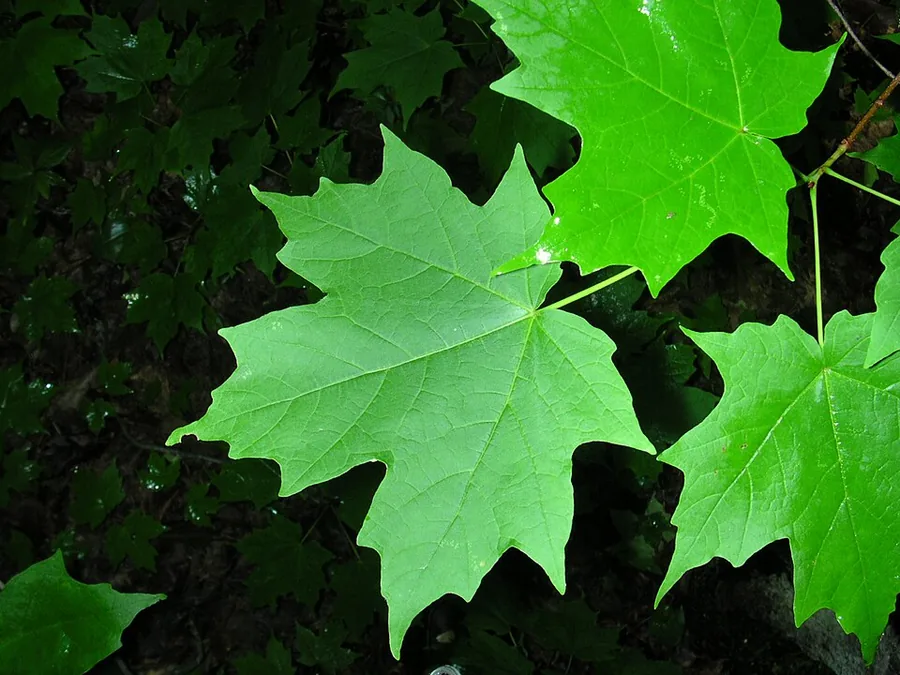
Acer saccharum is a slow-growing, long-lived shade tree that matures into a broad, rounded crown topping 80 feet (24 m) over a heavy trunk. The dense canopy casts cool, heavy shade through summer, and in fall the foliage turns orange, red, and gold. That autumn color is the trait that drives most landscape plantings.
This is a northern species by constitution. It is reliably hardy across zones 3 through 8 and tolerates winter lows near -40°F (-40°C), but it performs poorly under the heat load, road salt, and soil compaction of a confined urban site. Site it in deep, fertile, evenly moist ground with an unrestricted root zone, and it will persist for generations.
Longevity comes at the cost of speed. Sugar maple grows slowly and lives for decades, so it is planted as a long-term structural tree rather than a quick screen. Its late-winter sap runs sweet enough to tap, the basis of the northern maple syrup industry.
Care
The short version: grow it in full sun to partial shade in deep, fertile, evenly moist but well-drained soil, supply roughly an inch of water weekly through heat and drought, and keep it away from pavement and road salt that stress the root zone.
Light
Sugar maple develops best in full sun but tolerates partial shade, particularly as a young tree. Higher light supports denser crown structure and stronger fall color, though a half day of sun is enough to grow a sound tree.
Water
Maintain deep, even soil moisture, irrigating on roughly a 7 to 14 day cycle when rainfall is short. Under heat or drought, supply an established tree about an inch of water per week, because the root system otherwise cannot meet demand and the foliage scorches.
Soil
Establish it in deep, fertile loam that retains moisture yet drains freely and is high in organic matter. It prefers a pH of 5.5 to 7.0, slightly acidic to neutral, and will not tolerate compacted or poorly drained soil, which restricts root function.
Temperature
As a cold-adapted species it is comfortable from -40°F to 95°F (-40°C to 35°C). It thrives in northern climates and declines where summers are long and hot.
Humidity
Ambient humidity is not a limiting factor outdoors, so no target applies. Air circulation and consistent soil moisture contribute far more to tree health than atmospheric humidity.
Feeding
Apply a balanced slow-release tree fertilizer in early spring, with the rate guided by a soil test rather than a fixed schedule. A mulch ring at the drip line releases nutrients slowly as it decomposes and moderates the root zone.
Pruning
Prune in summer or full dormancy to remove dead, damaged, or crossing limbs, because maples cut in late winter or early spring bleed sap heavily. Disinfect tools between cuts with 10 percent bleach or 70 percent alcohol to avoid transferring pathogens.
Repotting
As a landscape tree it is essentially never containerized long term, so repotting rarely applies. On nursery or container stock, inspect for roots circling the trunk flare or top growth stunted relative to a pot-bound root mass, and correct girdling roots before planting.
Size & spacing
Allow generous space at planting. Mature height runs 40 to 80 feet (12 to 24 m) with a spread of 30 to 60 feet (9 to 18 m), so position it well clear of structures, drives, and overhead utility lines.
When to plant
Plant in spring or fall, when cool conditions let the root system establish before heat or cold stress. The inconspicuous greenish-yellow flowers open in April, just before or with the leaves, and the ornamental payoff is the autumn canopy of red, orange, and gold.
Northern hemisphere
Southern hemisphere
Typical months for a temperate climate: start earlier in warm zones, later where spring frosts linger.
- Plant: Spring or fall
- Harvest: Inconspicuous greenish-yellow flowers in April before or with the leaves; brilliant red, orange, and yellow fall color
Hardiness
USDA hardiness zones: 3–8
Temperature: down to -40°C
Troubleshooting
Sugar maple registers most stress in its foliage first, whether the driver is heat, a soilborne fungus, or a wet spring. Reading those symptoms accurately separates a cosmetic issue from a structural threat, so confirm the pattern below before treating.
Progressive one-sided wilt and dieback
Dieback confined to one limb or one side, while the rest stays healthy, indicates Verticillium wilt, a soilborne fungus that colonizes and plugs the vascular tissue. Expose the sapwood on a wilting branch to check for brown or green streaking, then confirm by laboratory test, since these diseases cannot be told apart by eye. No cure exists, so remove dead wood as it develops and sustain vigor with watering and soil-test-based feeding to prolong the tree's life.
Fix:
- There is no cure; prune out dead branches as they appear
- Water about one inch per week and fertilize based on a soil test to prolong tree life
- Mulch around the drip line and sanitize pruning tools with 10 percent bleach or 70 percent alcohol between cuts
Marginal and interveinal browning under heat and drought
The tan, dead tissue at the leaf margins and between the veins is leaf scorch, a physiological response to a root system that cannot supply water fast enough during hot, dry conditions. Salt accumulation, compaction, and a restricted root zone near pavement intensify it. Irrigate an established tree with about an inch weekly through heat and drought, and mulch the root zone to conserve moisture and moderate soil temperature.
Fix:
- Water established trees with about one inch of irrigation per week during heat and drought
- Mulch over the root zone to conserve moisture and moderate soil temperature
- Avoid salt accumulation and soil contaminants around the roots
Glossy black, tar-like spots ringed with yellow in late summer
The thick, glossy black spots encircled by yellow tissue are tar spot, a fungal leaf-spot disease that is disfiguring but rarely damaging. The pathogen overwinters in fallen leaves, so raking and destroying leaf litter each autumn breaks its cycle. On small trees a copper-based fungicide at leaf-out is an option, though for most maples treatment is unwarranted.
Fix:
- Rake up and destroy fallen leaves where the fungus overwinters
- If desired on small trees, apply a copper-based fungicide, mancozeb, or triadimefon three times at two-week intervals starting at spring leaf unfurl
Vein-following leaf browning and bud death after a wet spring
Brown blotches tracking the leaf veins, dead buds, and crooked twig dieback after a prolonged cool, wet spring point to anthracnose, a fungal disease favored by that weather. Because the fungus persists in fallen leaves, rake and destroy infected litter to reduce carryover. Improving air circulation and keeping foliage dry limit infection at the outset.
Fix:
- Rake and destroy fallen infected leaves
- On valuable small trees, spray a copper-based fungicide, mancozeb, or chlorothalonil three times at two-week intervals from spring leaf emergence
Toxicity
The toxicology here is straightforward. Sugar maple is not listed as toxic to people, pets, or livestock, and its boiled sap is the source of maple syrup. The red-blood-cell toxicity that concerns horse owners is associated with red and silver maple, not this species.
Safe for
People · Cats · Dogs · Horses · Rabbits · Livestock · Birds
Cats None
No toxic principle affects cats. A leaf taken from the ground poses no risk to them.
Dogs None
Dogs are unaffected. The leaves, bark, and twigs contain nothing harmful to them.
Horses None
Sugar maple poses no hazard to horses. The red-blood-cell toxicity documented for wilted red and silver maple leaves does not apply to this species.
Rabbits None
Rabbits can browse the foliage without adverse effect.
Livestock None
Cattle, goats, and sheep can graze around sugar maple with no toxic response.
Birds None
Birds nest and feed within the canopy safely, and the seeds provide food for wildlife.
People None
People are unaffected, and the tree is in fact edible in part: its boiled-down sap is the source of maple syrup.
Non-toxic to cats and dogs. Note that it is the related red maple (Acer rubrum) whose wilted leaves are notoriously toxic to horses; sugar maple is not the species classically implicated, but as a general precaution wilted maple leaves of any species are best kept away from horses.
Varieties
The sugar maples offered for landscape use are mostly named cultivars selected for improved leaf durability and fall color. The following are the selections worth specifying by name.
Green Mountain
A heat- and drought-tolerant cultivar that maintains a dense oval crown and colors orange-red in autumn.
Legacy
A vigorous, scorch-resistant clone whose thick, glossy foliage resists tearing and holds up under drought.
Fall Fiesta
A durable, fast-establishing selection valued for consistent yellow-orange to red autumn color and late leaf retention.
How to propagate
Seed propagation succeeds after a cold, moist period that satisfies the seed's dormancy, while named clones are maintained by grafting because they do not reproduce true from seed.
SeedModerate
Sow outdoors in fall or after 60-90 days of cold, moist stratification before spring sowing · 1 to 2 growing seasons
Sugar maple seed carries embryo dormancy that only a cold period breaks, so sow it outdoors in fall or provide 60 to 90 days of cold, moist stratification ahead of a spring sowing. A seedling generally establishes over 1 to 2 growing seasons. Layering and stem cuttings are alternative vegetative options.
GraftingDemanding
Late winter (bench graft) or summer (budding) · 1 to 2 seasons
Because named cultivars such as Green Mountain and Legacy do not come true from seed, they are propagated by grafting or budding onto seedling rootstock. Bench grafts are made in late winter and buds set in summer, with the graft union consolidating over 1 to 2 seasons. The technique demands precision, which places it in the demanding category.
Myths
All maples, sugar maple included, are lethally toxic to horses.
The documented hazard is specific to red maple and silver maple, whose wilted leaves can trigger destruction of a horse's red blood cells. Sugar maple is not the implicated species, and rather than being toxic it is the tree tapped commercially for maple syrup.