Tree · Sapindaceae
Japanese Maple
Acer palmatum
Give it dappled shade, steady moisture, and shelter from wind, and the Japanese maple returns color from spring through fall.
Partial shade
Every 3–7 days
USDA 5–8
10–25 ft · 3–7.6 m
Overview
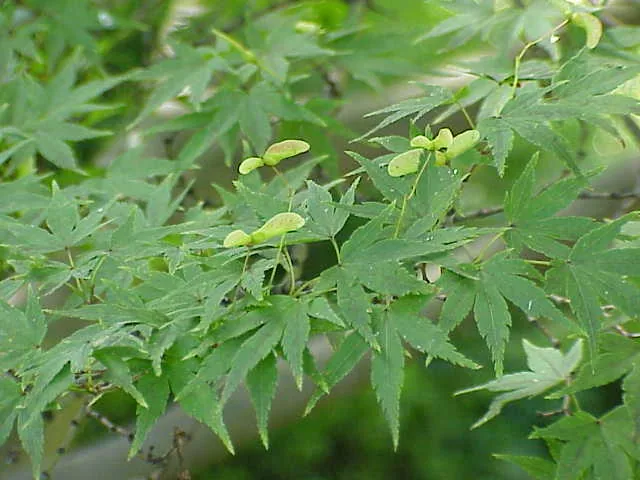
Acer palmatum is a small, slow-growing understory tree, and that origin explains its whole care profile: filtered light and cool roots are the conditions it evolved under. Growers sort it into two broad architectures. Upright forms develop into rounded small trees, while laceleaf forms mound and weep, their leaves so deeply dissected they resemble lace.
Foliage, not flower, is the reason to grow it. The palmate leaves cycle through red, green, bronze, and purple across the season and intensify to red, yellow, and gold in autumn as pigments shift. The April flowers are reddish and inconspicuous, contributing nothing ornamental, which is why the tree is planted for its leaves alone.
Its demands follow directly from its physiology. Hot afternoon sun, drying wind, and dry soil pull moisture from the leaf margins faster than the roots supply it, which is why scorch is the recurring failure and why dappled shade, even soil moisture, and a thick mulch layer are the corrective trio. Meet those conditions and, given its slow rate and perennial habit, it persists for decades with minimal intervention.
Care
The short version: site it in dappled or afternoon shade out of drying wind, hold the soil evenly moist and well drained, mulch the root zone, and confine pruning to late fall through winter.
Light
This tree wants dappled or afternoon shade, matching the filtered light of the forest understory it came from. It tolerates full sun in cooler climates, but on hot, dry, windy sites that exposure drives leaf scorch as transpiration outpaces uptake. Deep full shade errs the other way, reducing pigment intensity and loosening the branch structure.
Water
Hold the soil consistently moist, and increase attention through heat, because the tree has little drought tolerance. A 3 to 4 inches (8 to 10 cm) mulch layer under the canopy conserves soil moisture and moderates root temperature. Fluctuating moisture under full sun is what scorches the leaf margins, so consistency is the operative variable.
Soil
Grow it in moist, rich, well drained loam on the slightly acidic side with a high organic fraction. High-pH soils induce chlorosis, the interveinal yellowing that follows reduced iron availability, so maintaining acidity keeps the foliage green and functional.
Temperature
Hardiness spans roughly -20°F to 95°F (-29°C to 35°C), a wide envelope for a woody ornamental. The vulnerability is late frost, which damages the tender new spring growth, another reason to shelter the tree from open exposure and wind.
Humidity
Ambient outdoor humidity suffices, so there is no target figure to manage. What governs leaf health is even soil moisture and protection from wind, since it is desiccating airflow, not low humidity, that crisps the margins.
Feeding
Apply fertilizer once in spring before bud break, using a slow-release or balanced formulation. Restraint matters: excess nitrogen forces weak, rapid growth and can elevate soluble salts enough to scorch the leaf margins directly.
Pruning
Confine pruning to a minimum and to late fall to mid winter, the dormant window, removing only dead or crossing branches. Cuts made in spring or summer cause heavy sap bleeding, so correct timing matters more here than for most trees.
Repotting
Repot container and bonsai specimens every 2 to 3 years, refreshing the medium and root-pruning as required. The cues that a plant has outgrown its container are roots circling the pot, water passing straight through, and foliage that scorches and stalls.
Size & spacing
At maturity it attains 10 to 25 feet (3 to 7.5 m) in height with a comparable spread, so allocate equivalent lateral room. Its slow growth rate makes siting forgiving, since a misjudged scale takes years to become a problem.
When to plant
The tree breaks dormancy slowly and, cut at the wrong season, bleeds sap heavily, so timing follows its physiology. Plant during the mild windows of spring or fall, expect the reddish flowers to open and pass in April, and reserve pruning for the dormant interval from late fall into winter when sap flow is lowest.
Northern hemisphere
Southern hemisphere
Typical months for a temperate climate: start earlier in warm zones, later where spring frosts linger.
- Plant: Spring or fall, in dappled shade sheltered from drying wind and late frost.
- Harvest: Inconspicuous reddish flowers in April; brilliant fall foliage color (red, yellow, bronze, purple).
Hardiness
USDA hardiness zones: 5–8
Temperature: down to -29°C
Troubleshooting
The foliage is the first tissue to register stress on a Japanese maple, whether the cause is an over-exposed site or a vascular fault in the roots. Reading those early symptoms correctly lets you correct the manageable disorders before they progress. Match the presentation below, then intervene while the response still matters.
One-sided branch wilt and progressive dieback
Scattered, often one-sided dieback signals verticillium wilt, a soilborne fungus that colonizes and occludes the xylem so water cannot reach the limbs it serves. The vascular blockage explains both the wilt and any dark streaking visible under the bark, but the symptoms overlap with fusarium, so a laboratory culture is the only reliable confirmation. No cure exists: remove the dead wood, sustain the tree with irrigation and slow-release feed to encourage new growth, and never return a susceptible species to that ground.
Fix:
- No cure exists; prune out dead branches and have a certified arborist assess hazardous dieback
- Support the tree with appropriate irrigation and slow-release fertilizer to encourage new growth
- Remove severely affected trees; plant only resistant species in infested soil
Honeydew, soft insects on shoots, and encrusted bark
Two piercing-sucking pests produce this picture. Aphids colonize the tender new growth where the phloem is easiest to tap, while scale insects settle on bark and branches beneath hard or waxy covers, and both excrete the sugary honeydew that feeds sooty mold. Dislodge aphids with a strong water jet or insecticidal soap, target scale with dormant horticultural oil during dormancy, and scout through the season so a colony never builds unchecked.
Fix:
- Hose off aphids with a strong stream of water or treat with insecticidal soap/horticultural oil
- Apply dormant horticultural oil for scale and prune out heavily infested branches
- Conserve natural predators and monitor through the growing season
Brown, dry margins and curled leaf tips
This pattern is leaf scorch, a moisture deficit at the leaf margin driven by sun, heat, and drying wind pulling water faster than the roots can replace it. Because the margins transpire hardest, they brown first on the most exposed foliage, and the damage tracks the weather, deepening in hot, dry spells while the root system remains sound. Restore the water balance by irrigating deeply and evenly, laying 3 to 4 inches of mulch to cool the root zone, and cutting the exposure with afternoon shade or a wind screen.
Fix:
- Water deeply and consistently to keep soil evenly moist
- Apply 3-4 inches of mulch beneath the canopy to cool roots and retain moisture
- Provide afternoon shade or relocate to a site protected from sun and wind
Toxicity
Good news for pet owners: the Japanese maple is not toxic to cats, dogs, horses, or other animals. Critically, it lacks the hemolytic compound that makes wilted red maple foliage dangerous to horses. A pet that consumes leaves in quantity may show mild gastric upset from bulk alone, so discouraging chewing remains sensible.
Safe for
People · Cats · Dogs · Horses · Rabbits · Livestock · Birds
Cats None
The species carries no toxin that affects cats, so ingestion does not poison them. What follows a large mouthful of foliage is mechanical, not toxic: transient gastric upset or regurgitation that resolves on its own.
Dogs None
No toxic principle resides in the leaves, bark, or seeds, so dogs face no chemical hazard. A bulk feeding may irritate the gut for a day, the same nonspecific response any fibrous greenery produces.
Horses None
Acer palmatum lacks the compound that makes wilted red maple foliage hemolytic in horses, the agent that destroys equine red blood cells. That distinction makes it a sound species to establish near a paddock where red maple would be contraindicated.
Rabbits Safe
No part of the plant is toxic to rabbits. As with any novel forage, introduce it gradually and in small amounts so the hindgut microbiota can adjust.
Livestock Safe
Cattle, goats, and sheep may browse the foliage without toxic effect. It carries none of the red-maple hemolytic risk that concerns keepers of grazing stock.
Birds Safe
The tree presents no toxicity to birds, which commonly work the winged samaras for seed and shelter in the canopy without consequence.
People Safe
The species is non-toxic to people, and the leaves and sap see occasional culinary and tea use. In practice it is cultivated as an ornamental rather than an edible.
Generally non-toxic, but any plant material can cause mild stomach upset if eaten in quantity; discourage pets from chewing foliage.
Varieties
The species includes hundreds of cultivars, classified chiefly by leaf morphology and growth habit. The selections below are the ones most consistently offered in the trade.
Bloodgood
An upright cultivar selected for deep reddish-purple palmate foliage that resists the midsummer fade common to red-leaved forms and holds its color well into summer.
Crimson Queen
A weeping, mounded laceleaf selection whose finely dissected red foliage cascades over itself in the fountain-like habit typical of dissectum types.
Sango-Kaku (Coral Bark)
An upright form whose soft yellow autumn foliage gives way, once the leaves drop, to coral-red young bark that reaches peak intensity through winter.
Seiryu
A rare upright laceleaf that retains green foliage through summer before coloring gold to red in fall, an unusual habit within the otherwise weeping threadleaf group.
var. dissectum / subsp. matsumurae
The threadleaf and laceleaf assemblage as a whole, defined by deeply and finely dissected leaves borne on a low, weeping mound.
How to propagate
Japanese maples propagate slowly and with difficulty, and the named cultivars will not come true from seed because their traits do not segregate uniformly. The appropriate method depends on whether the goal is an exact clone or simply the species.
GraftingDemanding
Late winter to early spring (bench grafting onto seedling rootstock). · Several months to a year for the graft union to take and grow on.
Named cultivars do not reproduce true from seed, so the nursery trade perpetuates them clonally by grafting, the reliable route for an exact copy. Practitioners bench graft scion wood onto Acer palmatum seedling rootstock in late winter to early spring, after which the union requires several months to a year to callus, unite, and grow on. The technique is demanding and rewards a practiced hand, which is why it is the recommended method for cultivar fidelity.
SeedModerate
Sow stratified seed in fall or early spring. · Seedlings establish over one to several seasons.
Seed propagates the straight species, though the offspring segregate and will not replicate a named parent. Sow stratified seed in fall or early spring, then allow the seedlings one to several seasons to establish. Because the species self-sows readily enough to be listed as invasive in Virginia and DC, collect or contain seed where escape is a concern.
Stem cuttingsDemanding
Early summer (softwood cuttings). · Weeks to months to root, with low success rates.
Softwood cuttings taken in early summer will root on occasion, but the material is recalcitrant and success rates stay low. Even successful cuttings can take anywhere from weeks to months to strike, which makes the method unreliable for most cultivars. Grafting remains the dependable choice when a faithful clone is the objective.
Myths
Japanese maple leaves are dangerously poisonous to dogs and cats.
Acer palmatum does not appear on the ASPCA toxic-plant lists, and consistent with the other maples they have assessed, it is classed as non-toxic to cats and dogs. The wilted-leaf hazard people recall is specific to red maple in horses, a species and toxin distinct from this tree in companion animals. The species is safe to establish where pets have access.
Japanese maples must be grown in deep, full shade.
As understory trees they perform best under dappled light or afternoon shade, but excessive shade reduces pigment expression and slackens the branching habit. The real liability in sun is not irradiance itself but scorch, a moisture deficit that develops on hot, dry, windy sites where the soil dries. Filtered light paired with steady soil moisture outperforms deep shade every time.