Tree · Sapindaceae
Lychee
Litchi chinensis
Give it heat, acidic soil, and a cool winter rest, and this tropical evergreen repays the discipline it asks for.
Full sun
Every 3–7 days
USDA 10–11
20–40 ft · 6.1–12.2 m
Overview
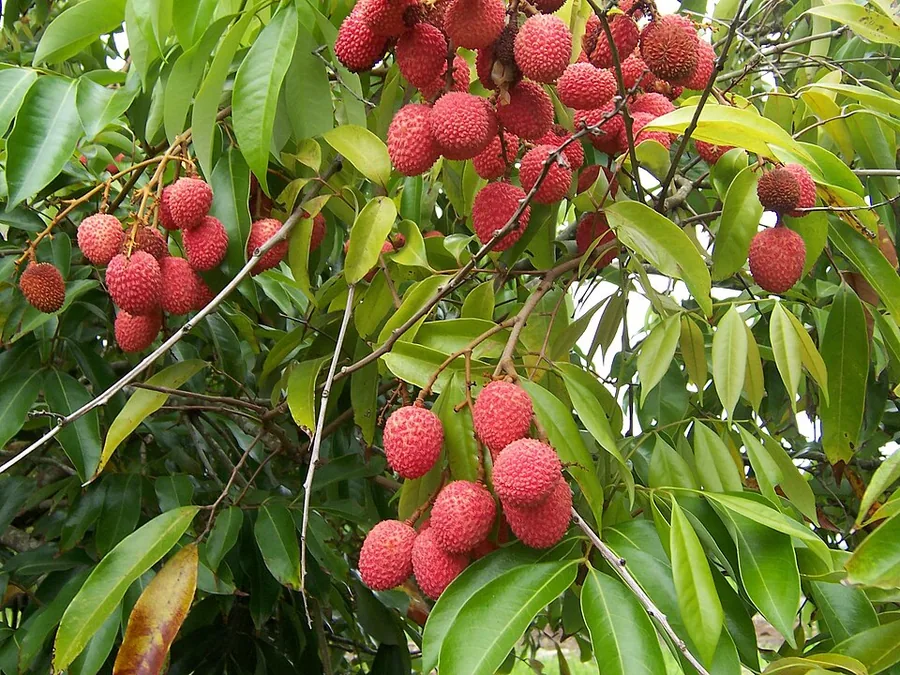
Lychee is an evergreen tropical tree native to southern China, valued for the sweet, aromatic aril inside its rough red pericarp. Growth is slow, building a dense, rounded crown over a lifespan measured in decades, so a planting is a durable investment rather than a seasonal crop. In open ground it attains 20 to 40 feet (6 to 12 m) in height with a nearly equal spread.
The species earns its demanding reputation chiefly through climate requirements. It depends on sustained warmth and frost-free winters, confining reliable culture to USDA zones 10 and 11 or an equivalent sheltered microclimate. The critical subtlety is floral induction: the tree requires a brief cool, dry winter period to initiate flower panicles, so a mild winter commonly yields a vegetative flush and no crop.
Under suitable conditions the return is substantial. Fruit ripens from May to July, peaking in June, and an established tree carries a heavy load. Growers should account for alternate bearing, in which a productive season is typically followed by a lighter one.
Care
The short version: full sun, fertile well-drained acidic soil, and consistent moisture through the growing season, followed by a cooler, drier winter rest to induce flowering, with protection from frost and wind.
Light
Site lychee in full sun to maximize growth and cropping, though it accepts some partial sun. Wind exposure is as important as insolation here, because the brittle wood fractures in storms, so favor a sheltered position.
Water
Maintain consistently moist soil through active growth, most critically while the tree is young or fruiting. Reduce irrigation in late fall and winter to deliver the cool, dry rest that supports floral induction. The species tolerates neither standing water nor saline water.
Soil
Establish in fertile, well-drained acidic sandy loam rich in organic matter, targeting a pH of 5.0 to 5.5. The tree is intolerant of salinity, so saline substrate or water will suppress performance.
Temperature
Lychee operates across roughly 32°F to 95°F (0°C to 35°C) but remains genuinely frost tender, and a freeze induces foliar browning and branch death. Conversely, a brief cool winter interval drives it into flower.
Humidity
The tree favors humid air in the range of 50% to 80%. Low humidity suits it poorly, which underlies its performance in warm, humid regions.
Feeding
Fertilize seasonally across the growing season, approximately March to November, with a complete fertilizer supplying micronutrients. Demand for manganese, zinc, and iron is high, so micronutrient foliar sprays during growth forestall the interveinal chlorosis to which the tree is prone.
Pruning
Prune lightly after harvest to shape the canopy and contain size, excising dead, crossing, or weak wood. An established lychee requires little beyond this.
Repotting
Pot a young container specimen up every 2 to 3 years until it is ready for the ground. Transplant to open soil once established, as the species is built for long-term in-ground culture.
Size & spacing
Anticipate a mature tree of 20 to 40 feet (6 to 12 m) in height with a spread of 20 to 30 feet (6 to 9 m). Allocate that open volume, clear of structures, so the broad canopy has room and wind can pass.
When to plant
Lychee is governed by the warm season and has no frost tolerance. Establish it in spring once cold has passed and the soil has warmed, let flowering proceed from late winter into spring, and harvest from May through July, with peak yield in June.
Northern hemisphere
Southern hemisphere
Typical months for a temperate climate: start earlier in warm zones, later where spring frosts linger.
- Plant: Spring, after all danger of frost has passed and the soil has warmed
- Harvest: Flowers late winter to spring; fruit ripens May to July, peaking in June
Hardiness
USDA hardiness zones: 10–11
Temperature: down to -1°C
Troubleshooting
The majority of lychee problems arise from climate and soil rather than from pests. Poor flowering, interveinal chlorosis, and cold or wind injury account for nearly the entire range. Match the symptom below and intervene before a season's crop is compromised.
Cold and wind injury with foliar necrosis and dieback
As a frost-tender species, lychee shows browned or blackened foliage after a cold event, and freezing temperatures can carry injury into whole branches as dieback. The tree's brittle wood makes it equally prone to mechanical damage from strong wind. Shield young trees during frost with covers or supplemental heat, and establish plantings in a wind-sheltered position to limit both stresses.
Fix:
- Protect young trees during frost with covers or added heat
- Relocate or shelter trees from strong wind
Vegetative vigor with poor flowering and fruit set
Persistent leaf flushing without panicle formation nearly always signals a missed cool, dry winter rest, the brief cold and moisture stress that redirects apical buds from vegetative flush into floral induction. Layered on top is alternate bearing, in which a heavy crop depletes reserves and thins the following year's set. Restrict water and nitrogen through late fall and winter to impose that rest, and expect the crop to swing across seasons.
Fix:
- Provide a cool, dry winter rest by withholding water and nitrogen in late fall and winter
- Avoid heavy nitrogen that drives vegetative growth at the expense of flowers
- Be patient through alternate-bearing cycles
Interveinal chlorosis on the youngest foliage
Chlorosis confined to the newest leaves, with veins staying green and margins scorching, reflects poor uptake of iron, zinc, and manganese, the three micronutrients this tree draws on heavily. Alkaline soil holds those elements in unavailable forms, and saline soil or irrigation water compounds the deficiency. Correct it with chelated iron and micronutrient foliar sprays, acidify the root zone back toward a pH of 5.0 to 5.5, and remove saline water from the program.
Fix:
- Apply chelated iron and micronutrient foliar sprays
- Acidify the soil and mulch with organic matter
- Stop using saline irrigation water
Toxicity
The ripe aril is a safe, widely consumed fruit, so the tree presents no meaningful household toxicity. Concern is limited to the unripe fruit and the seeds, which contain hypoglycin implicated in dangerous drops in blood glucose, with the hard seed additionally posing a choking hazard. Confine consumption to ripe fruit, discard the seeds, and keep green fruit and pits away from children and pets.
Toxic to
Cats · Dogs · Horses · Rabbits · Livestock · Birds
Safe for
People
Cats Caution
Ripe aril poses no meaningful risk to a cat, so the exposure of concern is the seed and any unripe fruit. Their hypoglycin can depress blood glucose enough to produce weakness or lethargy, and the firm pit represents a genuine choking hazard.
Dogs Caution
Because dogs tend to ingest a dropped fruit entire, pit included, the seed is the primary concern. A swallowed seed can obstruct the gut, while hypoglycin in seeds and unripe fruit may induce weakness or tremor from hypoglycemia; ripe flesh in small amounts is tolerated.
Horses Caution
Direct exposure is uncommon, and ripe flesh is not a documented problem in moderation. Even so, removing fallen seeds and green fruit is prudent, since the hypoglycin responsible for the fruit's hypoglycemia has not been established as safe for horses.
Rabbits Caution
Lychee is poorly suited to rabbits beyond a minimal taste of ripe flesh, given their low tolerance for the sugar load. The seed and unripe fruit additionally carry the hypoglycin capable of depressing blood glucose.
Livestock Caution
Grazing stock most often encounter lychee as windfall beneath the canopy. The ripe pulp is comparatively benign, but seeds and unripe fruit contain hypoglycin, so drops within reach of stock should be cleared.
Birds Caution
Birds readily consume ripe aril without apparent harm at small quantities. The seed is the limiting concern, acting both as a choking hazard and as a reservoir of the same hypoglycin present in unripe fruit.
People Ripe fruit safe
Ripe lychee aril is a widely consumed fruit and safe in moderation. Toxicity is confined to the unripe fruit and seeds, which contain hypoglycin implicated in dangerous hypoglycemia, most severely in undernourished children ingesting many green fruit on an empty stomach. Restrict consumption to ripe fruit, discard seeds, and keep the pit from small children as a choking hazard.
Caution: UNRIPE lychee fruit and the SEEDS contain hypoglycin A and MCPG, toxins linked to dangerous low blood sugar (hypoglycemia), most notably in undernourished children who eat many unripe fruit on an empty stomach; the hard seed is also a choking hazard. Ripe fruit eaten in moderation is safe.
Helpline numbers

United States
ASPCA Animal Poison Control: (888) 426-4435 (fee applies)
Poison Control: (800) 222-1222



Canada
Poison Centres: 1-844-764-7669
Varieties
A limited set of named cultivars accounts for most plantings in home and commercial groves, selected for consistent cropping and fruit quality. These merit familiarity.
Brewster
A vigorous early Chinese introduction bearing large red fruit, it advanced to become a leading commercial cultivar in Florida.
Mauritius
A reliable, heavy-cropping cultivar under commercial cultivation throughout warm, humid regions.
Sweetheart
Its large heart-shaped fruit frequently develops a small, aborted chicken-tongue seed, raising the proportion of edible flesh.
How to propagate
Lychee is propagated predominantly by air-layering, since cuttings root poorly and seedlings are slow and genetically variable. Method selection governs both trueness to type and the interval to first fruit.
Air layeringModerate
Warm growing season, spring into summer · Roots in about 8-12 weeks; trees typically fruit in 3-5 years
Air-layering, also termed marcotting, is the principal commercial method for lychee because conventional cuttings root poorly. Performed in the warm season from spring into summer, the layer differentiates roots in roughly 8 to 12 weeks. The resulting tree is true-to-type and enters bearing in about 3 to 5 years, well ahead of a seedling.
SeedModerate
Sow fresh seed immediately, as viability lasts only a few days · Germinates in 1-2 weeks; seedlings may take 7-10+ years to fruit
Lychee seed is recalcitrant, losing viability within a few days, so sow it fresh at extraction to secure germination in 1 to 2 weeks. The drawback is developmental. A seedling may require 7 to 10 years or more to fruit, and the resulting fruit is variable, which disqualifies the method where fruit quality is the objective.
GraftingDemanding
Growing season · Union forms in weeks; fruiting in 3-5 years
Grafting in the growing season forms a graft union within weeks and produces a tree bearing in about 3 to 5 years. It preserves select cultivars, though for lychee air-layering remains the method growers generally favor.
Myths
The entire lychee, including the ripe fruit, is dangerously poisonous.
The ripe aril is a safe, widely eaten fruit. Toxicity resides in the hypoglycin A and MCPG of the unripe fruit and seeds, and even then clinical harm concentrates in undernourished children consuming many green fruit on an empty stomach. Consume the ripe fruit and discard the seeds.
A productive lychee is easily raised from seed.
Seedlings are slow to reach bearing age, often requiring many years, and their variability means the fruit seldom reproduces the parent's quality. Air-layering is the sound method, yielding true-to-type trees that come into bearing far sooner.