Tree · Sapindaceae
Red Maple
Acer rubrum
A fast-growing eastern native that carries red through every season and ends in incandescent fall foliage.
Full sun
Every 7–14 days
USDA 3–9
39–89 ft · 12–27 m
Overview
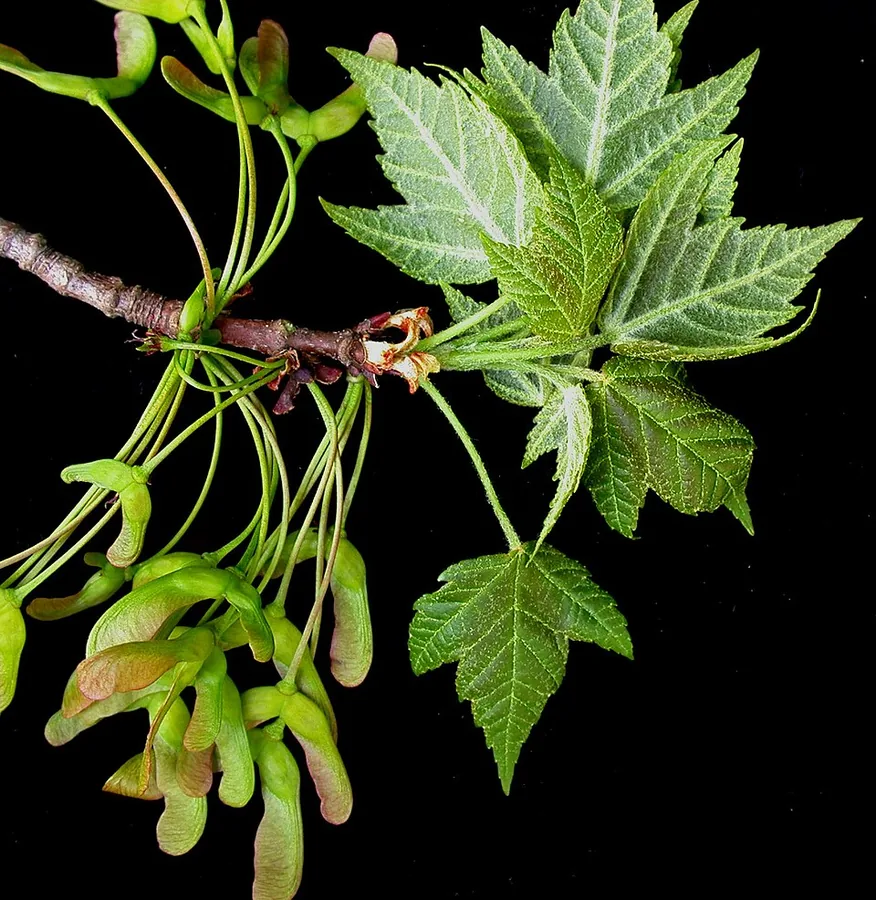
Acer rubrum ranks among the most abundant trees in eastern North America, a standing it owes to sheer adaptability. It establishes fast, takes to soils from clay to sand, and tolerates cold to -40°F (-40°C). The name tracks a run of red through the seasons: flowers open red in late winter, samaras ripen red in spring, the leafstalks hold red into summer, and the canopy closes in red and orange each fall.
Its affinity for wet ground explains much of its range. Red maple withstands saturated soil and periodic flooding that would drown most shade trees, which is why it occupies swamp margins and streambanks as readily as cultivated ground. That vigor carries a structural cost, because as a soft maple it lays down low-density wood, and rapid extension growth produces brittle limbs that fail under storm loading.
Because a mature specimen exceeds 40 feet (12 m) with a wide crown and a shallow, spreading root plate, siting is the decisive decision. Those surface roots heave pavement and foul mower blades over time. Placed well back from hardscape, an established tree makes minimal further demands.
Care
The short version: site it in full sun to part shade on moist, slightly acidic soil, and irrigate through establishment. It seldom warrants fertilizer, but early structural pruning is essential, since its brittle wood fails without a sound branch framework.
Light
Growth and coloration both respond to light. Red maple performs best in full sun yet tolerates partial shade, and greater sun exposure yields stronger fall color and a denser crown. Reserve the most open position available for it.
Water
The species is adapted to moisture at the roots, tolerating wet sites and occasional flooding that exclude most shade trees. Irrigate young and street trees through drought, when a limited root system cannot meet demand, though an established tree manages medium-to-wet soil on its own.
Soil
Average, well-drained soil suffices, and the tree adapts across clay, loam, and sand. Its true optimum is moist, slightly acidic soil at pH 4.5 to 6.5, because above roughly pH 6.5 manganese and iron become chemically unavailable and the foliage yellows from interveinal chlorosis.
Temperature
Cold hardiness is exceptional. The tree operates from -40°F to 100°F (-40°C to 38°C), spanning USDA zones 3 through 9, so low winter temperature seldom limits it within that range.
Humidity
Atmospheric humidity is immaterial here, since ordinary outdoor air is adequate and no target applies. What governs performance is soil moisture at the roots, not conditions in the air.
Feeding
In reasonable soil an established tree rarely requires fertilizer. Where feeding is warranted, a balanced or low-nitrogen, higher-potassium formulation applied in spring is appropriate. On alkaline sites the priority shifts from feeding to correcting manganese chlorosis through soil acidification or a micronutrient treatment.
Pruning
Time pruning for late summer or fall, since cuts made in spring bleed sap heavily, and remove dead, weak, and crossing limbs. Given the low-density wood, direct early work at eliminating narrow, weak branch angles, the unions most likely to fail under storm load.
Repotting
none
Size & spacing
This is a large shade tree, commonly 40 to 70 feet (12 to 21 m) tall with a crown of 30 to 50 feet (9 to 15 m). Allow generous spacing and keep it clear of sidewalks and driveways, because the shallow root system displaces pavement as it develops.
When to plant
As a long-lived tree, red maple has a brief and forgiving planting window. Transplant young stock in spring or fall under mild conditions, when root establishment outpaces top growth. Phenology then follows in order: red flowers in late winter, samaras in spring, and pigmented foliage in fall.
Northern hemisphere
Southern hemisphere
Typical months for a temperate climate: start earlier in warm zones, later where spring frosts linger.
- Plant: Spring or fall
- Harvest: Red flowers late winter to early spring (roughly January-April); red to yellow samaras mature in spring; brilliant red-orange-yellow foliage in fall.
Hardiness
USDA hardiness zones: 3–9
Temperature: down to -40°C
Troubleshooting
A vigorous red maple presents few problems, but three recur and reward early recognition. Each has a distinct cause: alkaline soil chemistry, a vascular soil fungus, or the mechanical weakness of the wood itself. Diagnose against the entries below and intervene before a minor disorder becomes a structural hazard.
Vascular wilt collapsing individual limbs
The cause is verticillium wilt, a soilborne fungus that colonizes the xylem and occludes water movement, killing branches piecemeal. Bark peeled from a symptomatic limb typically reveals green to black vascular streaking, accompanied by undersized leaves and heavy seed set. No cure exists, so excise and destroy affected wood, disinfect tools between cuts to check its spread, and maintain irrigation to reduce host stress.
Fix:
- Prune out and destroy (burn or landfill) dead branches; do not compost
- Disinfect tools with 10 percent bleach or 70 percent alcohol between cuts
- Water and fertilize with low-nitrogen, higher-potassium fertilizer to support recovery
Interveinal chlorosis on the newest foliage
The disorder is manganese chlorosis, an induced deficiency that appears once soil pH exceeds pH 6.5 to 7.0 and renders iron and manganese unavailable to the tree. Limestone, concrete, and over-liming near foundations and pavement drive the pH upward. Confirm with a soil test, acidify toward the slightly acidic range with elemental sulfur, and apply chelated manganese or iron where chlorosis is pronounced.
Fix:
- Test and lower soil pH toward slightly acidic with elemental sulfur
- Apply chelated manganese or iron as a soil or foliar treatment
- Mulch and improve drainage to reduce nutrient stress
Storm failure of weak-angled limbs
Failure traces to the mechanics of a soft maple: brittle, low-density wood combined with the narrow, weak crotches that rapid growth produces. Remove broken and hanging limbs promptly with clean cuts, and engage an arborist for large or overhead wood. The durable remedy is structural pruning in youth, developing a single dominant leader and wide, well-spaced branch attachments.
Fix:
- Remove broken and hanging limbs promptly with clean cuts
- Structurally prune young trees to favor strong, wide branch angles
- Consult an arborist for large or hazardous limbs
Toxicity
For cats and dogs the tree is unremarkable and safe. The clinically significant hazard is confined to horses: wilted or dried red maple leaves destroy equine red blood cells and can prove fatal within days. Exclude horses from fallen limbs, raked foliage, and prunings without exception.
Toxic to
Horses · Rabbits · Livestock · Birds
Safe for
People · Cats · Dogs
Horses Severe
This is the clinically dangerous case. Wilted or dried red maple leaves lyse equine red blood cells, and the earliest signs are weakness, inappetence, and a dull, depressed demeanor. Progression includes brown or blue mucous membranes, red-brown urine, colic, and laminitis; seek veterinary care immediately, as death may occur within 18 hours to 10 days and pregnant mares may abort.
Rabbits Caution
No safe-feeding data exist for rabbits, and the same hemolytic toxin could plausibly affect them, so exclude red maple leaves and prunings from the hutch.
Livestock Caution
Cattle, sheep, goats, and other grazers should be denied access to wilted maple foliage and fallen limbs, since the toxin that affects horses can extend to related species.
Birds Caution
Avian susceptibility is poorly documented, so treat the wilted leaves as a hazard and prevent poultry and pet birds from foraging on raked clippings.
Cats None
The ASPCA classifies red maple as non-toxic to cats, so incidental browsing warrants no concern.
Dogs None
Red maple presents no toxicity to dogs. Ingestion of a fallen leaf or samara is not expected to cause illness.
People None
Red maple presents no meaningful hazard to people. It is not a food plant, but handling the tree, foliage, and seed is harmless.
Horse owners must keep horses away from red maples and, critically, from fallen branches and raked or wilted leaves, which are the deadly form. Do not dump maple prunings or leaves where horses can reach them. The tree poses essentially no toxicity risk to cats or dogs.
Helpline numbers

United States
ASPCA Animal Poison Control: (888) 426-4435 (fee applies)

United Kingdom
Animal PoisonLine: 01202 509000 (fee applies)

Australia
Animal Poisons Helpline: 1300 869 738
Varieties
The red maples offered in the trade are almost all named cultivars, selected for consistent autumn coloration and predictable form. The following are the selections most often encountered.
October Glory
Selected for dependable red-to-orange autumn color that persists for weeks and develops late in the season.
Red Sunset (Franksred)
Among the most widely planted maple cultivars, valued for strong orange-red fall color on a vigorous, uniformly upright tree.
Brandywine
A seedless male clone that colors brilliant scarlet in autumn before deepening toward reddish purple.
Red Rocket
A narrowly columnar selection of roughly 40 feet (12 m) in height and about 15 feet (5 m) in width, suited to confined sites.
How to propagate
Seed propagation is straightforward but genetically variable, so fall color from seedlings is unpredictable. To reproduce a cultivar faithfully, growers rely on cuttings or grafting onto seedling rootstock.
SeedEasy
Sow fresh samaras in late spring to early summer as they ripen; some seed lots benefit from cold stratification. · 1 to 2 growing seasons
Seed is the simplest route to new plants. Sow the winged samaras fresh in late spring to early summer as they abscise, cold-stratify recalcitrant lots to break dormancy, and allow one to two growing seasons for establishment. Because seedlings segregate, particularly for fall color, a named cultivar will not reproduce true from seed.
Stem cuttingsModerate
Take softwood cuttings in early summer. · Several weeks to root, then a season or more to establish.
Softwood cuttings are feasible but inconsistent in their rooting. Collect them in early summer, expect several weeks for root initiation, and anticipate a season or more before the young plant is established.
GraftingDemanding
Bench graft or bud in the dormant or growing season onto seedling rootstock. · 1 or more seasons
Grafting is the nursery standard for reproducing a cultivar, which never comes true from seed. Bench graft or bud onto seedling rootstock during the dormant or growing season, then allow a season or more for the union to knit and grow on. The technique is exacting and best reserved for experienced propagators.
Myths
Red maple is hazardous to plant near cats and dogs.
The ASPCA classifies the species as non-toxic to both. The serious and occasionally fatal toxicity is specific to horses consuming wilted or dried leaves, so a household limited to cats and dogs carries no meaningful risk from this tree.
Only the seeds or bark of red maple are toxic to horses.
The toxic principle accumulates in the leaves rather than the seeds or bark. Wilted or dried fallen leaves represent the most dangerous form, whereas intact green foliage on the tree is considerably less hazardous.