Tree · Sapindaceae
Golden Rain Tree
Koelreuteria paniculata
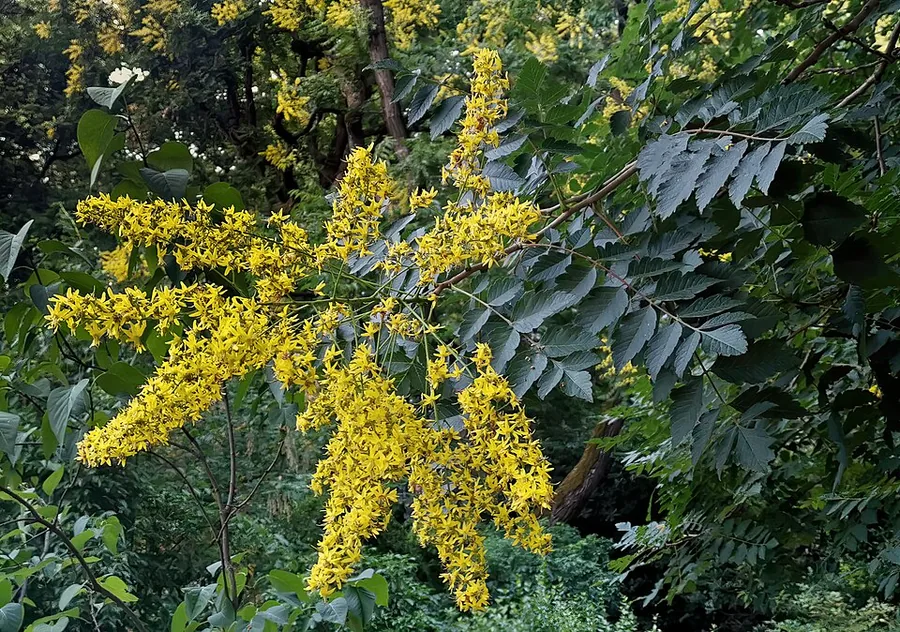
A resilient shade tree, peaking in midsummer, hung with papery lantern pods and loose yellow panicles.
Full sun
Every 7–14 days
USDA 5–9
30–40 ft · 9.1–12.2 m
Overview
Golden rain tree announces summer with terminal panicles of small yellow flowers that fill the whole crown at peak season. As those spent flowers set fruit, they form papery three-sided capsules resembling small Chinese lanterns, which persist on the tree into fall. Botanically it is a deciduous member of the soapberry family, carrying pinnately divided leaves on a rounded, spreading framework.
Its appeal to growers rests on genuine toughness. The root system endures drought once established, the tree accommodates clay, sand, and thin rocky ground with equal ease, and its cold tolerance reaches -20°F (-29°C). Supplied with full sun and adequate drainage, it demands very little intervention.
One trait warrants attention before siting. The tree produces seed in great volume and self-sows with vigor, to the degree that it has become weedy and invasive across parts of the eastern and southeastern US. Where escape is a concern, remove the capsules before dispersal or choose ground where volunteer seedlings are simple to rogue out.
Care
The short version: full sun, well-drained soil of nearly any texture, and deep irrigation during extended drought while the tree is young. Past the first year or two it is largely self-sufficient, and a light dormant-season prune maintains a sound structural frame.
Light
Site it in full sun to maximize floral display, though it performs acceptably in partial sun. Flowering intensity in summer scales directly with the quantity of direct light the canopy receives.
Water
Irrigate a young tree regularly through the first year or two while the root system extends and deepens. Once established the tree is drought tolerant and needs water only during prolonged dry spells, so allow the top half of the profile to dry between applications.
Soil
Few landscape trees are so indifferent to soil type. It roots successfully in clay, loam, sand, and shallow rocky ground, requires only adequate drainage, and tolerates a broad pH range from 6.0 to 8.0.
Temperature
Cold hardiness is a defining strength, with a working range of -20°F to 100°F (-29°C to 38°C). That envelope spans a great many climates, which partly accounts for how widely the species has naturalized.
Humidity
Ambient outdoor humidity is entirely adequate, so no target figure applies. Soil drainage is the governing factor, far outweighing atmospheric moisture in this tree's performance.
Feeding
Supplemental feeding is rarely warranted. Where growth is clearly deficient, a single spring application of balanced slow-release tree fertilizer suffices, since this species is not a demanding feeder.
Pruning
Prune in late winter during dormancy to develop a single strong central leader and to remove crossing, weak, or dead wood. Because the timber is somewhat brittle, sound early structural training reduces later limb failure.
Repotting
In the landscape the question is moot, as the tree remains in open ground. Container specimens need potting up only when roots circle the rootball, water drains through unimpeded, or top growth stalls.
Size & spacing
Allocate ample space at planting. A mature specimen attains roughly 30 to 40 feet (9 to 12 m) in height with a comparable spread, so position it well clear of structures and overhead utilities.
When to plant
Treat this as a long-term specimen rather than a crop tied to a narrow sowing date. Establish it in spring after the last frost or in fall, anticipate the yellow panicles in early to midsummer, and follow them with the lantern capsules that extend interest toward autumn.
Northern hemisphere
Southern hemisphere
Typical months for a temperate climate: start earlier in warm zones, later where spring frosts linger.
- Sow: Late winter, after seed scarification and cold-moist stratification
- Plant: Spring after last frost, or fall
- Harvest: Summer (June to July; cultivar 'September' blooms August to September)
Hardiness
USDA hardiness zones: 5–9
Temperature: down to -29°C
Troubleshooting
A vigorous golden rain tree presents few problems. The issues that do arise fall into two classes: a vascular or canker disease within the wood, or a harmless aggregation of insects on the ripening seed capsules. Compare your observations with the entries below and intervene while the tree retains its vigor.
Wilt on one flank with dark vascular streaking
One-sided wilt with dark streaking in the sapwood is the signature of verticillium wilt, a soilborne fungus that colonizes the vascular tissue and blocks water movement to the affected limbs, which is why the crown fails in patches and why there is no cure. Canker and coral spot fungi exploit wood already stressed or wounded, and root rot follows when waterlogged soil starves the roots of oxygen. Prune well below the visible damage, disinfect tools between cuts to avoid spreading spores, and correct the drainage so the tree holds its vigor.
Fix:
- Prune out and destroy affected branches well below symptoms, disinfecting tools between cuts
- Improve drainage and avoid drought and mechanical wounding to reduce stress
- Remove severely declining trees, as there is no cure for verticillium wilt
Aggregations of red-and-black bugs across the ripening capsules
The red-and-black insects massing on the papery capsules are the goldenrain tree bug, a boxelder relative that feeds on the seeds, which is exactly why the swarms track the ripening pods in late summer and fall. Because the feeding targets seed rather than living tissue, the tree suffers no real harm, so tolerance is reasonable, or a strong jet of water or insecticidal soap will scatter them. Removing the fallen capsules withdraws the seed food that sustains the population, and horticultural oil clears any scale that builds along the twigs.
Fix:
- Tolerate the bugs where possible, as they are a nuisance rather than a serious threat to tree health
- Knock bugs off or spray congregations with a strong stream of water or insecticidal soap
- Treat heavy scale infestations with horticultural oil
Toxicity
For households with pets or children, the record is reassuring: this species is not poisonous. The common name overstates the risk, as golden rain tree contains no recognized toxin and is absent from ASPCA toxic-plant lists. The critical point is not to conflate it with the genuinely poisonous golden chain tree, Laburnum, a distinct and unrelated species.
Safe for
People · Cats · Dogs · Horses · Rabbits · Livestock · Birds
Cats Safe
The tree carries no compound documented to poison cats, so contact or a nibble does no harm. A cat that gorges on foliage may regurgitate a hairball or plant matter, which reflects the mechanical irritation of bulk rather than any toxin.
Dogs Safe
No toxic principle in this species threatens dogs. A dog that chews a fallen capsule may pass loose stools because the indigestible roughage speeds transit, an effect that resolves on its own with access to water.
Horses Safe
Horses may graze nearby without risk, since the species holds no equine toxin. The alarm properly belongs to the unrelated golden chain tree, Laburnum, whose alkaloids do not occur here.
Rabbits Safe
The foliage presents no poisoning hazard to rabbits. Because the hindgut ferments novel forage slowly, introduce any new green in small quantities to let the gut flora adjust.
Livestock Safe
Cattle, goats, and sheep can pasture alongside this tree without toxic risk, as it is not poisonous to ruminants. Excess browsing of any one plant can disrupt the rumen, but that reflects overconsumption rather than poisoning.
Birds Safe
Neither the foliage nor the seed poses a toxic threat to birds, and many pass over the dry papery capsules as poor forage. Backyard poultry can forage the ground beneath the canopy without incident.
People Safe
The species is not poisonous to people, and the common name generates far more concern than the botany warrants. The seeds are ornamental structures rather than a food crop, so there is no reason to consume them.
No special handling required; as with any plant, discourage pets and children from chewing on foliage or seed pods to avoid mild stomach upset.
Varieties
The trade offers only a handful of selections, and one closely related species is frequently sold beside the type. The distinctions below are the ones worth knowing.
'September'
This cultivar delays anthesis into August and September, extending the yellow display beyond the species' usual summer window, though the trade regards it as marginally less winter hardy.
Koelreuteria bipinnata (Chinese flame tree)
A close congener distinguished by twice-divided (bipinnate) foliage and showy rosy-pink lantern capsules, it is less cold hardy and better suited to warmer zones than the golden rain tree.
How to propagate
Most growers first encounter this tree as a self-sown volunteer, since it reproduces prolifically without assistance. For deliberate increase, two routes apply: seed and root cuttings.
SeedModerate
Sow in fall outdoors, or stratify and sow in late winter to early spring · Seedlings appear in weeks; several years to a sizable tree
The species is a heavy seed producer and self-sows so readily that deliberate propagation is seldom necessary. To raise it on purpose, scarify the hard seed coat to admit water and follow with cold, moist stratification to satisfy dormancy, sowing outdoors in fall or in late winter to early spring. Germination follows within weeks, but expect several years before the seedling reaches any appreciable size.
Stem cuttingsModerate
Dormant season for root cuttings · One to two growing seasons
Root cuttings taken during dormancy are the standard vegetative method, and named cultivars are propagated this way rather than from seed to preserve their genetics true to type. Allow a rooted cutting one to two growing seasons to establish a working root system before appreciable top growth resumes.
Myths
Golden rain tree amounts to the toxic golden chain tree and endangers household pets.
The confusion is purely nominal. Golden rain tree is a member of the soapberry family and does not appear on ASPCA toxic-plant lists, whereas the genuinely poisonous golden chain tree is Laburnum, an unrelated legume that carries quinolizidine alkaloids. Verify the botanical name, Koelreuteria paniculata, and this species can be planted without concern.