Tree · Sapindaceae
Dwarf Japanese Maple
Acer palmatum
Provide dappled shade, consistent moisture, and wind shelter, and a dwarf Japanese maple holds its form and color for decades.
Partial shade
Every 3–7 days
USDA 5–8
2–6 ft · 0.6–1.8 m
Overview
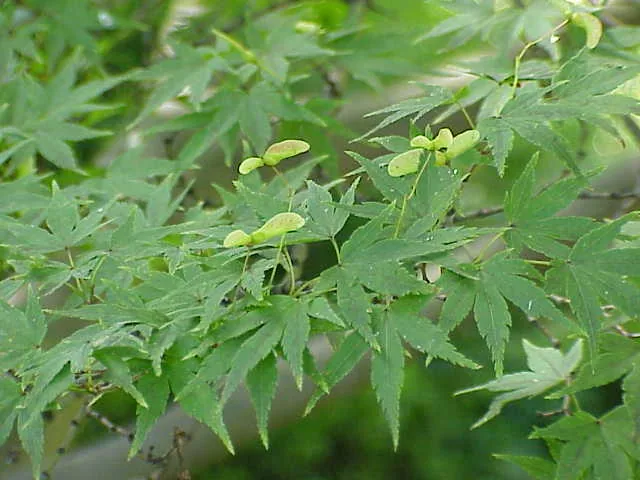
A dwarf Japanese maple compresses the architecture of a full Acer palmatum into a footprint that suits a small bed, a courtyard, or a sizable container. Growth is slow by nature, so the plant keeps its compact stature for many years while the species form would overtake it. The ornamental value lies entirely in the foliage, which transitions across the season and culminates in intense autumn color.
Every named cultivar is a clone, a fixed phenotype rather than a variable seedling, which is precisely why propagation relies on grafting rather than seed. That genetic fidelity is what makes a 'Shaina' or a 'Kiyohime' consistent from one garden to the next. The cost of that consistency is time, because slow growth is intrinsic to these plants and establishment is unhurried.
Rated for USDA zones 5 to 8, the dwarf forms perform in temperate gardens that supply light shade and shelter. A well-chosen site demands little ongoing intervention. An exposed site in full sun with drying wind, by contrast, registers as marginal leaf damage within weeks, because the canopy cannot transpire faster than the roots resupply water.
Care
The short version: site it in dappled or part shade, adding afternoon shade where summers run hot, hold the slightly acidic soil evenly moist beneath mulch, shelter it from drying wind, and confine pruning to a light pass in late fall to mid winter.
Light
Dappled light or part shade is optimal for a dwarf Japanese maple, with afternoon shade essential wherever summers run hot, since midday radiation drives the transpiration that scorches foliage. Cooler northern gardens permit more sun, which often improves color, provided soil moisture never lapses.
Water
Maintain the soil evenly moist but not waterlogged, because the species lacks drought tolerance and depends on steady root-zone water. Irrigate through dry spells and mulch to conserve moisture and moderate root temperature. Fluctuating moisture, compounded by sun or wind, exceeds the canopy's capacity to transpire and burns the leaf margins.
Soil
Use moist, organically rich, well-drained loam with high organic matter, and note that sandy loams also suit it well given their drainage. Target a slightly acidic pH of 5.5 to 6.5, the range in which nutrient availability best matches this maple's needs.
Temperature
Cold hardiness runs from about -20°F to 95°F (-29°C to 35°C), corresponding to USDA zones 5 through 8. Heat is the more limiting stress, so the hottest, most exposed positions are the ones to exclude, because high temperature accelerates moisture loss beyond root resupply.
Humidity
Ambient outdoor humidity is adequate and no target percentage applies. The more consequential variable is wind exposure, since moving air increases transpirational demand and draws moisture from the leaves faster than the roots can replace it.
Feeding
Apply a light feeding in spring before the leaves emerge, using a balanced slow-release tree and shrub fertilizer once per season. These are slow growers with modest nutrient demand, so restraint matters, and excess does more harm than benefit.
Pruning
Keep pruning minimal and schedule it for late fall to mid winter. Cuts made in spring or summer provoke heavy sap bleeding, which is why dormant-season work is preferred. Limit the work to removing dead, crossing, or crowded branches that compromise the compact form.
Repotting
Repot container or bonsai specimens every 2 to 3 years. The diagnostic cues are roots circling the pot or emerging from drainage holes, water passing straight through with little absorption, and slowed growth with undersized leaves.
Size & spacing
Mature dimensions stay small, 2 to 6 feet (60 to 180 cm) in height and 2 to 5 feet (60 to 150 cm) in spread. Allow open space around the plant so air circulates through the canopy and the branch structure can express itself.
When to plant
Plant a dwarf Japanese maple in spring or fall, once the soil is workable and the risk of hard frost has passed, which lets roots establish before extremes arrive. There is no crop to harvest. The seasonal payoff is foliar: the canopy flushes in spring, deepens through summer, and intensifies in color before leaf drop.
Northern hemisphere
Southern hemisphere
Typical months for a temperate climate: start earlier in warm zones, later where spring frosts linger.
- Plant: spring or fall when soil is workable and frost risk has passed
- Harvest: Small reddish-purple flowers in spring (April); grown for foliage, not bloom
Hardiness
USDA hardiness zones: 5–8
Temperature: down to -29°C
Troubleshooting
Stress in a dwarf Japanese maple registers first in the foliage, because leaves are where water deficit, vascular disease, and insect feeding all leave the earliest visible evidence. Reading those signs early allows intervention before damage progresses. Match the symptom below, then address the underlying cause rather than the surface appearance.
Patchy branch wilt progressing to dieback
Wilt and dieback confined to a few branches rather than the whole canopy implicate verticillium wilt, a soil-borne fungus that occludes the vascular system and interrupts water transport. No cure exists once infection is established. Excise and destroy affected wood, sustain vigor with consistent water and mulch, and exclude chips from an infected tree to avoid spreading the pathogen.
Fix:
- Prune out and destroy affected branches and improve plant vigor with proper watering and mulching
- Do not use chips from a Verticillium-infected tree as mulch or potting medium
- Where the disease is established, replant only resistant species; there is no cure for an infected tree
Marginal browning and crisping on sun-exposed foliage
Dry, browned margins are the signature of leaf scorch, the result of excess sun, drying wind, or soil moisture that oscillates between saturated and dry. The pattern concentrates on exposed margins while the root system remains sound, which distinguishes it from disease. Relocate the plant to dappled shade, provide wind shelter, and stabilize soil moisture beneath mulch.
Fix:
- Provide afternoon shade and shelter from drying winds
- Keep soil evenly moist and apply mulch to retain moisture and cool roots
- Water deeply during dry spells
Honeydew deposits, distorted new foliage, and insect activity
Honeydew and distorted young leaves indicate aphids colonizing soft new shoots, or scale, including Japanese maple scale, fixed to the bark. A forceful water jet dislodges aphids, and persistent infestations respond to horticultural oil or insecticidal soap. Resident predators such as lady beetles regulate light populations without further intervention.
Fix:
- Dislodge aphids with a strong spray of water
- Treat heavy infestations with horticultural oil or insecticidal soap, following label directions
- Encourage natural predators such as lady beetles
Toxicity
For households with animals the verdict is favorable: the dwarf Japanese maple is not toxic. The ASPCA does not list Acer palmatum among poisonous plants, and it is regarded as safe for cats, dogs, and other domestic species. Ingested foliage may cause transient gastric upset from indigestible plant matter, a mechanical effect rather than a toxicological one.
Safe for
People · Cats · Dogs · Horses · Rabbits · Livestock · Birds
Cats None
Safe around cats. A cat that ingests a leaf may show brief gastric upset, as with any houseplant, but the maple contains no compound poisonous to it.
Dogs None
Safe for dogs, which may share a garden with the tree without risk. A leaf-chewing dog faces only transient digestive discomfort from the plant matter, not a toxic response.
Horses None
Safe for horses, since Acer palmatum is not implicated in equine toxicity. The species responsible for those cases is the unrelated red maple, so a Japanese maple in or near a paddock presents no hazard.
Rabbits None
Safe for rabbits, which can graze nearby because the foliage carries no toxin that affects them.
Livestock None
Safe for cattle, goats, and sheep, whose grazing is unaffected, as the foliage contains nothing toxic to them.
Birds None
Safe for backyard and pet birds, to which the tree offers perching and shelter rather than any hazard.
People None
Safe to handle, and harmless to small children who brush against it. The plant is cultivated for foliage rather than consumption, so it presents no edible part requiring caution.
Generally safe to handle and to keep around cats and dogs; as with any plant, discourage pets from chewing foliage to avoid mild stomach upset.
Varieties
Dozens of named dwarf Japanese maples exist, each a distinct clone defined by its mature size, leaf morphology, and seasonal color. The selections below are among the most established and worth recognizing by name.
Sharp's Pygmy
Ranks among the shortest Japanese maples in commerce, a slow dwarf maturing around 2 to 4 feet with small green leaves that flush orange-red in autumn.
Shaina
A compact 4 to 5 foot witches'-broom sport of 'Bloodgood', distinguished by dark maroon summer foliage that clusters into tufted masses and turns red in fall.
Mikawa yatsubusa
A notably dense dwarf reaching roughly 4 to 6 feet tall and 4 feet wide, valued for its shingled, layered foliage and pronounced autumn color.
Kiyohime
A low, wide-spreading dwarf selected for its mounding, spreading habit rather than for vertical growth.
How to propagate
Two propagation routes apply, and they yield fundamentally different outcomes. Grafting reproduces a named dwarf with genetic precision, whereas seed reverts to the variable wild species and a population of nonidentical seedlings.
GraftingDemanding
Late winter to early spring (bench grafting) onto dormant rootstock · Several months to one growing season for the graft union to establish
Named dwarf cultivars do not reproduce true from seed, so propagation proceeds by bench-grafting scion wood onto Acer palmatum seedling rootstock in late winter to early spring while the stock is dormant. The technique is demanding, and the graft union requires anywhere from a few months to a full growing season to establish.
SeedModerate
Sow in fall or stratify and sow in spring · One to two growing seasons for seedlings
Seed reproduces the species, but the resulting seedlings vary and none replicate the parent dwarf cultivar. Sow in fall, or stratify the seed and sow in spring, then allow the young plants one to two growing seasons to establish.
Myths
Acer palmatum requires dense, full shade at all times.
Their preference is dappled or part shade, with afternoon shade where summers run hot, not deep continuous shade. In cooler northern zones they accept more sun and frequently develop better color under it, provided soil moisture remains even. The operative constraints are moisture and heat, not sunlight per se.
Acer palmatum foliage is toxic to household pets.
Acer palmatum is absent from the ASPCA toxic list and is classified as non-toxic to cats and dogs. A pet that ingests foliage may experience mild gastric upset from the plant matter itself, as with most vegetation, but no toxic principle is involved.