Tree · Sapindaceae
Silver Maple
Acer saccharinum
Fast-growing and flood-adapted, the silver maple builds shade quickly but pays for that speed in weak, brittle wood.
Full sun
Every 7–14 days
USDA 3–9
50–80 ft · 15.2–24.4 m
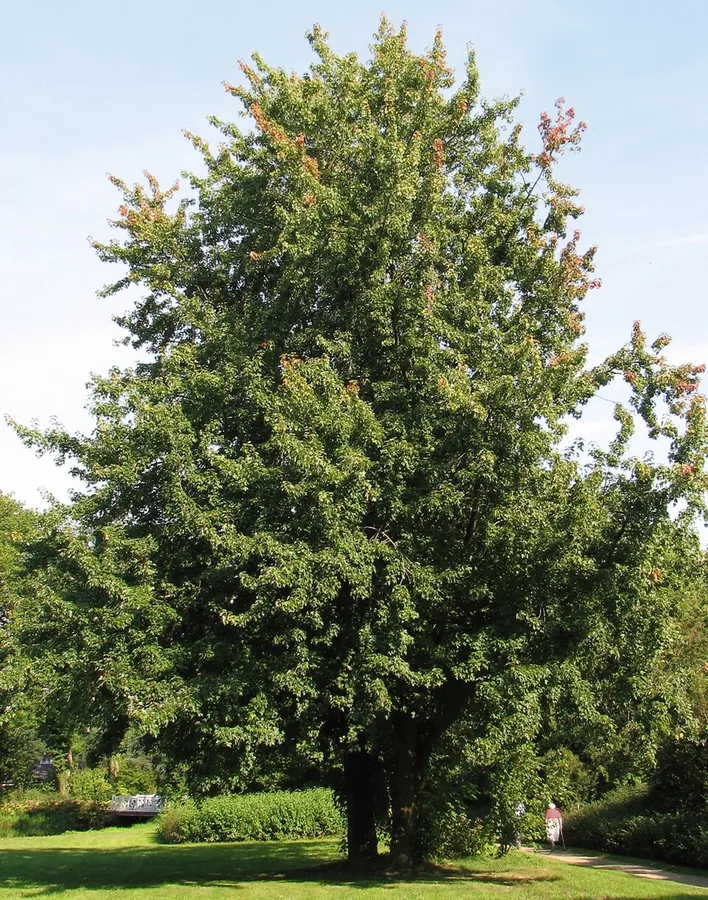
Overview
Silver maple (Acer saccharinum) takes its name from the pale, silvery undersides of its deeply lobed leaves, which flash as the wind lifts them. It is a large tree of riverbanks and floodplains, a native of moist ground that also goes by river, swamp, and water maple. Its rapid growth outpaces most other shade trees, and that pace explains much of what follows.
Speed has a cost written into the wood. Rapid growth lays down weak, brittle fibers, so limbs fail under ice and wind, especially at narrow crotches where included bark prevents a firm union. The same vigor drives shallow surface roots that lift sidewalks, block drains, and enter sewer lines. Distance from the house, drive, and utilities is the simplest defense.
Its strength is tolerance of sites that defeat choosier trees. Adapted to floodplains, it withstands wet soil, hard winters, and some drought once established, forms deep shade fast, and flowers in late winter ahead of leaf-out. Matched to an open, damp location and pruned early, it is among the easiest trees to grow.
Care
The short version: full sun and moist to wet, slightly acidic soil match its floodplain origins, feeding is rarely warranted, and the decisive task is structural pruning while the tree is young, because that is when branch architecture, and later storm resistance, is set.
Light
Full sun produces the strongest, densest tree, since a maple's canopy fills in proportion to the light it intercepts, though it accepts partial shade with only modest thinning of form. Site it in the open for the best structure. The more direct light, the fuller the crown.
Water
Its floodplain origin explains a wide moisture tolerance: it thrives in moist to wet ground and endures poorly drained soils that would suffocate other roots. Water young trees regularly until the root system establishes, after which the tree draws on that reach to tolerate some drought.
Soil
Silver maple is very adaptable, growing from average to wet and from well-drained to poorly drained ground. It performs best in slightly acidic soil, a pH of 5.5 to 7.0, because alkaline conditions lock up manganese and iron and trigger the interveinal chlorosis that pales its foliage.
Temperature
Its cold hardiness is considerable, enduring winter lows near -29°F (-34°C) and summer highs to 100°F (38°C). That breadth of tolerance is the reason the species is plantable across much of the continent.
Humidity
Ambient outdoor air meets its needs, so no humidity target applies. What governs this tree is soil moisture at the root, not the moisture of the air around the canopy.
Feeding
Feeding is rarely necessary, and a soil test should precede any application. Use a balanced slow-release tree fertilizer in early spring only where a test confirms a deficiency, and on alkaline ground correct chlorosis with iron or manganese, which addresses the cause rather than adding needless nitrogen.
Pruning
Pruning is the intervention that most affects long-term health. Work in summer or dormancy to remove dead, weak, crossing, or co-dominant stems and any included bark, and prune young trees to a single leader with wide angles, since branch architecture set early determines how the brittle wood withstands later storm loads.
Repotting
As a landscape tree it rarely requires repotting. A young specimen held in a nursery container should be planted out before roots begin circling or emerge from the drainage holes, since circling roots persist and can girdle the trunk over time.
Size & spacing
Allow generous space. A mature silver maple reaches 50 to 80 feet (15 to 24 m) in height and 35 to 70 feet (11 to 21 m) in spread, so it must sit well clear of buildings, walks, and pipes within reach of its roots.
When to plant
Hardy across zones 3 to 9, silver maple transplants in spring or fall while dormant or barely active, when root disturbance carries the least risk. Its flowers open early, from February to April, before the leaves, a habit of many maples. Establishing a young tree early lets the root system anchor before its first testing season.
Northern hemisphere
Southern hemisphere
Typical months for a temperate climate: start earlier in warm zones, later where spring frosts linger.
- Plant: Spring or fall
- Harvest: February to April (flowers before leaves)
Hardiness
USDA hardiness zones: 3–9
Temperature: down to -40°C
Troubleshooting
Most disorders of silver maple follow from two causes: the mechanical weakness of fast-grown wood, and soil chemistry that does not suit it. Reading the limbs and leaves early lets you intervene before structural failure or nutrient stress advances. Match the sign below to its cause, then act on the mechanism rather than the symptom.
Limb failure under wind, ice, and snow
The mechanism is the wood itself: fast growth produces weak, brittle fibers, and narrow crotches pinch bark inside the union, so tight V-shaped forks split under ice, snow, or wind loading. Prune young trees to a single leader with wide branch angles to build a sounder structure. Remove cracked or hanging limbs promptly, and refer large overhead limbs to a certified arborist.
Fix:
- Remove broken and hanging limbs promptly
- Make clean cuts back to the branch collar
- Have large or hazardous limbs assessed by a certified arborist
Vascular wilt and branch dieback
Sudden one-sided wilting with greenish to olive streaking in the sapwood indicates verticillium wilt, a soilborne fungus that occludes the vascular system from within. In cool, wet springs anthracnose additionally blotches the leaves along their veins. No fungicide cures the wilt, so prune dead wood well below the streaking, sustain vigor with water and mulch, and avoid replanting susceptible species where the pathogen is known.
Fix:
- Prune out dead wood well below symptoms
- Water during drought and maintain tree vigor
- Do not replant susceptible species in known Verticillium sites
Interveinal chlorosis on new foliage
Yellowing between green veins on new leaves is chlorosis, driven by alkaline soil that renders manganese and iron unavailable to the roots. Confirm it with a soil pH test. Lower the pH where practical, supply chelated iron or manganese to bypass the lock-up, and keep lime away from the root zone so the condition does not recur.
Fix:
- Test and lower soil pH where feasible
- Apply chelated manganese or iron amendments
- Mulch and avoid lime near the root zone
Cottony scale with honeydew and sooty mold
The cottony masses on the undersides of branches are the egg sacs of cottony maple scale, an insect whose feeding produces honeydew that supports the black sooty mold beneath. On a vigorous tree the effect is largely cosmetic. Monitor through late spring and early summer, treat the emerging crawlers with horticultural oil, and conserve the natural predators and parasitoids that regulate the population.
Fix:
- Apply horticultural oil during dormancy
- Spot-treat crawlers with horticultural oil
- Conserve natural predators and parasitoids
Toxicity
For most households the record is reassuring: silver maple, in common with the genus, is non-toxic to cats and dogs and harmless to people, whose spring tapping of its sap yields a light syrup. Horses are the exception. Wilted or dried maple leaves damage a horse's red blood cells, so fallen and storm-broken foliage must be kept clear of any paddock.
Toxic to
Horses
Safe for
People · Cats · Dogs · Rabbits · Livestock · Birds
Horses Caution
Green leaves on the tree are not the concern; the hazard lies in wilted or dried leaves, whose compounds damage red blood cells. A horse that consumes them may become dull and weak, refuse feed, and pass dark red to brown urine as hemolysis proceeds. Remove storm-downed branches and fallen leaves before they reach a paddock, and consult a veterinarian immediately after any exposure.
Cats Safe
The ASPCA non-toxic listing covers the genus, so ingestion of a leaf by a cat carries no toxic effect.
Dogs Safe
A dog may chew the foliage or carry a fallen twig with no risk of poisoning, since the same non-toxic listing applies.
Rabbits Safe
No toxic principle affects rabbits, so browsing carries no poisoning risk.
Livestock Safe
Cattle, goats, and sheep can graze near a silver maple without harm, though the wilted-leaf risk documented in horses warrants the same caution for grazing animals.
Birds Safe
Birds nest in the canopy and consume the seeds with no adverse effect.
People Safe
The tree is not poisonous to people, and its spring sap has long been tapped for a light syrup.
Keep wilted, fallen, or storm-downed silver maple leaves and branches away from horses; wilted leaves can cause red blood cell damage (hemolytic anemia) in horses.
Helpline numbers

United States
ASPCA Animal Poison Control: (888) 426-4435 (fee applies)

United Kingdom
Animal PoisonLine: 01202 509000 (fee applies)

Australia
Animal Poisons Helpline: 1300 869 738
Varieties
The species is usually raised from seed, but two named selections correct its weaker traits and are the ones most often offered.
Silver Queen
It holds a tidier oval crown, produces little or no seed to clean up, and turns yellow in autumn.
Skinneri (Skinner's Cutleaf)
It is recognized by deeply cut, lacy foliage and the soft, weeping habit of its branches.
How to propagate
Propagation is straightforward, largely because the seed germinates so readily. The tree is raised from its fresh winged seed, or, with lower success, from summer cuttings.
SeedEasy
Sow fresh seed in late spring to early summer as soon as samaras ripen · 2 to 4 weeks to germinate; fresh seed germinates readily without stratification
Seed is the reliable route, since the winged samaras germinate with little dormancy. They ripen in late spring to early summer and should be sown fresh at once, because delay and drying reduce viability. Sown immediately, they emerge in 2 to 4 weeks without any cold stratification.
Stem cuttingsModerate
Early summer from softwood · Several weeks to root under mist
Softwood cuttings taken in early summer offer an alternative, rooting under mist over several weeks where humidity keeps the tissue from drying before roots form. Success is lower and less predictable than seed, so most propagation relies on the samaras.
Myths
The whole maple genus is toxic to dogs and cats.
The ASPCA classifies silver maple, and maples generally, as non-toxic to dogs and cats, so a leaf sampled by a curious pet presents no poisoning risk. The documented hazard is confined to horses and to wilted or dried leaves, not the green foliage on the tree, because drying concentrates the compounds that damage equine red blood cells. Keeping fallen and storm-broken foliage out of a paddock removes the risk.