Ornamental · Plumbaginaceae
Statice
Limonium sinuatum
In full sun with sharp drainage, statice sets papery blooms that retain their pigment for months after drying.
Full sun
Every 7–10 days
61–81°F · 16–27°C
90–120 days
Overview
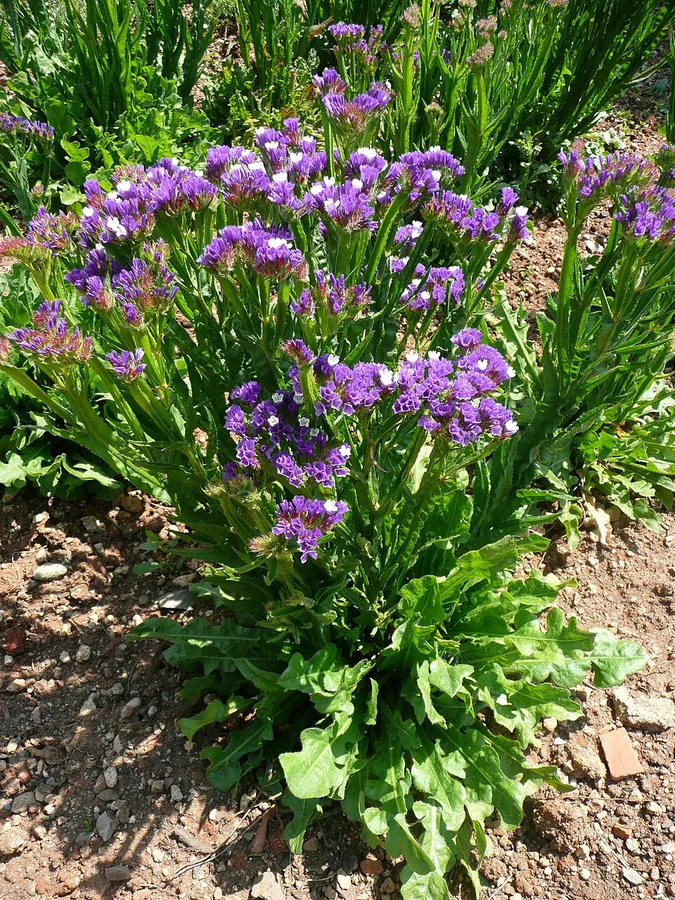
Statice, Limonium sinuatum, produces its papery flowers on stiff, winged stems across the summer. It belongs to the leadwort family, Plumbaginaceae, and evolved on the dry, sunny coasts of the Mediterranean, an origin that explains both the common name sea lavender and its low tolerance for wet ground. Growers treat it as a warm-season annual, since the tender perennial persists only in the mild climates of zones 8 to 10.
The ornamental value rests in the color, and there is a broad palette of it. Expect deep blue, purple, rose, apricot, and yellow, carried in tight clusters that already feel dry to the touch on the living plant. That inherent dryness is the reason statice stands as a premier subject for drying, since cut stems retain their pigment for months.
Cultural demands are minimal once the plant establishes. Statice tolerates drought and performs in lean, sandy substrates that would leave a more demanding species deficient. Its one intolerance is saturated soil at the root zone, so effective culture reduces to sun and drainage.
Care
The short version: site statice in full sun, in a light, sharply drained medium, and water conservatively. Allow the soil to dry between irrigations, fertilize minimally, and space plants for air movement.
Light
Statice requires full sun and shows no meaningful shade tolerance. Place it in the most open, unshaded position available, because weak light yields floppy stems and washed-out flower color.
Water
Allow the medium to dry between waterings, on the order of every 7 to 10 days, and err toward the dry end. Established plants are drought tolerant, whereas continuously saturated roots induce the crown and root rot that is the primary cause of collapse.
Soil
Grow statice in light, well-drained sandy loam, loam, or sand, where drainage outranks fertility. The species accepts a wide reaction, from 6.0 to 8.0, so most garden soils are suitable provided water moves freely through the profile rather than accumulating around the crown.
Temperature
Optimal growth occurs in moderate warmth, between 61°F and 81°F (16°C to 27°C). As a tender perennial, the plant is killed back by frost, which is why cultivation as an annual is standard outside its hardiness range.
Humidity
No specific humidity level is required, since ordinary outdoor air is adequate. Air movement matters more than any humidity figure, because stagnant, humid conditions stress the plant and favor the rots it is prone to.
Feeding
Fertilize sparingly, if at all. Statice is adapted to lean soils and needs no more than a light application of balanced fertilizer during the growing season, since excess nutrition simply drives soft, weak growth that adds no ornamental value.
Pruning
Deadheading is unnecessary, because each plant yields one long bloom rather than a recurring flush, so removing spent heads returns nothing. Cut stems once the flowers reach full color, for fresh use or for drying.
Size & spacing
Mature plants stand 12 to 18 inches (30 to 46 cm) tall with a spread of 9 to 12 inches (23 to 30 cm). Space them at roughly that interval so air circulates between crowns and the base stays dry, which limits rot pressure.
When to plant
Statice follows a frost-bracketed calendar. Sow indoors in late winter, transplant after the spring frosts have passed and the soil has warmed, and harvest stems from early summer into fall wherever temperatures remain moderate.
Northern hemisphere
Southern hemisphere
Typical months for a temperate climate: start earlier in warm zones, later where spring frosts linger.
- Sow: 6 to 8 weeks before the last spring frost date, or direct sow at the last spring frost date
- Plant: After the last spring frost when soil has warmed
- Harvest: Summer (June to July), continuing into fall in cooler climates
Hardiness
USDA hardiness zones: 8–10
Temperature: down to -12°C
Troubleshooting
Most statice disorders originate in excess moisture or humid air rather than under-care. Inspect the crown and the newest growth first, since symptoms register there earliest. Identify the condition below and intervene early, before a setback becomes plant loss.
Wilting foliage above a blackened crown at the soil line
The presentation is classic crown and root rot, a condition driven by overwatering or impeded drainage. On lifting an affected plant you find soft, darkened tissue at the crown and disintegrating roots. Remove and discard the worst-affected specimens, then correct the drainage and reduce irrigation frequency to halt further spread.
Fix:
- Remove and discard severely affected plants
- Improve drainage and reduce watering frequency
Stunted plants with sparse bloom through hot, humid weather
This is heat-and-humidity stress on a Mediterranean tender perennial that is poorly suited to muggy conditions. Under a hot, humid summer the plant slows and flowers thinly. Provide full sun, sharp drainage, and free air movement, and in climates with hot, humid summers cultivate it as a cool-season annual to sidestep the stress entirely.
Fix:
- Site in full sun with excellent drainage and air movement
- Grow as a cool-season annual where summers are hot and humid
Distorted shoot tips coated in sticky residue
The cause is aphid infestation on the tender tips and flower stalks, recognizable as colonies of small soft-bodied insects and the sticky honeydew they leave. Dislodge them with a forceful water spray, and apply insecticidal soap only where populations persist. Moderating nitrogen also helps, since the soft growth it stimulates is what attracts them.
Fix:
- Dislodge aphids with a strong spray of water
- Use insecticidal soap if populations are heavy
Toxicity
For pet-owning households the verdict is favorable: statice is non-toxic. The ASPCA places it on its list of safe plants, so ingestion of a stem by a cat, dog, or rabbit produces no toxic effect, and the dried blooms are equally benign in a vase or wreath.
Safe for
People · Cats · Dogs · Horses · Rabbits · Livestock · Birds
Cats None
Statice is non-toxic to cats per the ASPCA, so incidental ingestion of foliage or flower presents no hazard.
Dogs None
Dogs are equally unaffected, since consumption of a stem or a shed flower head carries no risk of poisoning.
Horses Safe
Horses may graze in proximity without concern, as statice contains no toxins documented to affect them.
Rabbits Safe
Rabbits are not endangered by it, the papery blooms and foliage containing no harmful compounds.
Livestock Safe
Cattle, goats, and sheep can pasture alongside statice with no toxic consequence from grazing it.
Birds Safe
Both wild and pet birds are safe near the plant, which presents no toxic parts.
People Safe
The plant is harmless to humans, which underlies its widespread use as a floral filler, and handling fresh stems and dried blooms poses no risk.
Varieties
Statice reaches the market chiefly as seed series developed for cut-flower production. A few names recur, each selected for a defined color range or a particular stem quality.
QIS Series
A uniform cut-flower strain whose designation abbreviates Quick In Spring, marketed across a broad color range extending from dark blue and purple to apricot.
Pacific Series
A vigorous mix selected for long, strong stems that perform reliably in both fresh and dried arrangements.
Sunset Mix
A warm-toned blend spanning apricot, rose, and yellow.
How to propagate
Statice is propagated from seed, the sole dependable method, whether the grower raises transplants under cover or direct-sows into the bed.
SeedModerate
Sow indoors 6 to 8 weeks before the last spring frost, or direct sow after frost danger passes · Germinates in about 2 to 3 weeks; transplants establish over several weeks
Statice is raised from seed. Sow under cover 6 to 8 weeks before the last spring frost, or direct-sow once frost danger has passed. Germination takes roughly 2 to 3 weeks, after which transplants require several additional weeks to establish. Maintain warmth and a light, well-drained medium, and keep water restrained so seedlings do not damp off.
Myths
Statice requires continual deadheading to remain in flower.
Because each plant produces one long bloom rather than a repeating flush, deadheading spent heads yields no additional flowers. The practical consequence is that deadheading is optional, so simply harvest stems once color is full, for the vase or for drying.
Statice is toxic to cats and dogs and unsafe in floral arrangements.
The ASPCA classifies statice, also known as sea lavender, as non-toxic. It therefore functions as a safe filler flower in arrangements destined for households with pets.