Ornamental · Plumbaginaceae
Sea Thrift
Armeria maritima
In full sun and sharply drained grit, sea thrift builds a long-lived cushion of pink over the rock garden.
Full sun
Every 7–14 days
USDA 4–8
6–12 in · 15–30 cm
Overview
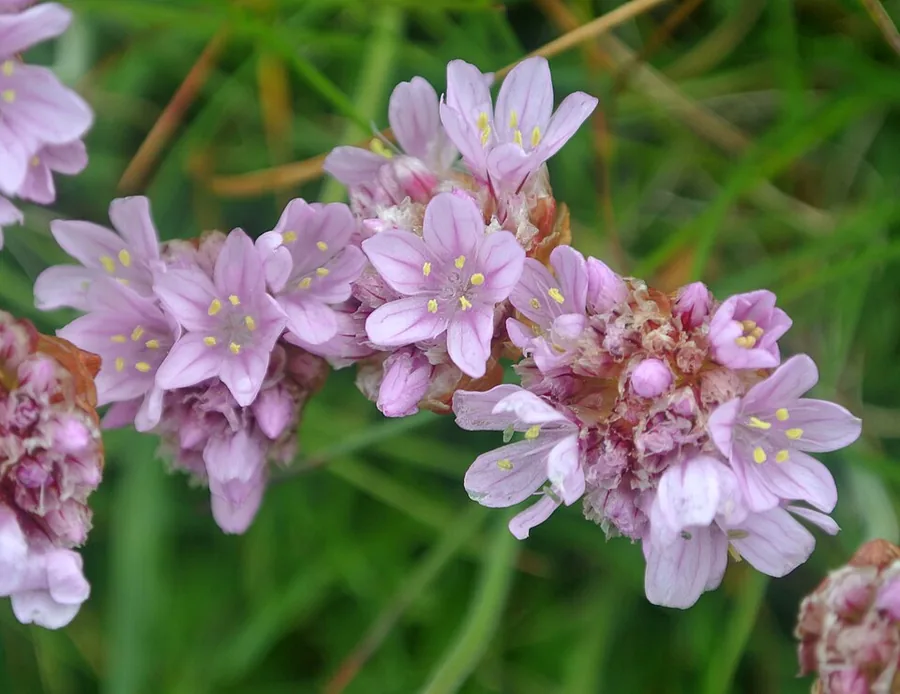
Armeria maritima evolved on exposed sea cliffs and salt marshes, and that origin dictates its needs in the garden. It grows as an evergreen perennial, forming a dense grassy cushion of narrow basal leaves from which leafless scapes rise to carry rounded pink to white flower heads in spring. Mature height runs 6 to 12 inches, which suits it to border fronts, rock gardens, and planting pockets in walls.
The traits that make it low-maintenance also explain its failures. Adapted to poor, sharply drained ground, its crown cannot cope with the moisture held by rich or heavy soil, so the very conditions gardeners create for most perennials work against it. Provide full sun and free drainage, and its cultural demands drop to almost nothing.
Its coastal heritage brings further payoffs. The cushion holds its green through winter over much of its range, its tolerance of salt spray, drought, and wind reflects the maritime habitat it came from, and an established clump persists for years before division becomes necessary.
Care
The short version: site sea thrift in full sun and lean, sharply drained soil, and restrain both irrigation and feeding. A dry, infertile regime keeps the crown sound and the plant productive for years.
Light
Flowering depends on strong light, so give sea thrift full sun. It persists in partial sun or light shade, yet in dimmer positions the cushion opens up and bloom falls off, which is why an open, sunny site pays off.
Water
Sea thrift tolerates drought once established and fails in wet ground, so water only every 7 to 14 days and let the soil dry through between applications. Saturated soil around the crown is the trigger for rot, and keeping the root zone dry between waterings removes that risk.
Soil
Match the plant's native ground with lean, gritty, very free-draining soil, ideally sandy to rocky. It performs across a pH of 6.0 to 7.5. Fertile or clay soils retain the moisture its crown cannot tolerate, which is the mechanism behind most losses.
Temperature
Cold hardiness is not the limiting factor here; the plant withstands -29°F to 86°F (-34°C to 30°C). What it does not tolerate is warmth combined with moisture, so damp heat, not low temperature, sets the practical limit.
Humidity
A dry, freely moving atmosphere suits sea thrift, and it declines in muggy, stagnant air. No target humidity applies, but still, humid air favors mildew on the foliage, so spacing that keeps air moving is the practical safeguard.
Feeding
Feed rarely; a single light application in spring is the ceiling. Excess fertility rots the center of the clump, so infertile ground is a requirement, not a compromise, for a plant adapted to poor soils.
Pruning
Deadhead entire spent scapes to prompt the sporadic later flushes the plant produces. Avoid cutting the foliage to ground level in autumn, since shearing the evergreen cushion back that hard reduces the following spring's bloom.
Repotting
Rather than repotting, renew sea thrift by division every 2 to 3 years. The signal is a clump that has gone woody and bare at the center with declining flower output, which reflects the natural die-out of the oldest crown tissue.
Size & spacing
Expect a compact mound of about 6 to 12 inches (15 to 30 cm) in both height and spread. Space plants at roughly that interval so the cushions close the gap without crowding, since dense, overlapping growth traps the humid air that encourages disease.
When to plant
Sea thrift follows a cool-season cycle. Seed started in late winter yields plants ready to set out in spring after the last frost, and the main flush of globular pink heads opens through April and May, followed by intermittent rebloom into summer and fall.
Northern hemisphere
Southern hemisphere
Typical months for a temperate climate: start earlier in warm zones, later where spring frosts linger.
- Sow: late winter to early spring
- Plant: spring after last frost
- Harvest: mid to late spring (April-May) with sporadic summer/fall rebloom
Hardiness
USDA hardiness zones: 4–8
Temperature: down to -34°C
Troubleshooting
Read the disorders below through a single lens: excess moisture. Because the crown of Armeria maritima cannot shed trapped water, sharp drainage prevents most of what follows. When a symptom does appear, trace it to its cause and intervene before rot advances into the crown.
Collapsed, dead center within the cushion
The disorder is crown rot, the principal cause of death in Armeria maritima, and it develops when the crown sits in persistent moisture. Heavy clay, over-rich soil, or a prolonged cool, wet autumn keeps water against tissue that cannot drain. Lift the plant, excise the dead core, and re-establish the viable outer growth in lean, gritty, fast-draining soil.
Fix:
- Lift and divide the clump, discarding the dead center
- Replant healthy outer divisions in lean, gritty, very well-drained soil
- Reduce watering
Wilting while the soil remains saturated
Persistent saturation produces root rot: the roots break down and the plant declines even as the soil stays wet, which is the diagnostic contradiction. Confirm it by lifting a section and checking for soft, darkened roots. Correct the drainage, withhold water, and reset the plant in a gritty, quick-draining medium.
Fix:
- Improve drainage
- Withhold water
- Move or replant in gritty, fast-draining soil
Sticky deformed shoots or perforated leaves
Two agents account for this. Aphids feed on the stems and distort new growth, leaving it sticky and misshapen, while slugs and snails graze irregular holes and leave mucus trails across the foliage. Dislodge aphids with a forceful water spray or apply insecticidal soap, and reduce slugs by hand-collection or trapping after dark.
Fix:
- Rinse aphids with a strong stream of water or use insecticidal soap
- Hand-pick or trap slugs and snails
Powdery white deposit across the foliage
The white bloom is powdery mildew, a foliar fungus favored by humid air and close planting. Increase spacing to move air through the stand, remove the most affected leaves, and keep irrigation off the foliage. Grown in full sun with sharp drainage, the plant rarely carries it.
Fix:
- Improve air circulation
- Remove affected foliage
- Avoid overhead watering
Toxicity
For households with animals or children, the record is clear: Armeria maritima carries no toxic rating. Neither ASPCA nor the botanical references flag it as poisonous to people, livestock, or pets, so incidental ingestion warrants no concern. Routine hand-washing after handling is enough.
Safe for
People · Cats · Dogs · Horses · Rabbits · Livestock · Birds
Cats None
No source assigns Armeria maritima a toxic rating for cats, so an exploratory nibble presents no hazard. As with any plant, consuming a large quantity may cause brief, mild gastrointestinal upset.
Dogs None
Dogs are unaffected, as no part of sea thrift is poisonous to them. A dog that eats a substantial amount of foliage might show transient mild stomach upset and nothing more.
Horses Safe
Armeria maritima appears on no equine toxicity list, so horses are not at risk. The plant is a low rock-garden perennial and offers little a horse would graze in any case.
Rabbits Safe
Rabbits can browse sea thrift safely, since it contains no toxins. As a general principle, no single garden species should dominate their diet.
Livestock Safe
Cattle, goats, and sheep are not poisoned by sea thrift, which holds no toxic rating. Its low cushion of grassy foliage is unlikely to draw grazing stock regardless.
Birds Safe
Birds are unharmed by sea thrift; none of its leaves, stems, or flowers contains anything injurious to them.
People Safe
No reference rates Armeria maritima poisonous to people, so handling it and gardening around it are safe. Wash the hands after soil work, as with any plant.
Generally safe to handle; wash hands after gardening as a routine precaution.
Varieties
Alongside the wild pink species, several named cultivars extend the range of flower and foliage color. The selections below are the ones most often available in the trade.
Alba
Alba is the white-flowered form, replacing the species' pink heads with white.
Splendens
Splendens is the deeper-colored selection, its rose-pink heads held above green foliage.
Rubrifolia
Rubrifolia is grown for reddish-purple foliage, a tint that contrasts with the pink flowers.
Vindictive
Vindictive is a compact, free-flowering rose-red cultivar long held to be among the finest garden forms.
How to propagate
Three methods propagate Armeria maritima, distinguished by speed, cost, and genetic fidelity. Choose according to whether rapid increase, free numbers, or a true clone of a chosen plant matters most.
DivisionEasy
Spring · One growing season
Spring division is the most dependable method and simultaneously rejuvenates an aging clump. Discard the woody, dead center typical of older plants and replant the vigorous outer divisions, which re-establish within one growing season.
SeedEasy
Sow in spring or fall · Generally flowers in the second year
Seed germinates readily whether sown in spring or fall. Expect a delay to flowering, however, as most seedlings do not bloom until their second year.
Stem cuttingsModerate
Summer · Several weeks to a few months
Basal cuttings taken in summer yield an exact clone of the parent. The method is slower and less reliable than division, rooting over several weeks to a few months.
Myths
Sea thrift is inherently short-lived and inevitably declines within a few years.
The record does not bear this out. Given lean, sharply drained soil and full sun, Armeria maritima persists for many years. The apparent short lifespan is almost always crown rot arising from wet or fertile conditions rather than any built-in decline. Correct the drainage and longevity follows.