Ornamental · Poaceae
St. Augustine Grass
Stenotaphrum secundatum
Supply consistent warmth, even moisture, and a tall mowing height, and St. Augustine grass develops into a dense, carpet-like stand.
Full sun
Every 3–7 days
60–365 days
USDA 8–10
Overview
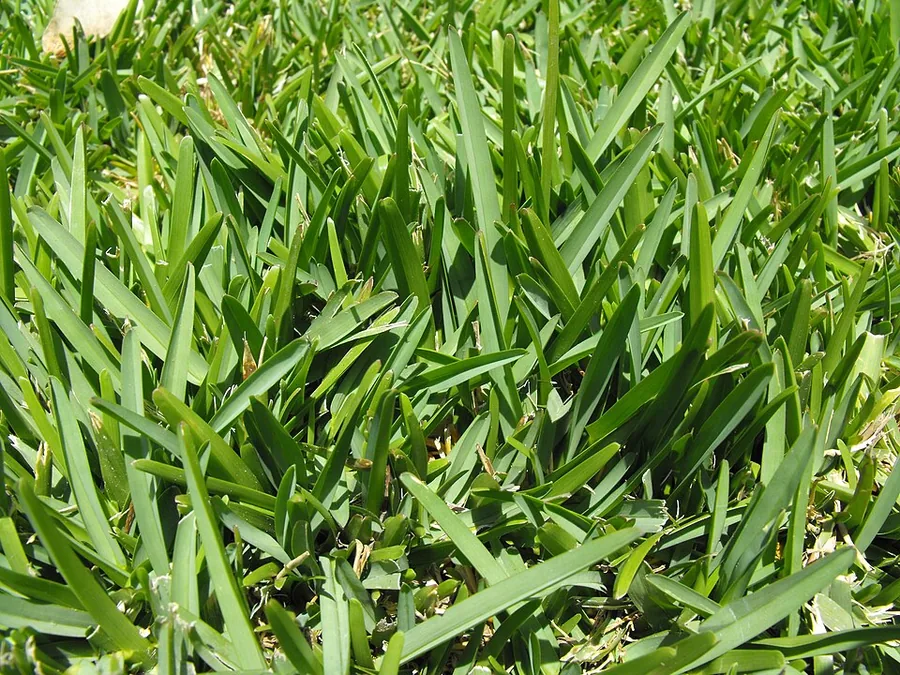
St. Augustine grass, Stenotaphrum secundatum, is the dominant lawn turf of the warm, humid South. Its coarse blades and creeping stolons, the above-ground runners it spreads by, let it close over bare ground into a dense mat. It breaks dormancy early in spring and holds color through summer heat, traits that explain its reach across the Gulf Coast and Florida. Its comparatively good shade tolerance sets it apart from most warm-season grasses, yet full sun still yields the thickest stand.
As a warm-season perennial, its physiology favors heat over cold. Growth continues through high temperatures, then halts into a brown dormancy as winter chill arrives, and a hard freeze can thin or kill an unprotected lawn because the plant lacks strong cold hardiness. That low tolerance for cold confines its best performance to the Gulf states, where freezing spells are brief.
The cost of fast, lush coverage is maintenance. The grass demands steady irrigation and regular nitrogen, and its dense canopy and rapid growth leave it prone to several pests and diseases, the southern chinch bug foremost among them. Correct mowing height, deep watering, and restrained nitrogen together produce a thick, uniform turf and limit that vulnerability.
Care
The short version: site it in sun to partial shade, irrigate to hold the soil evenly moist at about 1/2 to 3/4 inch per application, mow high at 3 to 4 inches, and apply nitrogen through the warm season in moderation.
Light
Full sun produces the densest, most vigorous turf, yet St. Augustine grass carries better shade tolerance than most warm-season species. Give it as much light as the site allows, since deep shade thins the canopy and weakens the stand.
Water
Manage irrigation to keep the soil evenly moist, using the plant itself as the cue: blades that fold, wilt, or take on a blue-gray cast signal the onset of drought stress. Apply about 1/2 to 3/4 inch per watering, and avoid prolonged dry periods, since its drought tolerance is only moderate.
Soil
The species adapts widely but performs best on well-drained soil held at a medium to low pH, roughly 6.0 to 7.5. On alkaline soils, iron becomes less available and the turf can turn chlorotic, a deficiency corrected with a supplemental iron application.
Temperature
This warm-season grass sustains growth through heat to about 95°F (35°C). Cold defines its limit: it enters a protective brown dormancy in winter, and temperatures near 25°F (-4°C) can thin or kill an unprotected lawn, since it holds the least cold tolerance among common warm-season turfgrasses.
Humidity
High humidity suits it, which is one reason it performs along the muggy Gulf Coast. That same warm, moist air favors several of its fungal pathogens, so airflow and mowing dry foliage do more to limit disease than managing humidity directly.
Feeding
Supply nitrogen across the warm season in 2 to 6 applications per year, scaled to your climate and growing length. Limit quick-release soluble nitrogen, because surges of available nitrogen intensify chinch bug damage rather than benefiting the turf.
Pruning
Mow standard cultivars high, at 3 to 4 inches, and dwarf types lower, near 2 to 2.5 inches, matching height to the cultivar's growth habit. Remove no more than a third of the blade at once, since deeper cuts stress the plant, deplete reserves, and open the canopy to weeds.
Repotting
none
Size & spacing
Mowed blades reach only about 3 to 4 inches (8 to 10 cm) in height, but growth is lateral: the stolons extend outward so a single plant covers roughly 1 to 3 feet (30 to 100 cm), knitting adjacent plants into a continuous mat.
When to plant
Establishment succeeds when the plant is metabolically active, which for a warm-season grass means warm soil and air. Install sod, plugs, or sprigs in spring or late summer into early fall, avoiding cold periods and hot, dry extremes that stall rooting. Expect spring green-up and a brown winter dormancy as temperatures fall.
Northern hemisphere
Southern hemisphere
Typical months for a temperate climate: start earlier in warm zones, later where spring frosts linger.
- Plant: Lay sod, plugs, or sprigs during active warm-season growth in spring or late summer/early fall (late fall to spring in south Florida); avoid cold and hot, dry extremes.
- Harvest: Grown as turf; not flowered or harvested. Greens up in spring and goes dormant/brown in winter cold.
Hardiness
USDA hardiness zones: 8–10
Temperature: down to -12°C
Troubleshooting
Nearly every St. Augustine grass complaint presents as yellowing or dying turf, and the differential diagnosis turns on season and weather. Reading the timing alongside the pattern of injury separates summer insect feeding from cool-season fungal disease. Identify the match below, then intervene before the affected area enlarges.
Enlarging yellow-brown patches in hot, sunny, dry areas
The near-certain cause is the southern chinch bug, which injures St. Augustine grass more than any other pest. Feeding along sunny, dry margins during peak summer heat, the insects draw sap from the plant, and the killed turf radiates outward from the initial patch. Treat the affected zone and the adjacent green turf as soon as injury appears, reduce quick-release nitrogen, and irrigate thoroughly, since heavy rainfall or irrigation suppresses populations.
Fix:
- Treat affected and surrounding turf with a labeled insecticide as soon as injury appears, targeting both nymphs and adults
- Avoid excess soluble nitrogen, which accelerates chinch bug buildup
- Irrigate adequately, since heavy irrigation or rainfall suppresses populations
- Consider a resistant cultivar such as Floratam when renovating
Persistent mottled chlorosis that does not respond to feeding
Mottled chlorosis that fails to green up after fertilization points to St. Augustine Decline, a viral disease with no chemical cure. First exclude iron or manganese deficiency on high-pH soil, which supplemental iron will resolve; a true nutrient shortage responds to feeding, whereas SAD does not. Confirmed SAD requires replanting with a resistant cultivar such as Floratam or Raleigh, plugged on 2 to 3 foot centers to displace the infected stand.
Fix:
- Replant with a SAD-resistant cultivar (for example Floratam, Floralawn, Raleigh, or Seville), plugging it in on 2 to 3 foot centers to crowd out diseased grass
- Rule out iron/manganese deficiency on alkaline soil with supplemental iron
- Use clean, virus-free sod or plugs
Circular brown patches in cool, wet conditions, sheaths rotting free
Rounded patches emerging in the cool, wet weather of fall and spring indicate large patch, caused by the Rhizoctonia fungus. Diagnosis is confirmed at the patch margin, where blades detach readily from dark, rotted leaf sheaths. Withhold fertilizer until summer when the turf is growing actively, reduce irrigation, and aerate compacted soil to improve drainage, since the pathogen thrives in cool, saturated conditions.
Fix:
- Limit fertilizer to summer when turf is actively growing
- Avoid mowing too low and avoid over-irrigation
- Aerate to reduce compaction and improve drainage
- Apply a preventive fungicide in fall when soil temperatures favor the pathogen
Gray-tan oval lesions with purple margins on the blades
Tan-to-gray lesions bordered in purple identify gray leaf spot, a fungal disease favored by warm, wet weather and excess nitrogen. Mow only when the foliage is dry and collect the clippings while the disease is active to limit spread. The durable correction is to reduce nitrogen and shorten periods of leaf wetness, since both drive infection.
Fix:
- Mow at the proper height and only when grass is dry
- Bag and dispose of clippings while disease is active
- Reduce nitrogen and avoid prolonged leaf wetness
- Apply a labeled fungicide if needed
Toxicity
For pet owners the record is clear: St. Augustine grass is an ordinary lawn turfgrass carrying no toxic principle. Cats, dogs, horses, and other animals may rest on it and graze it without risk of poisoning. Ingested grass sometimes provokes vomiting, but the mechanism is mechanical irritation of the stomach rather than any toxin, and the pollen alone can aggravate grass allergies in sensitive individuals.
Safe for
People · Cats · Dogs · Horses · Rabbits · Livestock · Birds
Cats None
A cat may chew this turfgrass without harm. Any vomiting or the occasional hairball results from mechanical irritation by the blades, not from a toxic effect.
Dogs None
Dogs are unaffected on and around the grass. Grazing followed by regurgitation reflects physical irritation of the stomach rather than the action of any toxin.
Horses Safe
Horses may graze St. Augustine grass with no risk of poisoning.
Rabbits Safe
Rabbits may consume the blades safely, as this turfgrass contains no toxic compound.
Livestock Safe
Cattle, goats, and sheep can graze the stand without adverse effect.
Birds Safe
Backyard birds and poultry may forage in it freely, as the plant presents no hazard.
People Safe
The grass poses no danger to people, though its pollen can provoke hay-fever symptoms in those sensitive to grass allergens.
The grass is not poisonous. Pets that nibble lawn grass may occasionally vomit, but this is mechanical, not poisoning. Grass pollen can trigger hay-fever-type allergies in sensitive people and pets.
Varieties
Several named cultivars exist, and selection should follow local climate and the pest or disease pressure you face most. The following are the cultivars worth knowing.
Floratam
Floratam is the most widely planted cultivar, a coarse, vigorous grass that resists the SAD virus but has poor cold and shade tolerance.
Palmetto
Palmetto is valued for improved cold hardiness, though it lacks insect resistance and is prone to disease in humid climates.
Raleigh
Raleigh, developed at NC State for cooler northern regions, combines cold hardiness with SAD resistance but remains susceptible to chinch bugs and large patch.
Seville
Seville is a fine-textured, dark green dwarf that resists SAD while remaining vulnerable to chinch bug and webworm damage.
Captiva
Captiva, a University of Florida dwarf, resists southern chinch bugs and grows low enough to reduce mowing frequency.
How to propagate
This species is not established from seed. It propagates through its own stolons, so plugs, sprigs, and sod are the practical means of starting or repairing a lawn.
DivisionEasy
During active warm-season growth in spring or late summer/early fall · Several weeks to a few months for plugs/sprigs to fill in; sod establishes fastest
Establish a lawn in spring or late summer into early fall, during active warm-season growth. Because the plant spreads by stolons, propagate it vegetatively as sod, plugs, or sprigs, cutting sod into small squares for plugs and setting them 6 to 24 inches apart, with closer spacing achieving faster coverage. Sod establishes most quickly, while plugs and sprigs require several weeks to a few months to fill in, and seeding is not an option.
Myths
St. Augustine grass can be established from seed like other lawn grasses.
The species produces almost no viable seed, so seeding is unreliable and rarely succeeds. Propagation is vegetative, accomplished by laying sod or planting plugs and sprigs.