Ornamental · Poaceae
Sorghum-sudangrass
Sorghum × drummondii
A vigorous summer hybrid grass that smothers weeds and relieves soil compaction, carrying a serious cyanide risk for grazing animals.
Full sun
Every 7–14 days
45–90 days
USDA 3–11
Overview
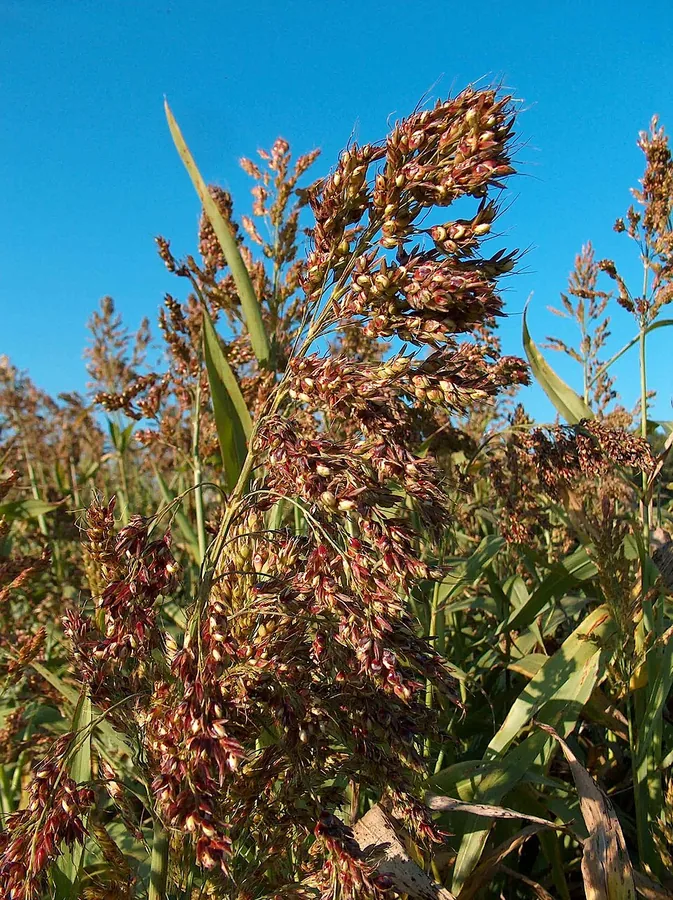
Sorghum-sudangrass is a hybrid summer grass valued for performance rather than form. The cross of sorghum with sudangrass yields a fast, heat-loving annual capable of moving from seed to several feet of dense growth within weeks. It earns its place as a cover crop and forage because that rapid canopy shades out weed competition while returning organic matter to the soil profile.
The plant's greatest value is below ground. A dense canopy suppresses weed seedlings by intercepting light, and a single mid-season mowing at 3 to 4 feet provokes a compensatory flush of root growth and tillering that penetrates and fractures compacted soil layers. The roots also exude sorgoleone, an allelochemical that inhibits germination in many weed seeds, which accounts for much of its cleanup effect on infested ground.
One hazard governs how it is used. This grass and related sorghums synthesize cyanogenic glycosides that liberate prussic acid, the cyanide form, and they accumulate nitrate under stress. Both make it dangerous to horses and grazing livestock, with risk concentrated in young, drought-affected, wilted, or frosted tissue. The sound approach is to manage it for soil benefit and regard any grazing as a genuine hazard.
Care
The short version: full sun, warm soil, and minimal inputs. Direct-seed after frost into well-drained ground, irrigate sparingly given its drought tolerance, and mow at 3 to 4 feet before the stems lignify.
Light
It demands full sun and high heat, the conditions that drive its speed. As a warm-season grass, it makes its fastest growth in open, hot sites, so give it an exposed plot with unobstructed light.
Water
Once established it is drought-tolerant, going nearly dormant rather than dying when moisture is short, which is why irrigation at only every 7 to 14 days suffices and can be withheld when rainfall meets the demand. Avoid overwatering and poorly drained sites. Note the toxicological corollary: drought-stressed plants carry the highest cyanide and must not be grazed.
Soil
It performs in almost any well-drained loam and tolerates a broad pH span of 5.5 to 9.0, an unusually wide range that reflects its adaptability. The consistent limitation is waterlogging, which it does not tolerate.
Temperature
As a warm-season grass it grows across roughly 32°F to 100°F (0°C to 38°C) and performs best toward the upper limit. Frost is lethal to it, a trait that conveniently serves as the termination mechanism for the cover crop in autumn.
Humidity
Ambient outdoor humidity is adequate, and no target value applies. Growth is governed by heat and solar exposure far more than by atmospheric moisture.
Feeding
Supply nitrogen at planting, on the order of 75 to 100 pounds per acre, to support full biomass. Restraint matters: excess nitrogen against low phosphorus and potassium elevates the cyanide and nitrate the plant accumulates, so avoid overfertilizing.
Pruning
The defining operation is a single mow-kill at roughly 3 to 4 feet, which triggers the compensatory root growth and tillering responsible for its compaction relief and biomass. Cut or terminate before it advances past 4 feet toward its full 5 to 12 feet, since the stems then lignify into woody, slow-decomposing residue.
Repotting
none
Size & spacing
Established as a dense stand, it reaches 5 to 12 feet (1.5 to 3.7 m) when unchecked, with individual plants occupying about 1 to 3 feet (30 to 91 cm). The density is functional, as the shade cast by that canopy is what suppresses weeds.
When to plant
This is a warm-season annual with no frost tolerance. Establish it in late spring or summer once frost has passed and soil temperature exceeds 60°F to 65°F (16°C to 18°C), carry it through the heat of the season, and terminate it by mowing or by the first autumn frost.
Northern hemisphere
Southern hemisphere
Typical months for a temperate climate: start earlier in warm zones, later where spring frosts linger.
- Sow: not recommended
- Plant: Late spring to summer after all frost danger has passed and soil is warm (above about 60-65 degrees F)
- Harvest: Mow or harvest at about 3-4 ft; grown for biomass/cover, not bloom
Hardiness
USDA hardiness zones: 3–11
Temperature: down to -40°C
Troubleshooting
Problems fall into two categories: a toxic risk to grazing animals and loss of manageability as the stand matures. Because the same forage shifts from useful to hazardous or unworkable with growth stage, monitoring height is central to managing it. Identify the pattern below and intervene early.
Grazing animals collapse abruptly with labored respiration
This is acute cyanide (prussic acid) poisoning, the most severe risk this grass presents. The plant liberates hydrogen cyanide from the glycoside dhurrin, and concentrations peak in young growth under 18 to 24 inches, in rapid regrowth after cutting, and in drought-stressed, wilted, or frosted tissue. Signs emerge within minutes and animals seldom survive two hours, so exclude livestock from that growth, allow 5 to 7 days after a frost, and summon a veterinarian at the first suspicion.
Fix:
- This is a veterinary emergency - contact a veterinarian immediately
- Remove all animals from the forage at once
- For pets, call ASPCA Animal Poison Control at (888) 426-4435
Stems lignify into tall, woody, hard-to-cut stalks
Allowed past 4 feet, the stand advances to its full 5 to 12 feet and the stems lignify into coarse, woody stalks up to half an inch thick. That accumulated mass resists the mower, decomposes slowly, and obstructs spring planting. Mow at about 3 to 4 feet before lignification sets in, then terminate or allow winterkill so the residue breaks down in time.
Fix:
- Mow at about 3-4 ft before stalks turn woody
- Terminate (mow or let winterkill) before residue becomes excessive
- Chop or mow finely to speed breakdown
Stressed tissue accumulates nitrate and frost terminates the crop
Drought and heavy nitrogen drive nitrate accumulation in the foliage, and that stressed forage can poison livestock independently of the cyanide pathway. Assay any stressed or heavily fertilized growth before feeding, and dilute or reject material that tests high. Being a frost-tender warm-season annual, it blackens and dies at the first hard freeze, the customary means of terminating the cover crop.
Fix:
- Test stressed forage before feeding
- Dilute or avoid feeding high-nitrate forage
- Accept winterkill as the cover-crop termination method
Toxicity
Regard this as a serious toxicity. The plant liberates prussic acid (cyanide) and accumulates nitrate, and either can be rapidly fatal to horses and grazing livestock, with the greatest concentration in young, drought-stressed, wilted, or frosted tissue. Household pets and people face lower exposure because they do not graze it, yet the foliage remains unsafe to chew, so exclude animals and children from it.
Toxic to
Cats · Dogs · Horses · Rabbits · Livestock · Birds · People
Cats Caution
The ASPCA classifies Sudan grass as non-toxic to cats, and an incidental bite of blade is not the concern. The relevant risk is the cyanide that accumulates in young, wilted, or frosted tissue, so prevent a cat from chewing stressed plants.
Dogs Caution
The ASPCA does not list this grass as toxic to dogs, and most will not consume it. The hazard resides in stressed or frost-damaged foliage, so redirect a grass-chewing dog away from it as a precaution.
Horses Toxic
Horses face two distinct injuries. Beyond acute cyanide poisoning with labored breathing, foaming, and tremors, they develop a characteristic cystitis and ataxia syndrome: hind-limb incoordination, a paralyzed bladder that dribbles urine, and permanent nerve damage. Pregnant mares may abort or produce malformed foals. Do not graze horses on this forage, and note that risk intensifies in young, drought-stressed, wilted, or frosted tissue.
Rabbits Caution
A grazing rabbit is exposed to the same cyanide that accumulates in young, wilted, drought-stressed, or frosted blades. Exclude rabbits from this growth, since a small animal can reach a lethal dose quickly.
Livestock Toxic
Cattle, sheep, and goats are the classic casualties and succumb rapidly to cyanide and nitrate poisoning, showing rapid respiration, staggering, and convulsions within 15 minutes to 2 hours. Risk is greatest on young growth under 18 to 24 inches, on rapid regrowth, and on drought-stressed, wilted, or frost-damaged plants, which must never be grazed.
Birds Caution
Poultry and other birds that ingest the foliage encounter the same cyanogenic compounds that threaten grazing stock. The seed is used in feed, but exclude birds from young, stressed, or frosted green growth.
People Caution
This is a forage and cover crop, not a food plant, so no part is consumed raw. The fresh foliage holds the cyanide and nitrate that poison livestock, so avoid tasting it and keep children from chewing the stalks.
Keep grazing animals off young (under 18-24 in), drought-stressed, wilted, or frost-damaged growth and off fast regrowth - these have the most cyanide and can kill within an hour. Wait at least 5-7 days after frost; properly cured hay/silage is generally safer. Not for use as forage for horses without testing. Contact a vet or ASPCA Animal Poison Control at (888) 426-4435 immediately if poisoning is suspected.
Helpline numbers

United States
ASPCA Animal Poison Control: (888) 426-4435 (fee applies)
Poison Control: (800) 222-1222



Canada
Poison Centres: 1-844-764-7669
Varieties
Breeding has adapted this grass to distinct end uses, from more digestible forage to taller stands to cover-crop performance. The principal types are outlined below.
Brown midrib (BMR) types
A recessive low-lignin trait, signaled by a reddish-brown leaf midrib, raises digestibility and energy content in these types while reducing their standing ability against wind and weather.
Photoperiod-sensitive types
These types defer seedhead formation until day length falls below about 12 hours and 20 minutes, producing very tall stands and extending the interval for harvesting high-quality vegetative forage.
Forage hybrids vs cover-crop selections
Both carry coarser stems and broader leaves than true sudangrass with stronger regrowth and yield, but forage selections are bred for grazing and silage whereas cover-crop selections are bred for biomass, weed suppression, and relieving compaction.
How to propagate
Propagation is limited to a single, straightforward method. Sow it directly into warm soil and allow it to establish.
SeedEasy
Late spring to summer once soil is warm (above about 60-65 degrees F) and frost danger has passed · Germinates in days; reaches mowable 3-4 ft and dense canopy within several weeks
Sow once soil temperature surpasses about 60°F to 65°F (16°C to 18°C) and frost has passed, targeting at least two months before autumn frost. Drill at 20 to 40 pounds per acre or broadcast 30 to 50 pounds, placing seed about half an inch to 2 inches deep. Emergence follows within days, and a mowable 3 to 4 foot canopy develops within several weeks.
Myths
Sorghum-sudangrass is equivalent to grain sorghum or to perennial Johnsongrass.
It is a frost-tender annual hybrid managed as a summer cover and forage grass, distinct from grain sorghum and from the perennial weed Johnsongrass. The three are Sorghum relatives sharing the prussic-acid hazard, but the annual cover crop must not be conflated with perennial Johnsongrass, whose field behavior differs substantially.
Properly cured hay retains the full danger of the fresh, growing plant.
Most prussic acid volatilizes as the forage cures into hay or ensiles into silage, so cured hay and silage are considerably safer than fresh young, stressed, or frosted growth. Horses remain the exception and should not be fed it long-term without prior testing.