Ornamental · Plantaginaceae
Snapdragon
Antirrhinum majus
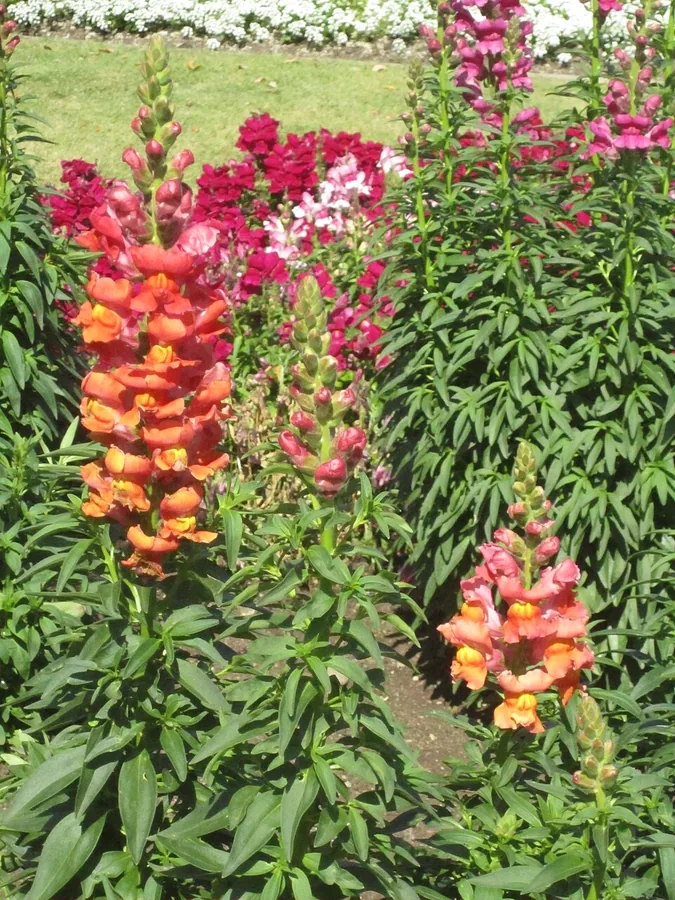
In cool weather and full sun, snapdragon produces dense flower spikes in nearly every hue except true blue.
Full sun
USDA 7–10
0–3 ft · 0.2–0.9 m
Overview
The common name records a mechanical quirk of the corolla: pressed at the sides, each bloom hinges open and shut, a feature long used to amuse children. Antirrhinum majus carries its flowers on upright terminal spikes in nearly every hue except true blue. It performs as a cool-season species, timed to the mild temperatures of spring and fall.
Although the flowering habit reads as substantial, the plant is short-lived. Botanically a tender perennial, it is grown as an annual across most gardens because the crown survives winter only in mild climates near USDA zone 7 and warmer. The genus spans a wide size range, from low dwarfs to tall cut-flower selections, which lets a grower place it as edging, as a mid-border filler, or as a cutting crop.
Its cultural needs follow from its origins: full sun drives dense flowering, and rich, evenly moist soil supports its low drought tolerance. Because the ASPCA records no toxicity and the flowers are edible, it carries no household risk around pets or children. The chief limitation is thermal, since sustained heat suppresses bloom until temperatures ease.
Care
The short version: site snapdragon in full sun with rich, evenly moist, free-draining soil, and deadhead through the season to sustain spike production. Grow it for spring or fall, since heat suppresses flowering.
Light
Flowering density depends on light, so give snapdragons full sun. Under shade the stems stretch and set fewer flowers, whereas an open, bright position keeps the spikes rigid and well filled.
Water
Because snapdragons have low drought tolerance, hold the soil evenly moist and do not let it dry out. Deliver water at the base and keep the canopy dry, since free moisture on the leaves is what rust and Botrytis require to establish.
Soil
Grow snapdragons in rich, well-drained soil near neutral pH. A medium that retains moisture yet drains freely prevents both drought stress and the waterlogging that undermines the roots.
Humidity
Average
Feeding
A single application of all-purpose fertilizer in spring, as growth resumes, meets the needs of this cool-season plant. Additional feeding is unnecessary and does little for a species that is not a heavy user of nutrients.
Pruning
Deadheading spent flowers removes developing seed and redirects the plant into fresh spikes, extending the display. Cutting away damaged or diseased tissue at the same time reduces inoculum and keeps the canopy open.
Size & spacing
Mature height ranges from 6 to 36 inches (15 to 91 cm) by class. Spacing of 6 to 10 inches (15 to 25 cm) maintains airflow between plants, which lowers canopy humidity and the disease pressure that follows.
When to plant
Snapdragon flowering is governed by temperature rather than warmth alone. Transplant in early spring once frost has passed, or in fall where winters remain mild near USDA zone 8 and warmer, and the plant will flower through the cool phases of spring and autumn until rising heat curtails it.
Northern hemisphere
Southern hemisphere
Typical months for a temperate climate: start earlier in warm zones, later where spring frosts linger.
- Plant: Early spring after the last frost, or in fall in mild zones (about USDA zone 8 and warmer)
- Harvest: Blooms in cool weather of spring and fall (and summer in cool climates); flowering slows in summer heat
Hardiness
USDA hardiness zones: 7–10
Temperature: down to -18°C
Troubleshooting
Most disorders here are environmental, driven by prolonged leaf wetness, stagnant humid air, or off-season heat. Examine the lower foliage and stems first, since rust and Botrytis establish there. Identify the symptom below, then intervene before the pathogen advances up the plant.
Yellow upper spots over dark pustules on the undersides
This is snapdragon rust (Puccinia antirrhini), the species' defining disease. Infection requires 6 to 8 hours of leaf wetness under cool 55°F to 70°F (13°C to 21°C) conditions and is suppressed once temperatures exceed 80°F (27°C), which is why dry foliage and warm spells both check it. Remove and bag colonized leaves, keep the canopy dry, and select rust-resistant cultivars at planting.
Fix:
- Remove and bag affected leaves
- Apply a labeled systemic fungicide if severe
Distorted yellow leaves sporulating on the undersides
The agent is downy mildew, typically introduced on infected plugs rather than arising in the bed, so the distorted, yellowing leaves and gray undersurface spores usually trace to purchased stock. An infected plant cannot be cured and should be pulled and destroyed. Inspect incoming material before planting, withhold overhead water, and space plants so the canopy dries.
Fix:
- Remove and destroy infected plants
Tan stem cankers under humid, still air
The cause is Botrytis gray mold, which colonizes tissue where humidity is high and air movement is poor, conditions common in crowded stands. Excise the infected stems and any decaying tissue, then open the planting so air circulates and the canopy dries. Base watering rather than overhead irrigation keeps the foliage dry and denies the fungus its damp foothold.
Fix:
- Remove and destroy infected plant parts
- Improve air circulation
Bloom arrest under sustained heat
This reflects the plant's biology, not a pathogen: snapdragon is a cool-season species with limited heat and drought tolerance, so flowering slows or halts once temperatures hold above about 80°F (27°C). Cut the plants back and maintain soil moisture, and many will resume flowering as autumn temperatures fall. No treatment beyond seasonal timing applies.
Fix:
- Cut plants back and keep them watered; they may rebloom as temperatures cool
Toxicity
For households with animals, the profile is straightforward: the ASPCA classifies garden snapdragon as non-toxic to cats, dogs, and horses, and the flowers are edible for people. The species can be sited anywhere pets or children have access without concern.
Safe for
People · Cats · Dogs · Horses · Rabbits · Livestock · Birds
Cats Safe
The ASPCA classifies garden snapdragon as non-toxic to cats, so ingestion presents no poisoning risk.
Dogs Safe
For dogs the plant is likewise non-toxic, and an eaten leaf or flower is harmless, though bulk ingestion of any plant may cause transient digestive upset.
Horses Safe
Horses may graze in proximity without hazard, as the ASPCA records no equine toxicity.
Rabbits Safe
Rabbit consumption of the foliage carries no toxic effect, so an accessible plant poses no risk.
Livestock Safe
Cattle, goats, and sheep tolerate the plant, which contains no toxin known to affect grazing stock.
Birds Safe
Birds foraging on the flowers or seed encounter no toxic principle in snapdragon.
People Safe
The flowers are edible and used as a garnish, though the flavor can be bitter, and the plant is safe in households with children.
Varieties
Cultivated snapdragons are grouped chiefly by mature height, spanning low edging forms to tall spikes cut for the vase. The principal classes below are worth knowing before selection.
Dwarf (such as Floral Showers, Snapshot)
Compact selections hold at 6 to 10 inches, suiting them to path edging and container culture.
Medium (such as Liberty Classic, Snaptastic)
Intermediate types reaching 12 to 22 inches occupy the mid-border position.
Tall or Rocket (such as Rocket, Potomac, Madame Butterfly)
Tall spikes of 24 to 60 inches are produced chiefly as cut flowers, yielding long stems for the vase.
Trailing (such as Candy Showers)
A trailing habit that rises about 6 inches and cascades to roughly 12 inches is adapted to hanging-basket culture.
How to propagate
Propagation is almost exclusively by seed, sown under cool conditions for a spring or fall crop.
SeedModerate
Sow in cool weather for spring or fall display · Several weeks from germination to transplant size
Snapdragon is raised almost entirely from seed sown under cool conditions for a spring or fall crop. Seedlings require several weeks to reach transplant size, so sowing should begin early. Pinching the growing tips of established seedlings encourages branching, which increases the number of flower spikes.
Myths
Snapdragons persist as reliable perennials, returning each season.
Antirrhinum majus is a short-lived tender perennial, and standard practice is to grow it as an annual. Perennation occurs only in mild climates, roughly USDA zone 7 and warmer, where winter temperatures remain high enough to preserve the crown.
Snapdragons are toxic to pets.
The ASPCA classifies garden snapdragon as non-toxic to cats, dogs, and horses, so there is no poisoning risk from a nibbled leaf. The flowers are additionally recorded as edible for people.
Snapdragons flower most heavily in summer heat.
The species is a cool-season bloomer, most productive in spring and fall. Once heat sets in, flowering slows or ceases until temperatures moderate.