Ornamental · Plantaginaceae
Foxglove
Digitalis purpurea
Tall spires of speckled bells illuminate a shaded border, yet every part of the plant is poisonous.
Partial shade
Every 3–7 days
USDA 4–9
2–5 ft · 0.6–1.5 m
Overview
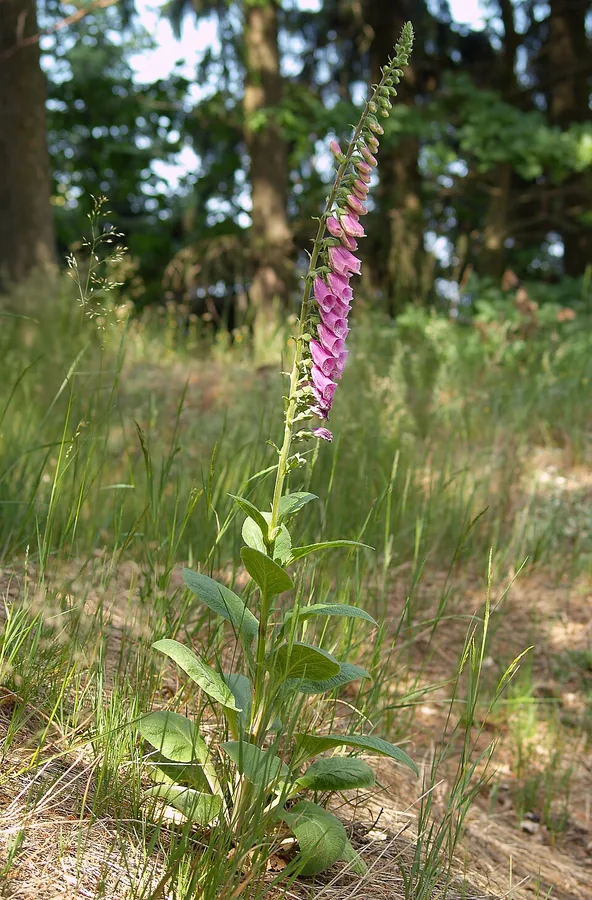
Foxglove produces tall, one-sided spikes of speckled tubular bells sized for bees to climb inside. It belongs in a part-shade border or at a woodland edge, where its acid-loving roots meet the steady moisture they require. Flower color ranges from the wild plant's purple through the white, cream, and rose of garden strains.
The genus is predominantly biennial. A low leaf rosette forms in the first year, and the second year produces the flower spike, sets seed, and then declines. Allow a spike or two to ripen and the plant self-seeds, sustaining a planting from one generation to the next.
That ornamental value carries a serious caveat. Foxglove is the botanical source of the heart drug digitalis, and every part of the plant is poisonous to people and animals. Confine it to positions where children, pets, and grazing animals cannot gain access.
Care
The short version: foxglove performs best in partial shade on moist, acidic, organically rich soil, watered every 3 to 7 days to hold steady moisture, since drought stress suppresses flowering. It is a light feeder, biennial by habit, and an outdoor plant. Critically, every part carries cardiac glycosides, so it must be sited beyond the reach of children, pets, and grazing animals.
Light
Partial shade, the dappled light of a woodland edge, suits foxglove best. It will tolerate full sun where summers remain cool and moist, but in hot regions a few hours of afternoon shade prevents the spikes from wilting under heat stress.
Water
Hold the soil evenly moist, which typically calls for irrigation every 3 to 7 days depending on heat and rainfall. Because drought stress directly limits flower production, the soil should never dry out, and a layer of mulch conserves moisture between waterings.
Soil
Foxglove favors moist, well-drained ground high in organic matter and distinctly acidic conditions, with an optimal pH of 5.0 to 6.0. Incorporate compost to build that organic content, and withhold lime, which would push the pH the wrong way.
Humidity
No ambient humidity level needs targeting, as ordinary outdoor air is adequate. The operative factor is airflow among plants. Still, damp air trapped around crowded foliage creates the conditions powdery mildew exploits, so circulation matters more than the moisture in the air itself.
Feeding
As a light feeder, foxglove asks little at the root. A balanced fertilizer, or compost incorporated into already rich soil, supplies enough across the growing season on a seasonal schedule.
Pruning
Deadhead spent spikes after bloom to promote secondary flowering and to limit excessive self-seeding, while retaining a few spikes to set seed where you want the planting to persist. Cutting the flowering stalks back to the basal foliage before seed sets prompts plants to behave as short-lived perennials rather than exhausting themselves in seed production.
Size & spacing
Mature height runs 2 to 5 feet (61 to 152 cm) with a spread of 12 to 30 inches (30 to 76 cm). Set plants about 18 inches apart so air circulates and foliage dries quickly. Growth is moderate and the habit biennial. The species is suited to the garden and not to indoor culture.
When to plant
Foxglove follows a deliberate two-year cycle. Surface-sow seed in late spring, or direct sow in late summer, then transplant young plants outdoors after the last frost. The tall flower spikes appear in the second year, the following May and June.
Northern hemisphere
Southern hemisphere
Typical months for a temperate climate: start earlier in warm zones, later where spring frosts linger.
- Sow: Late spring; surface-sow because seed needs light to germinate, do not cover
- Plant: Transplant or thin seedlings to about 18 inches apart after the last spring frost; can also be direct sown in late summer for bloom the following year
- Harvest: Spring to summer (May to June), with a tall one-sided flower spike in the second year
Hardiness
USDA hardiness zones: 4–9
Temperature: down to -34°C
Troubleshooting
Foxglove is easy to grow, yet damp, crowded conditions favor a handful of fungal diseases and the common garden insects. Read the leaves and crown early, because prompt intervention keeps a minor issue from spreading.
Plant wilts, base of stem rots, and plant collapses
This pattern points to crown rot in poorly drained or waterlogged soil. A mushy, discolored crown and roots in saturated ground confirm the diagnosis. Remove and destroy affected plants, correct the drainage before replanting, and avoid siting in low, waterlogged spots. The outcome is severe, and once the crown has softened the plant cannot be recovered.
Fix:
- Remove and destroy affected plants
- Improve soil drainage before replanting
- Avoid planting in low, waterlogged spots
White powdery coating or dark spots on leaves
These symptoms indicate powdery mildew or a leaf spot fungal disease, both favored by crowding and poor air circulation. To distinguish them, a white powdery film signals mildew, whereas discrete brown or tan lesions signal leaf spot. Remove and discard affected leaves, restore air movement through correct spacing about 18 inches apart, and avoid overhead irrigation that wets the foliage. The condition is a setback rather than a loss.
Fix:
- Remove and discard affected leaves
- Improve air circulation by proper spacing (about 18 inches apart)
- Avoid overhead watering and wetting foliage
Clusters of small insects on new growth, or chewed and skeletonized leaves
The damage falls into two categories. Sap-feeding aphids or mealybugs gather on tender new growth, while Japanese beetles or slugs chew foliage into irregular holes and skeletonized leaves. Inspect stems and leaf undersides for the sap-suckers, and look for beetles, slug slime trails, and ragged feeding damage. Dislodge aphids with a strong spray of water, hand-pick beetles and slugs, and treat persistent infestations with insecticidal soap. Routine monitoring, vigorous plants, and the removal of debris that shelters slugs hold this to a setback.
Fix:
- Knock off aphids with a strong spray of water
- Hand-pick Japanese beetles and slugs
- Treat persistent infestations with insecticidal soap
Reduced flowering and stressed appearance
Diminished bloom paired with a stressed look during hot, dry weather reflects drought stress from the soil drying out. The confirmation is dry soil and a limp plant through those dry spells. Water consistently to return the soil to evenly moist and apply mulch to conserve that moisture, since allowing the soil to dry limits flower production. The effect is cosmetic and reversible.
Fix:
- Water consistently to keep soil evenly moist
- Mulch to conserve soil moisture
Toxicity
Regard foxglove as dangerous without exception. Every part contains cardiac glycosides, the same class of compounds behind the heart drug digitalis, and even a small quantity can provoke vomiting and a life-threatening cardiac rhythm. The plant is severely toxic to cats, dogs, horses, rabbits, livestock, and birds, and it has poisoned people who took the leaves for an edible herb. Site it away from children, pets, and grazing animals, and do not leave cut spikes in vase water within reach.
Toxic to
Cats · Dogs · Horses · Rabbits · Livestock · Birds · People
Cats Severe
Cats (severe): even a nibble is dangerous, as cardiac glycosides cause drooling and vomiting followed by a slow or wildly irregular heartbeat that can stop the heart. Treat any chewing as an emergency.
Dogs Severe
Dogs (severe): a dog that consumes any part may vomit, scour with diarrhea, and weaken before the heart rhythm turns dangerous, with collapse and death possible. Seek veterinary care immediately.
Horses Severe
Horses (severe): foxglove poisons horses gravely whether encountered in pasture or in hay, producing colic, a staggering gait, and a heartbeat that races or stutters toward heart failure.
Rabbits Severe
Rabbits (severe): the same cardiac toxins affect rabbits acutely, leaving them limp and off their food at genuine risk of sudden heart failure. Never allow a rabbit access to the leaves.
Livestock Severe
Livestock (severe): cattle, sheep, and goats are poisoned by the plant fresh or dried in hay, showing drooling, gut upset, weakness, and fatal rhythm changes. Dried material remains just as deadly.
Birds Severe
Birds (severe): cardiac glycosides are toxic to birds as well, so keep poultry and pet birds well clear of every part.
People Caution
People (caution, not safe to eat): no part of foxglove is food, and people have been poisoned after mistaking the leaves for comfrey. Ingesting any of it, or even drinking water from a vase of cut spikes, can trigger vomiting and a dangerous heartbeat. Keep it well away from children.
Keep all parts of the plant away from pets, children, and livestock; wash hands after handling and do not allow any part to be eaten.
Helpline numbers

United States
ASPCA Animal Poison Control: (888) 426-4435 (fee applies)
Poison Control: (800) 222-1222



Canada
Poison Centres: 1-844-764-7669
Varieties
The wild species tends toward purple, but garden strains broaden the palette, and several have been bred for first-year flowering. The following selections are the ones to know.
Foxy
Foxy is a compact strain reaching roughly 2 to 3 feet in white, cream, and rose, frequently flowering in its first year from seed.
Camelot
Camelot is a first-year-flowering cultivar that blooms in the same year when sown in fall for the following spring.
Dalmatian
Dalmatian is a first-year-flowering series bred to bloom the first year from seed rather than waiting a second season.
Temple Bells
Temple Bells is a dwarf type bearing yellow tubular flowers brushed with brown markings.
How to propagate
Foxglove is propagated from seed. The single point of technique is that the seed requires light to germinate.
SeedEasy
Surface-sow indoors in late spring or direct sow in the garden in late summer/spring after frost danger passes · Forms a basal rosette the first year and flowers the second year; first-year-flowering cultivars can bloom about 5 months from an early indoor sowing
Foxglove is readily raised from seed. Because the seed requires light to germinate, press it onto the surface and leave it uncovered. Sow indoors in late spring or direct sow in the garden in late summer, or in spring once frost has passed, then thin the seedlings to about 18 inches apart. Most plants form a leaf rosette in the first year and flower in the second, though first-year-flowering cultivars can bloom about 5 months from an early indoor sowing. Leave a few spikes standing and the plant reseeds itself freely.
Myths
Foxglove is behind modern heart medicine, so a little must be harmless or even healthy.
Foxglove is indeed the origin of the heart drug digitalis, yet the raw plant is deadly. No safe home dose exists, because potency varies wildly from leaf to leaf and a small quantity can throw the heart into a fatal rhythm. The pharmaceutical form is purified and dosed to the microgram, a precision the garden plant can never offer.
Foxglove always lives exactly two years then dies.
The typical pattern is a two-year clock, a leaf rosette in the first year and a flower spike in the second, but it is not fixed. Certain cultivars flower in year one, and cutting the stalks back before seed sets can extend a plant into a short-lived perennial.