Ornamental · Plantaginaceae
Beardtongue
Penstemon digitalis
Grow it in full sun with sharp drainage, and this hardy native raises white spikes that pull in foraging bees.
Full sun
Every 7–14 days
USDA 3–8
2–4 ft · 0.6–1.2 m
Overview
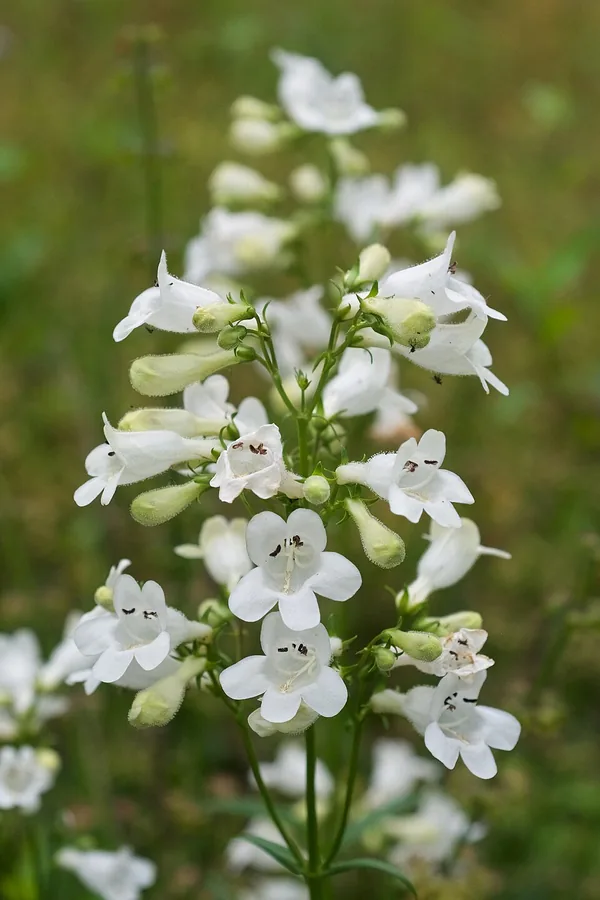
Beardtongue is a clump-forming native perennial in the figwort alliance, and it performs dependably in an open, sunny border. Across late spring into early summer it produces tall spikes of white, two-lipped tubular flowers, a form built for bees and visited on occasion by hummingbirds. The common name foxglove beardtongue describes that tubular flower shape and signals no botanical relationship to true foxglove.
Its ease in cultivation follows from a lean, resilient constitution. Cold hardiness reaches -29°F (-34°C), the established root system carries the plant through drought, and a fast growth rate closes a gap within one season. Supplied with sun and free-draining ground, it needs little further intervention.
The trait that warrants management is its capacity to spread. Because beardtongue both self-seeds and expands its crown each year, a settled specimen can exceed the space allotted to it. Deadheading curbs the seed source, and periodic division checks the clump, so the two together hold it in position.
Care
The short version: full sun and sharp drainage govern success. Water moderately through establishment, then rely on its drought tolerance, feed sparingly because lean soil suits it, and lift and divide the clump every 2 to 3 years to sustain flowering.
Light
Flowering is heaviest in full sun, the light level at which the spikes hold upright and set the most bloom. The plant tolerates partial sun or light shade, but reduced light produces a looser habit and a lower flower count.
Water
During establishment, water moderately and allow the top half of the soil to dry between applications, which typically falls at every 7 to 14 days. Once the roots are established the plant is drought tolerant, and the greater hazard runs the opposite way, because wet or poorly drained soil induces root rot, so keep the regime on the dry side.
Soil
The species accepts loam, clay, or sand provided the medium drains freely. Target a pH of 5.5 to 7.0, and note that drainage governs performance here far more than fertility does.
Temperature
This cold-hardy native withstands winter lows to -29°F (-34°C) and summer highs near 86°F (30°C). That tolerance range spans a broad geographic band with no supplemental protection required.
Humidity
Ambient outdoor humidity is adequate, so no target value applies. Air movement is the operative factor, since stagnant, crowded air prolongs leaf wetness and favors leaf spot.
Feeding
As a native adapted to lean substrates, beardtongue has a low nutrient demand. A light spring application of balanced fertilizer or compost suffices, and excess fertility only promotes weak, floppy growth.
Pruning
Deadhead the spent flower spikes through the season to maintain form and to reduce self-sowing. Cut the foliage down in late fall or early spring to clear the crown ahead of new growth.
Repotting
Grown in the open ground rather than a container, beardtongue nonetheless benefits from renewal. Divide the clump every 2 to 3 years to sustain vigor, treating declining bloom or a crowded, dying center as the indicator to act.
Size & spacing
At flowering the plant stands 2 to 4 feet (60 to 120 cm) tall and forms a clump 18 to 24 inches (45 to 60 cm) wide. Space specimens to that mature width so air circulates and leaf spot is suppressed.
When to plant
Beardtongue follows a cool-season schedule set by its seed dormancy. The seed requires a cold, moist chill to break dormancy, so it is sown outdoors in fall or stratified and started indoors in late winter, transplanted out in spring once frost has passed, with the white spikes appearing from May to July.
Northern hemisphere
Southern hemisphere
Typical months for a temperate climate: start earlier in warm zones, later where spring frosts linger.
- Sow: Late winter after 1-3 months cold-moist stratification
- Plant: Spring after last frost
- Harvest: May to July
Hardiness
USDA hardiness zones: 3–8
Temperature: down to -40°C
Troubleshooting
Beardtongue is largely free of serious pests, and the disorders it does show trace to excess soil moisture or a clump that has outgrown its position. Identify the symptom below against your plant and intervene early, while correction still alters the outcome.
Wilting plant with a blackened base and mushy roots
The wilt and blackened crown point to root or crown rot, a disorder that sets in when saturated soil, most often over winter, starves the roots of oxygen and lets pathogens take hold. Because this species evolved to tolerate drought rather than standing water, the corrective is drainage rather than irrigation. Relocate the plant to a raised, free-draining position and excise any tissue that has already broken down.
Fix:
- Improve drainage by amending soil or relocating to a raised, well-drained site
- Reduce watering and avoid wet winter soils
- Remove and discard severely rotted plants
Plant creeping past its spot and crowding neighbors
Beardtongue advances by two routes at once, self-seeding and steady clump expansion, which together let it move past its intended footprint in an established bed. Deadheading the spent spikes before seed matures removes the reproductive source and slows the sowing, while pulling volunteers clears the offspring already germinated. Lifting and dividing the clump every few years resets its spread and keeps the planting contained.
Fix:
- Remove unwanted seedlings
- Deadhead before seed set to limit self-sowing
- Divide and thin the clump
Spots and blotches scattered across the leaves
Discrete lesions on the foliage indicate fungal leaf spot, an occasional infection that rarely does more than mar the leaf. Removing the affected foliage lifts the inoculum from the plant, and growth continues unchecked. Since these fungi need prolonged leaf wetness to establish, the durable control is air movement: space the plant well and keep irrigation off the foliage.
Fix:
- Remove and dispose of affected leaves
- Improve air circulation and avoid overhead watering
Toxicity
The safety picture is straightforward: beardtongue is non-toxic. Despite the foxglove in its common name, it produces none of true foxglove's poison and appears on no toxic plant list, so it is safe around cats, dogs, livestock, and children.
Safe for
People · Cats · Dogs · Horses · Rabbits · Livestock · Birds
Cats None
Beardtongue holds no compounds known to harm cats, so ingestion carries no risk of poisoning. Any interest a cat shows in it is harmless.
Dogs None
No toxin in this plant threatens dogs. A large volume of any foliage can irritate the gut mechanically, but nothing here poisons them.
Horses Safe
Horses take no harm from beardtongue, because it lacks the cardiac glycosides that give true foxglove its toxicity.
Rabbits Safe
Rabbits can browse the plant with no consequence, since neither the leaves nor the flowers contain a poisoning agent.
Livestock Safe
Cattle, goats, and sheep encounter no toxin in this plant, which appears on no register of livestock hazards.
Birds Safe
Birds face no danger from the foliage or seed. The flowers supply nectar to pollinators and present no toxic risk.
People Safe
People, children included, are not harmed by beardtongue. The name references foxglove, yet the plant carries none of that genus's poison.
Generally safe around pets and people; no special handling required.
Varieties
Cultivation centers on either the wild species or a single cultivar valued for its dark foliage. The two below are the ones worth distinguishing.
Husker Red
Recognized as the 1996 Perennial Plant of the Year for maroon-red spring foliage that greens as the season advances while retaining maroon veining and red stems.
Foxglove Beardtongue (species)
The unselected species produces tall clusters of white, two-lipped tubular flowers across the late spring to early summer window.
How to propagate
Beardtongue propagates readily by three methods: dividing an established clump, sowing the ripe seed, or rooting summer cuttings to preserve a cultivar's traits.
DivisionEasy
Spring · One growing season
Division propagates the plant clonally and renews an aging clump in one operation, which is why it is the most reliable method here. Lift and separate the crown in spring on a 2 to 3 year cycle, and each division re-establishes its root system over a single growing season.
SeedModerate
Fall sow outdoors or stratify and sow late winter · Germinates best with cold-moist stratification and light; blooms typically the following year
Seed matures in fall and germinates most fully after a cold, moist chill together with light exposure, a dormancy requirement typical of temperate perennials. Sow outdoors in fall so winter supplies the stratification naturally, or chill the seed and start it in late winter, with flowering usually following the next year.
Stem cuttingsModerate
Summer · Several weeks to root
Softwood cuttings taken in summer reproduce a named cultivar faithfully, which seed cannot do because the foliage color does not come true from seed. The cuttings develop roots over several weeks before they are firm enough to pot on.
Myths
Foxglove beardtongue is poisonous like foxglove because of its name.
The resemblance runs no deeper than the shared common name. Penstemon digitalis is classified in a separate genus and produces none of the cardiac glycosides that account for true foxglove's toxicity. It appears on no toxic plant list and is safe around pets and people.