Tree · Rosaceae
Serviceberry
Amelanchier × grandiflora
A four-season landscape tree offering white spring bloom, sweet June pomes, and strong fall color.
Full sun
Every 7–14 days
USDA 4–9
15–25 ft · 4.6–7.6 m
Overview
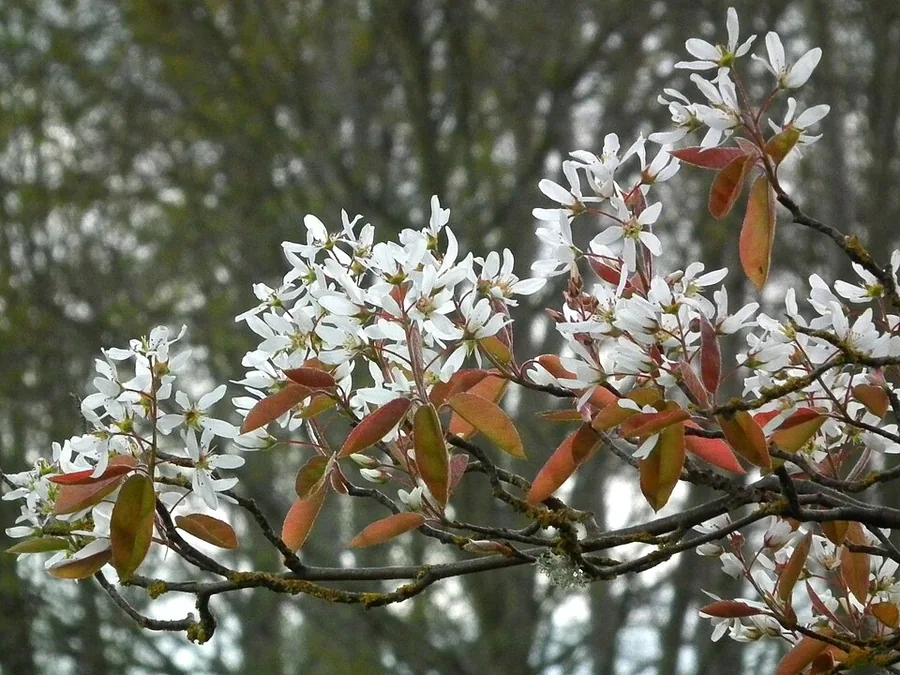
Serviceberry works as a small tree or large shrub that performs across all four seasons. Bloom comes first, with white flowers opening in early spring ahead of most canopy trees, followed by blue-purple pomes ripening in June and foliage that colors red and orange in autumn. Its many common names, among them juneberry, shadbush, and saskatoon, all refer to this single adaptable native.
Taxonomically it sits in Rosaceae with apples and pears, and that kinship shows in its fruit. The ripe pomes eat much like a blueberry, palatable fresh or cooked into preserves, though birds compete heavily for the crop. Growers can train it to a single trunk or allow root suckers to build a multi-stem form, since the species readily produces suckers from the base.
Few small trees demand so little of a site. Serviceberry performs in full sun through full shade, withstands winter cold to zone 4, and grows in loam, sand, or clay provided drainage is adequate. Steady moisture during establishment sets it up for a long, productive life.
Care
The short version: site it in full sun to maximize flowering and fruiting, since light drives both, though it tolerates shade, and plant it in moist, well-drained, slightly acidic soil. Maintain consistent moisture through establishment, and confine pruning to the dormant season.
Light
Flowering and fruiting are strongest in full sun, since both depend on light, yet serviceberry is among the few small trees that also tolerate partial shade and full shade. Deep shade reduces both berry set and fall coloration, so give it the maximum light the site allows.
Water
Hold the soil evenly moist during establishment, watering roughly every 7 to 14 days, because a developing root system cannot yet buffer drought. Once established the tree tolerates short dry spells, but sustained moisture supports the heaviest flowering and fruit set.
Soil
Soil texture is not limiting: loam, sand, or clay all work provided the site drains well, since standing water stresses the roots. A slightly acidic pH of 5.5 to 7.0 is optimal, and a moist, organically rich medium yields the most vigorous growth.
Temperature
Cold tolerance is a defining trait, with the tree hardy from -29°F to 100°F (-34°C to 38°C) across zones 4 to 9. That range explains why it succeeds in climates where many fruiting trees cannot overwinter.
Humidity
Ambient outdoor humidity is sufficient, so no target level applies. Air circulation is the more important factor, because still, humid air around dense foliage favors rust infection during a wet spring.
Feeding
A light spring application of balanced slow-release fertilizer suffices, or top-dress with compost and mulch. Keep nitrogen low, because excess nitrogen drives the soft, succulent growth that fire blight preferentially colonizes.
Pruning
Prune in fall to early winter, during dormancy, to limit heavy sap loss from active tissue. Remove dead, damaged, or crossing wood, and thin root suckers to maintain either a single-trunk tree or a multi-stem shrub, according to the form you want.
Repotting
As a landscape tree rather than a container subject, serviceberry seldom requires repotting. Where grown in a pot, pot up only when roots circle the base, water drains through too quickly, or top growth slows, all indicators of a rootbound plant.
Size & spacing
Mature dimensions run 15 to 25 feet (4.6 to 7.6 m) tall by 15 to 20 feet (4.6 to 6.1 m) wide. Space each plant to develop its full spread so that air moves freely through the canopy, which suppresses rust.
When to plant
Serviceberry follows a predictable phenology. Establish container or balled-and-burlapped stock in spring or fall, expect bloom across March and April, and harvest the ripe pomes in June, ahead of bird predation.
Northern hemisphere
Southern hemisphere
Typical months for a temperate climate: start earlier in warm zones, later where spring frosts linger.
- Sow: Sow seed only after 2-6 months of cold stratification; germination is slow and often delayed to the second spring, and seedlings are not true to type.
- Plant: Plant container or balled-and-burlapped trees in spring or fall.
- Harvest: White flowers appear in early spring (March-April); sweet blue-purple pome fruit ripens in June.
Hardiness
USDA hardiness zones: 4–9
Temperature: down to -34°C
Troubleshooting
Serviceberry is low-maintenance, and the majority of its disorders are cosmetic rather than lethal. Recognizing a few diagnostic signs lets you intervene early against the one disease capable of serious damage. Match the symptom below, then respond while control is still effective.
Shoot tips killed and hooked over from the tips down
This is fire blight, caused by the bacterium that scorches shoot tips from brown to black and curls them into a characteristic hook while killed leaves persist on the wood. Excess nitrogen predisposes the tree by forcing soft, succulent growth, and the resulting cankers can exude bacterial ooze in wet spring weather. Prune infected wood at least 4 inches below the canker in dry, dormant conditions, disinfecting tools between cuts to prevent mechanical spread.
Fix:
- Prune out infected branches at least 4 inches below the canker during dry, dormant weather
- Disinfect pruning tools between cuts
- Remove highly susceptible root suckers and water sprouts
Orange pustular spots and swellings on leaves, fruit, and stems
The cause is cedar-serviceberry rust, a Gymnosporangium fungus that requires two hosts, a serviceberry and a nearby juniper or redcedar, to complete its life cycle. Wet spring conditions promote spore infection, producing orange lesions on the upper leaf surface and tube-like fungal structures beneath. Remove the most heavily infected leaves and fruit, exclude junipers from the vicinity, and apply a protective spray at bud break where reinfection is chronic.
Fix:
- Remove and destroy heavily infected leaves, fruit, and twigs
- Avoid planting near junipers or eastern redcedar and remove unwanted ones nearby
- Apply a protective fungicide at bud break in problem areas if needed
Ripe pomes removed from the tree almost overnight in June
This is bird predation, and a flock can clear the ripe crop within a day. Because the fruit is a valued wildlife food, the loss is beneficial unless a human harvest is intended. Net the canopy just before the fruit colors, then harvest promptly as it ripens.
Fix:
- Net branches before fruit ripens if you want to harvest for yourself
- Harvest promptly as fruit colors up
- Accept fruit loss as wildlife value if harvest is not a goal
Interveinal skeletonizing of the leaves in midsummer
The damage points to Japanese beetles, whose metallic green-and-bronze adults aggregate on the foliage and consume the tissue between the veins. Pear slug sawflies produce a similar skeletonized pattern. Dislodge the beetles into soapy water during the cool of the morning, and rely on an established tree to tolerate light defoliation without lasting harm.
Fix:
- Hand-pick beetles into soapy water in the morning
- Tolerate light feeding on established trees
- Use labeled insecticides only for severe infestations
Toxicity
The safety profile here is reassuring. Serviceberry is not on ASPCA toxic-plant lists, and the ripe fruit is edible for people, pets, and wildlife. As in other Rosaceae, the leaves and seeds hold only trace cyanogenic compounds, so preventing animals from consuming large quantities of foliage is sensible, but the plant is safe to grow around the entire household.
Safe for
People · Cats · Dogs · Horses · Rabbits · Livestock · Birds
Cats None
Serviceberry is safe for cats and does not appear on ASPCA toxic-plant lists. A cat that samples the foliage should experience, at most, mild gastrointestinal upset.
Dogs None
Dogs face no hazard near the tree, and an ingested fallen berry or two causes no harm. Only substantial consumption of leaves and seeds would produce brief gastrointestinal upset.
Horses Safe
Horses can graze in the vicinity without concern. The foliage contains only trace cyanogenic compounds, well below any threshold of significance at normal browsing rates.
Rabbits Safe
Rabbits browse the leaves and twigs safely, as wild populations do throughout winter. The ripe fruit is also acceptable in small quantities.
Livestock Safe
Cattle, goats, and sheep graze serviceberry without adverse effect. As with other Rosaceae, the foliage carries only minor cyanogenic compounds that present no meaningful risk at pasture.
Birds Safe
Birds consume the ripe fruit readily, and it ranks among their preferred foods. No part of the tree poses a risk to them.
People Safe
For people, the ripe blue-purple fruit is sweet and suitable for fresh eating or preserves. The seeds, like those of related rosaceous fruits, contain trace cyanogenic compounds, so there is no reason to crush and consume them in quantity.
Ripe fruit is safe and tasty; like other Rosaceae the leaves and seeds contain low levels of cyanogenic compounds, so discourage pets from eating large amounts of foliage or seeds.
Varieties
Several serviceberries appear in cultivation, ranging from selected hybrids to unimproved natives. The following are the ones worth identifying by name.
'Autumn Brilliance' (Amelanchier × grandiflora)
A disease-resistant hybrid of A. arborea and A. laevis, this widely planted selection reaches about 25 feet tall and 15 feet wide with a rounded crown and intense red-orange autumn color.
Amelanchier canadensis (shadblow/Canadian serviceberry)
A multi-stemmed, strongly suckering shrub or small tree hardy in zones 3 to 8, well suited to naturalizing and to the wet sites that challenge other forms.
Amelanchier alnifolia (saskatoon/western serviceberry)
A western North American native grown commercially in Canada as a superfruit for its large, sweet, juicy berries.
Amelanchier arborea (downy serviceberry)
A tall eastern native tree of 15 to 25 feet distinguished by downy young foliage, early white bloom, and reliable orange-red fall color.
How to propagate
Serviceberry can be increased by several methods, and the appropriate choice depends on whether cultivar fidelity or simply more plants is the objective.
SeedDemanding
Fall or spring after stratification · Often germinates the second spring
Seed propagation is slow and exacting. Provide 2 to 6 months of cold, moist stratification before sowing in fall or spring, and expect germination to be delayed, often until the second spring. Because seedlings develop slowly and do not reproduce a named cultivar, this method is best reserved for wild or naturalized plantings.
DivisionModerate
Dormant season · One growing season
The suckering shrub forms, notably A. canadensis, divide readily. During dormancy, sever a rooted root sucker from the base and replant it, and it will establish within a single growing season.
Stem cuttingsModerate
Summer · One growing season
Softwood cuttings root in summer, while hardwood cuttings can be taken in spring if the softwood window is missed. Rooted cuttings establish over one growing season and reproduce the source plant true to type.
GraftingDemanding
Dormant season · One to two seasons
Grafting is the standard commercial method for maintaining cultivar identity. A scion is joined to seedling rootstock during dormancy, and the graft union requires one to two seasons to develop into a reliable plant.
Myths
Serviceberry fruit is toxic and useful only to wildlife.
This is incorrect. The ripe blue-purple pomes are sweet and edible, comparable to blueberries, and are eaten fresh or processed into preserves. Serviceberry is not on ASPCA toxic-plant lists, so the only genuine competition for the harvest comes from birds.
A named cultivar such as 'Autumn Brilliance' can be reproduced true to type from its own seed.
It cannot, because serviceberry, like apple, does not come true from seed, so seedlings deviate from the parent and vary considerably. Named cultivars are propagated by grafting or cuttings to preserve their habit and fall color.