Ornamental · Onocleaceae
Sensitive Fern
Onoclea sensibilis
Give it shade and soil that never dries out, and this wetland fern colonizes a damp corner unaided.
Partial shade
Every 2–4 days
USDA 2–10
12–35 in · 30–90 cm
Overview
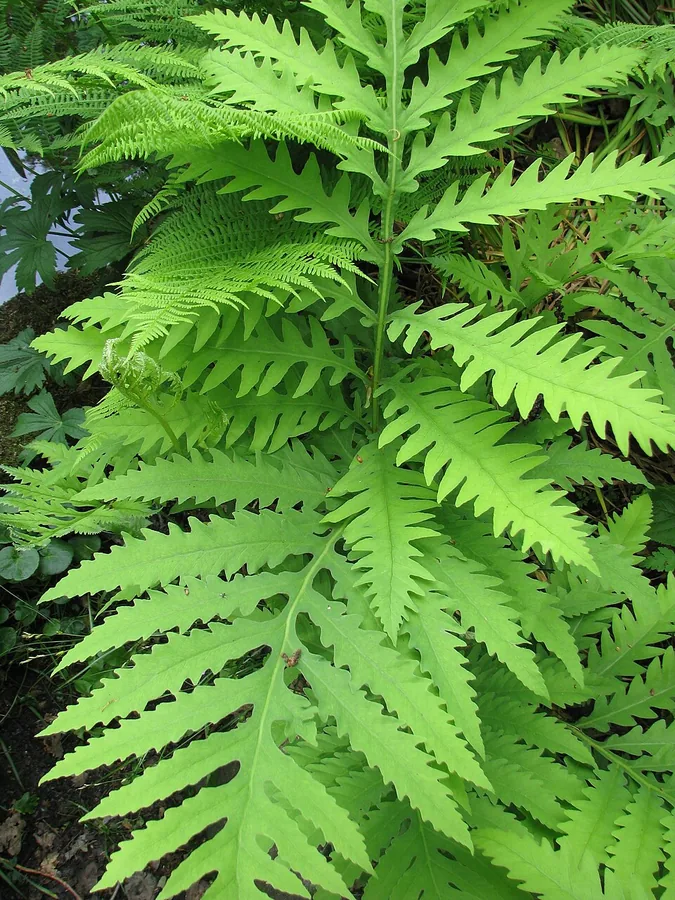
Onoclea sensibilis is a wetland fern native across North America, at home along pond margins and in shaded borders because that is the ground it evolved in. Its common name comes from the green sterile fronds, which die back at the first autumn frost, a response to cold rather than touch. Below them stand persistent bead-like fertile fronds, which carry the spores through winter and give the plant its second name, bead fern.
Its adaptability follows directly from that wetland origin. Supplied with constant moisture and shade, it tolerates a wider cold range than most garden plants, holding from zone 2 to zone 10. The fronds are broad and coarsely cut rather than finely divided, which reads as a fuller, leafier texture than most ornamental ferns.
The trait to plan around is its spread. Creeping rhizomes extend through moist soil and build an expanding colony, useful in a rain garden and a liability in a formal bed. Match the site to that habit, or install a barrier, and the plant demands little further attention.
Care
The short version: site it in shade or part shade in rich, moist soil that never dries out, water often enough to hold the root zone damp, and either allow room for the rhizomes to run or contain them with a barrier.
Light
Site it in partial to full shade, its natural understory position. It tolerates full sun only where the soil stays constantly wet, because the roots must replace the water the fronds lose, and without that supply the fronds scorch quickly in hot afternoon light.
Water
This is a wetland species, so the soil must never dry out. Hold the root zone evenly moist to wet and water every 2 to 4 days in ordinary garden soil. On a pond edge or in a bog the water table meets that demand, and supplemental watering becomes unnecessary.
Soil
It performs in rich, moist, organic ground and accepts heavy clay or soil that floods on occasion, conditions that hold water well. A slightly acidic pH of 5.0 to 6.5 suits it, though sustained moisture governs its health far more than the exact reading.
Temperature
Its cold tolerance is exceptional, spanning -49°F to 86°F (-45°C to 30°C) and covering zone 2 to zone 10. The green fronds are the frost-tender part and collapse at the first hard freeze, while the insulated rhizome survives underground to regrow the following spring.
Humidity
It favors humid air in the 50% to 80% range, which the shaded, moist sites it prefers produce as a matter of course. In dry, exposed air the fronds transpire faster than the roots can replace, and the margins crisp and look tired.
Feeding
Feeding is largely unnecessary in suitable soil. A light spring topdressing of compost or leaf mold supplies what it needs, and in rich ground even that can be skipped, since surplus nutrients only accelerate the spread you will later have to contain.
Pruning
Pruning is minimal by nature. Cut back the dead fronds once they collapse at the first hard frost, or leave them and tidy in early spring before new growth breaks, and remove any tattered or scorched fronds through the season.
Repotting
It is not suited to containers. Manage vigor instead by lifting and dividing congested clumps in spring every few years, once the rhizomes crowd the crown or extend well past the original patch.
Size & spacing
Mature plants reach 12 to 35 inches (30 to 90 cm) tall with a comparable spread. Set divisions 24 to 35 inches (60 to 90 cm) apart, allowing for continued outward travel of the rhizomes beyond that initial spacing.
When to plant
As a hardy perennial, this fern involves planting timing rather than a frost deadline. Set plants out in spring once the soil is workable, and lift and divide established clumps in spring or early fall when they outgrow their space, seasons when cool, moist conditions favor recovery.
Northern hemisphere
Southern hemisphere
Typical months for a temperate climate: start earlier in warm zones, later where spring frosts linger.
- Plant: spring
Hardiness
USDA hardiness zones: 2–10
Temperature: down to -46°C
Troubleshooting
Most complaints with this species reduce to a single cause, which is inadequate soil moisture. Because it evolved in wet ground, the fronds and the spread both signal what the plant needs. Match the symptom below and correct the underlying moisture or siting before damage sets in.
Fronds yellowing and crisping in summer
The disorder is drought stress, the failure this wetland fern cannot tolerate. Deprived of the moisture it evolved with, the frond margins lose turgor, curl, and brown, most severely under afternoon sun. Restore deep, consistent watering, apply organic mulch to slow evaporation, and relocate the plant to shade in hot climates.
Fix:
- Water deeply to keep soil consistently moist
- Apply organic mulch to conserve moisture
- Move to part or full shade in hot climates
- Remove withered fronds
New fronds emerging at a distance from the clump
The cause is the plant's defining habit, spread by creeping rhizomes, which advance freely through moist soil and overtake less vigorous neighbors. Install a deep root barrier to block the rhizomes, lift and divide the runners in spring, or assign it a rain garden or pond edge where colonization is an asset rather than a problem.
Fix:
- Install a deep root barrier
- Dig and divide or remove spreading rhizomes in spring
- Confine to contained or naturalized areas
Fronds blackening and collapsing after the first frost
This is normal seasonal dieback, the frost response that names the species. The green sterile fronds are cold-tender and fail at the first freeze, while the insulated rhizome persists below ground unharmed. Cut back the dead fronds and take no further action, since the rhizome regenerates fresh growth the following spring.
Fix:
- No action needed; cut back the dead fronds
- Rhizome regrows new fronds the following spring
Toxicity
For households with pets and children, the record is reassuring: this is a true fern with no toxin, safe to plant and handle without gloves. The one real caution concerns its vigor rather than any chemistry, since the rhizomes carry it well past where it was set.
Safe for
People · Cats · Dogs · Horses · Rabbits · Livestock · Birds
Cats None
The ASPCA classifies this true fern as non-toxic, so ingestion by a cat presents no poisoning risk. A large mouthful may provoke mild, self-limiting gastrointestinal upset, the mechanical response any coarse plant matter can trigger.
Dogs None
No toxin is present in the fronds, so dogs are unaffected chemically. The likely consequence of persistent chewing is transient loose stool driven by the indigestible fiber rather than any poisoning.
Horses None
The living plant contains nothing toxic, so a grazing horse takes no harm from it. The fronds are coarse and unpalatable, and horses reject them under normal pasture conditions.
Rabbits None
Rabbits browse the fronds without toxic risk. Introduce only small quantities at a time, since an abrupt increase in any fresh green can disrupt a sensitive digestive system.
Livestock None
The plant carries no compounds hazardous to cattle, goats, or sheep. Its tough, fibrous fronds are low in palatability, so grazing animals seldom select it in the first place.
Birds None
Poultry and other birds can peck at it without risk. The bead-like fertile fronds hold spores through winter, and some wild birds work through them for that food.
People None
Contact with the fronds and spores carries no documented hazard, so planting and dividing it barehanded is safe. It has no culinary use, so there is no reason to consume it.
Handling the fronds and spores poses no known contact hazard to people; the risk is from ingestion by grazing animals, especially fern mixed into horse hay.
Helpline numbers

United States
ASPCA Animal Poison Control: (888) 426-4435 (fee applies)

United Kingdom
Animal PoisonLine: 01202 509000 (fee applies)

Australia
Animal Poisons Helpline: 1300 869 738
Varieties
The selection here is minimal, which is no drawback. The wild species is the plant nearly every grower plants and the one the trade offers.
Onoclea sensibilis (species)
The wild species accounts for nearly all plants in cultivation, valued for its broad, coarsely cut green fronds and the distinctive bead-like fertile fronds that named cultivars rarely improve upon.
How to propagate
Propagation is straightforward because the rhizomes that drive the plant's spread also make division simple. The same growth habit that has to be contained in the bed works in your favor at the propagation bench.
DivisionEasy
Early spring or fall · 1 to 2 seasons
Division is the practical method, best carried out in early spring or fall while conditions are cool and moist. Lift a congested clump, cut the creeping rhizomes into sections that each retain an active growing point, and replant them without delay. Held in moist soil, the divisions establish over the next one to two seasons. Spore culture on a moist sterile medium is possible but slow and exacting, and it offers no advantage over dividing the rhizomes.
Myths
The sensitive fern folds up when you touch it, like a Mimosa.
The fronds show no thigmonastic response and do not move when handled. The name records their sensitivity to frost, since the green sterile fronds die back at the first autumn cold, a reaction to falling temperature rather than to contact.
A fern in the garden will take over and smother everything around it.
It does spread, but at a pace you can govern. The creeping rhizomes advance through moist soil and can crowd neighbors over time, so a root barrier or a contained, naturalized site holds it within bounds with little ongoing effort.