Ornamental · Onocleaceae
Ostrich Fern
Matteuccia struthiopteris
Give it shade and steady moisture, and this hardy fern raises knee-high fronds shaped like green shuttlecocks.
Partial shade
Every 3–7 days
USDA 3–7
3–6 ft · 0.9–1.8 m
Overview
Among cultivated ferns, the ostrich fern ranks with the easiest hardy species to establish, grown for tall, arching fronds arranged in the vase-like whorl that suggests a shuttlecock. Its extreme cold tolerance, down to -40°F (-40°C), lets it succeed in zones 3 through 7, a range that excludes many ornamentals. Given the damp, shaded conditions it evolved for, it forms a self-sustaining colony with minimal intervention.
Two site factors govern its performance: shade and moisture. As a plant of cool riparian woodland and streamside soils, it depends on roots that stay cool and wet, and it deteriorates on hot, dry, exposed ground. Placed in consistently damp soil out of direct afternoon sun, it develops fronds reaching 3 to 6 feet (90 to 180 cm) tall.
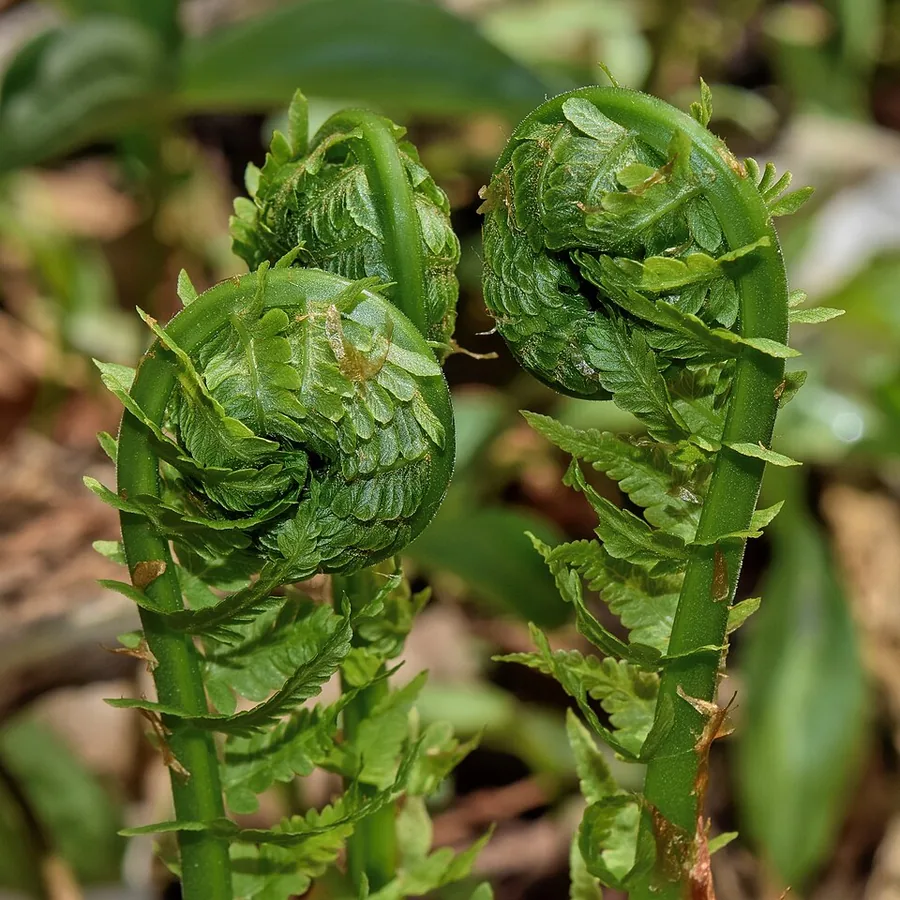
One habit warrants planning. The fern advances by underground runners and enlarges its patch year on year, so allow space or install containment at planting. Its second notable feature is the fiddlehead, the tightly coiled emerging crown harvested in early spring as a foraged vegetable and safe to eat only after thorough cooking.
Care
The short version: part to full shade over rich, consistently moist soil that never dries, matching the streamside habitat it evolved in. Mulch to retain moisture and moderate root temperature, apply a light spring feed, and allow space or a root barrier to manage the colony's rhizomatous spread.
Light
Site this fern in part to full shade. It tolerates a little morning sun where soil moisture is maintained, but hot afternoon sun exceeds what the fronds can transpire against, scorching the tissue and triggering premature dormancy.
Water
Hold the soil consistently moist to wet and never let it dry, because the fern is adapted to streambanks and damp woodland and lacks drought defenses. Under normal conditions, watering every 3 to 7 days suffices, with more frequent application through heat.
Soil
Establish it in rich, humusy ground with good moisture retention, and note that it tolerates clay, which holds water well. It performs across a pH of 5.0 to 7.0, so most garden soils are suitable provided they stay damp.
Temperature
Cold imposes no limit here, with hardiness spanning -40°F to 86°F (-40°C to 30°C). The constraint lies at the upper end, since sustained heat is the trigger that drives the fronds into summer dormancy.
Humidity
It favors the moist air of a shaded, damp position, roughly 40% to 70%. Outdoors this is self-regulating once soil moisture and shade are correct, requiring no supplementation.
Feeding
A light spring application of a balanced fertilizer meets its needs, or simply topdress with compost or leaf-mold mulch. A fern in genuinely humusy woodland soil derives most of its nutrition from that substrate.
Pruning
Pruning requirements are minimal. Cut tattered or browned green fronds in late fall or early spring before the fiddleheads emerge, and leave the brown fertile fronds standing over winter for structural interest, removing them in spring.
Repotting
This species is not a container subject. In place of repotting, lift and divide a congested colony every 3 to 4 years once crown crowding reduces frond size and vigor.
Size & spacing
Mature fronds attain 3 to 6 feet (90 to 180 cm) in height, and an established colony extends 2 to 8 feet (60 to 240 cm) wide over time. Space to accommodate that eventual footprint, or restrict it with a root barrier.
When to plant
This is a spring-active fern with a summer rest. Establish new plants in spring after frost, or in early fall, and harvest the coiled fiddleheads in early spring as the crowns emerge but before the fronds unfurl. Anticipate the fronds tiring and browning by midsummer as the crown enters its natural dormancy.
Northern hemisphere
Southern hemisphere
Typical months for a temperate climate: start earlier in warm zones, later where spring frosts linger.
- Plant: Spring after frost, or early fall
- Harvest: Non-flowering; harvest fiddleheads in early spring as the coiled crowns emerge, before the fronds unfurl
Hardiness
USDA hardiness zones: 3–7
Temperature: down to -40°C
Troubleshooting
The ostrich fern presents few genuine problems, and most apparent disorders are the plant's normal response to heat or to running out of room. Interpret the signs below before intervening. In most cases the corrective is shade, water, or a spade rather than any treatment.
Outlying crowns emerging at a distance from the main clump
This reflects the fern's rhizomatous spread, a clonal growth strategy rather than any pathology. The plant advances by underground stolons that travel laterally and surface as new fiddlehead crowns, so a vigorous colony expands steadily outward. Excavating the outlying crowns in spring or fall removes the advance, while a deep root barrier physically intercepts the stolons and holds the patch to its intended footprint.
Fix:
- Dig out unwanted crowns and runners in spring or fall
- Install a physical root barrier to contain the colony
- Divide and relocate or discard excess crowns
Frond scorch and dieback in mid-to-late summer
Part of this decline is programmed: summer dormancy is the ostrich fern's natural response to rising heat, when the crown slows and older fronds are spent. The remainder is true heat and drought stress, since fronds without cool, moist roots lose water faster than they can replace it, and excess sun accelerates the damage. Deep watering restores the moisture the crown needs, mulch buffers root temperature, and next spring the crown regenerates a fresh flush of fronds.
Fix:
- Water deeply to keep soil consistently moist
- Mulch to retain moisture and cool the roots
- Provide more shade in hot climates
- Remove tattered fronds; the plant rebounds from the crown the following spring
Toxicity
For a household with animals, the record is reassuring: the ostrich fern contains no known toxins and is not flagged as a poison to pets or livestock. Its fiddleheads are consumed by people as well, though only after thorough cooking. The single real caution attaches to preparing foraged fiddleheads for the table, not to pets contacting the plant.
Safe for
People · Cats · Dogs · Horses · Rabbits · Livestock · Birds
Cats None
No feline poisoning is documented for this fern, so an exploratory nibble carries no expected consequence. Any greenery consumed to excess may provoke a nonspecific vomit or a loose stool, an effect of volume rather than toxin.
Dogs None
The record shows no canine poisoning from this species. In a sensitive individual, a chewed frond amounts to at most transient gastrointestinal upset lasting about a day.
Horses None
No equine harm is on record for ostrich fern. Unlike bracken, which contains thiaminase and other toxins implicated in pasture poisoning, this fern presents no such hazard to a grazing horse.
Rabbits None
Rabbits browse the fronds without any documented adverse effect. Introduce the forage gradually, as with any new green, to let the hindgut microbiota adapt.
Livestock None
Cattle, goats, and sheep graze safely around an ostrich fern, since it lacks the toxic constituents that make bracken dangerous to ruminants. It poses no known risk in mixed pasture.
Birds None
No avian toxicity is reported, for cage birds or backyard poultry alike. A hen sampling the fronds is exposed to no documented hazard.
People None
The young fiddleheads are an esteemed spring vegetable once the heat treatment is complete. Boil them for 15 minutes or steam them for 10 to 12, because raw or undercooked fiddleheads carry a documented risk of foodborne illness.
No special contact precautions are documented. If foraging fiddleheads for food, rub off the brown papery husk, wash, and cook thoroughly (boil 15 minutes or steam 10-12 minutes); never eat them raw or merely sauteed/stir-fried/microwaved.
Varieties
Most plantings use the unimproved species, but a few selections are worth knowing where extra size or the true native form is wanted. These are the ones to recognize by name.
'The King'
An oversized selection distinguished by a heavy crown and fronds roughly half again the species dimensions, with vigorous specimens approaching 7 feet tall.
'Jumbo'
A vigorous large-fronded selection chosen where maximum frond size, the largest shuttlecock the plant can produce, is the objective.
subsp./var. pensylvanica
The North American native infraspecific form of the species, taxonomically distinguished from the Eurasian populations of the same fern.
How to propagate
Propagating an ostrich fern demands little technique, because the plant is already generating clones underground and leaves the grower only to lift and relocate the results.
DivisionEasy
Spring as crowns emerge, or early fall · 1 to 2 growing seasons
Divide by lifting and splitting the crowns as they break dormancy in spring, or alternatively in early fall. The species propagates itself readily through underground stolons that surface as offset crowns, and these detach cleanly for replanting. Allow a division 1 to 2 growing seasons to establish a root system and resume producing full-sized fronds. Spore propagation from the brown fertile fronds occurs in the wild, but vegetative division is the practical and dependable method in cultivation.
Myths
Fiddleheads can be consumed raw or lightly cooked, as with other early greens.
Raw and undercooked fiddleheads have caused documented foodborne-illness outbreaks across the US and Canada since 1994, presenting as nausea, vomiting, cramps, diarrhea, and headaches. The reliable protocol is to rub off the brown husk, then boil them 15 minutes or steam them 10 to 12 minutes. A brief saute, stir-fry, or microwave fails to hold the tissue at temperature long enough to render it safe.
The fiddleheads of any fern species are edible.
Only ostrich fern fiddleheads are recommended for consumption, and only after thorough cooking. Bracken and other ferns can be toxic or carcinogenic, which makes accurate species identification the essential first step before any harvest reaches the kitchen.
Ostrich fern belongs solely to Eurasia and is foreign to North America.
Taxonomically the species is native to both Eurasia and North America. The North American populations are recognized as their own form, M. struthiopteris subsp./var. pensylvanica.