Ornamental · Cyperaceae
Sedge
Carex
Match each Carex species to its niche and the genus rewards you with easy, year-round texture, from open sun to full shade.
Partial shade
Every 3–10 days
USDA 3–9
6–35 in · 15–90 cm
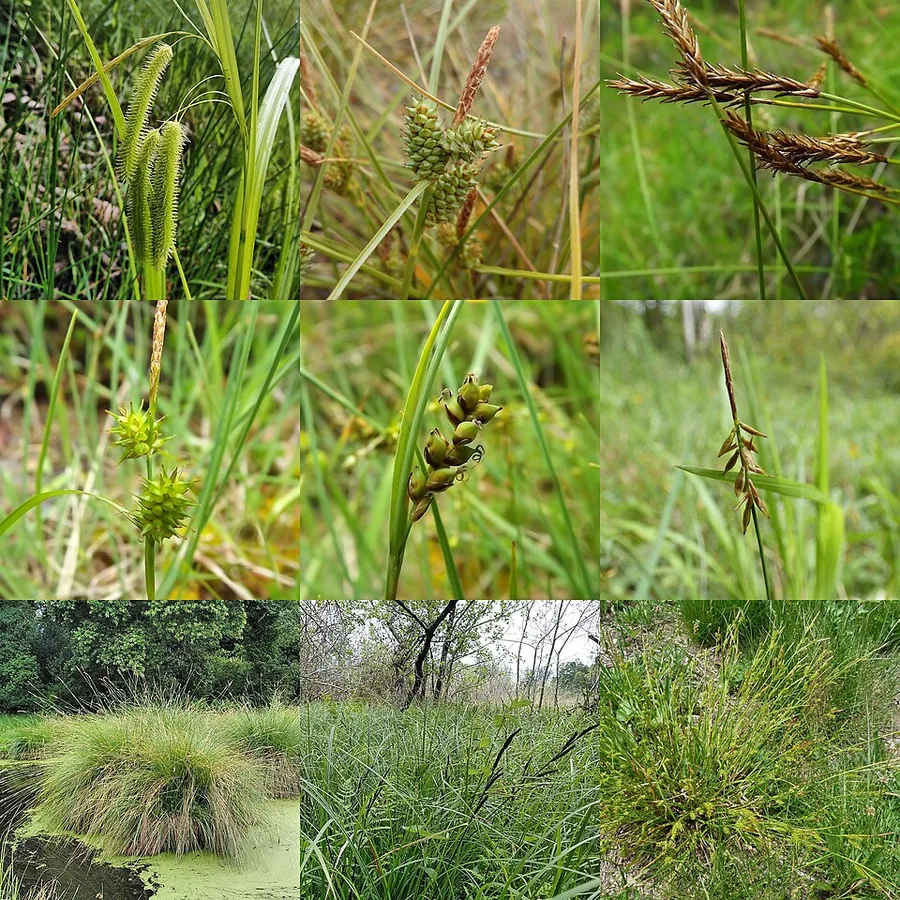
Overview
Sedge ranks among the most useful and least demanding perennials you can grow. The genus Carex spans roughly 2,100 species, from groundcovers only a few inches tall to arching clumps approaching a couple of feet. The foliage carries the ornamental value here, in green, gold, white-margined, and even bronze and copper forms.
One caveat governs success with the genus: moisture preference varies enormously between species. Wetland types demand constantly moist to wet soil and colonize pond margins, whereas dry-shade species occupy the dry ground beneath trees where competition and low light exclude most plants. Fit the species to the site and cultivation becomes close to automatic.
After establishment, sedge demands little intervention. Growth is slow, the habit holds its form, the genus tolerates the full span from full sun to full shade, and pest and disease pressure stays low. A single late-winter cleanup accounts for essentially the whole annual workload.
Care
The short version: identify the species before planting, because moisture preference splits the genus sharply between wetland types and dry-shade types. Supply the moisture that species evolved for, place it anywhere from full sun to deep shade, cut back once a year, and the plant largely maintains itself.
Light
Sedge tolerates an unusually wide light range, from full sun to full shade, with optimum performance for most species in partial shade. Because higher light increases water demand, sun-grown plants require correspondingly steadier moisture, so the two must be balanced.
Water
Water strategy hinges entirely on the species. Moisture-loving taxa such as Carex elata, oshimensis, and morrowii require consistently moist to wet soil, particularly under sun where demand rises, while dry-shade species like Carex pensylvanica perform in dry to medium soil. Irrigate every 3 to 10 days at an interval matched to the species, and err toward less, because the genus signals stress rapidly under waterlogging.
Soil
Most ornamental sedges want rich, organic soil held moist to wet, though dry-shade species tolerate leaner, drier ground, reflecting their native habitats. Target a pH of 5.5 to 7.0, spanning slightly acidic to neutral, which encompasses the majority of garden soils.
Temperature
Across the genus, sedge withstands 19°F to 84°F (-7°C to 29°C). That lower limit explains its value in cold-climate plantings, where it retains green or evergreen foliage after tender perennials have died back.
Humidity
Ambient outdoor humidity meets the plant's needs, so no target figure applies. Root-zone moisture governs performance, not atmospheric humidity, which is why soil moisture, not the air, drives its condition.
Feeding
Sedge has minimal nutrient requirements. A light spring application of balanced or slow-release fertilizer suffices, and it is often unnecessary in fertile soil. Excess feeding induces stress rather than vigor, so restraint is the correct approach.
Pruning
Maintenance pruning amounts to one annual renovation. In late winter or early spring, comb out or shear away the old, brown, tattered foliage to refresh the crown. Avoid cutting evergreen and semi-evergreen types to the ground, because the genus recovers slowly from hard cutbacks.
Repotting
Divide potted or congested clumps every 2 to 3 years. The diagnostic signs are a dead, hollow crown center, roots filling the container, and declining vigor or thinning foliage, all indicating the clump has outgrown its space.
Size & spacing
Mature dimensions run 6 to 35 inches (15 to 90 cm) in both height and spread, depending on species. Space to the expected mature width: closer for a knitting groundcover, wider to display individual clumps as specimens.
When to plant
Sedge is a cold-hardy perennial, with cold tolerance reaching USDA zone 3. Plant in spring or early fall, once the soil is workable enough to settle roots, and expect the foliage to hold interest from spring into summer. No harvest applies, because the leaves, not any flower or fruit, are the ornamental feature.
Northern hemisphere
Southern hemisphere
Typical months for a temperate climate: start earlier in warm zones, later where spring frosts linger.
- Sow: Late winter to early spring (8-10 weeks before last frost); seed of many species germinates slowly and erratically
- Plant: Spring or early fall once soil is workable
- Harvest: Spring to early summer (foliage is the main ornamental feature)
Hardiness
USDA hardiness zones: 3–9
Temperature: down to -40°C
Troubleshooting
Sedge presents few disorders, and most reduce to a single cause: a species grown outside its moisture and light range. Monitor the foliage and crown for the early indicators below, and intervene before the problem moves through the clump.
New planting declines or thins after installation
Early decline nearly always reflects a species and site mismatch rather than chance. A wetland species set in dry soil, or a dry-shade species held wet, cannot meet its moisture requirement and thins accordingly. Determine the species, relocate or amend the site to its moisture and light range, and allow a full first season for slow establishment.
Fix:
- Identify the species and its preferred moisture/light range
- Move or replant to a matching site, or amend soil and adjust irrigation
- Provide consistent moisture for sun-grown, moisture-loving species
- Be patient through slow establishment
Rust pustules, leaf spots, or a rotting crown
Orange pustules or dark lesions indicate rust or leaf spot fungi, while a soft, blackened crown indicates rot driven by saturated soil. Because both advance in still, wet conditions, improve air movement through the clump, irrigate at the base rather than overhead, and remove infected foliage. For crown rot, correct drainage and reduce watering, unless the species is a true wetland type that tolerates saturation.
Fix:
- Improve air circulation and avoid overhead watering
- Remove and discard affected foliage
- Correct drainage and reduce watering if crown rot is present
- Hose off or treat aphids if present
Old outer foliage browning and turning ragged
Browning outer leaves represent normal senescence, not pathology. Older foliage dies back over winter while the crown remains viable and regenerates in spring, so the clump is healthier than it looks. In late winter, comb out the dead leaves by hand or rake, shear deciduous types, and merely tidy evergreen ones to avoid setting them back.
Fix:
- In late winter or early spring, comb out dead foliage with gloved hands or a rake
- Shear deciduous types back; only tidy (do not scalp) evergreen types
- Remove debris to let new growth emerge
Toxicity
For households with pets or children, the assessment is favorable: sedge is not poisonous. Carex does not appear on the ASPCA toxic-plant list, which supports a non-toxic rating wherever animals have access. Two non-toxic hazards remain: leaf margins abrasive enough to nick skin, and pollen that can provoke allergy in sensitive people.
Safe for
People · Cats · Dogs · Horses · Rabbits · Livestock · Birds
Cats Safe
Carex poses no toxic risk to cats. Ingested blades can irritate the stomach and prompt occasional vomiting from the coarse texture, but the plant itself is not poisonous.
Dogs Safe
Dogs are likewise unaffected. The coarse foliage may cause mild, transient stomach upset if swallowed, but the plant produces no toxic effect.
Horses Safe
Carex is non-toxic to horses, and it occurs naturally in the pastures and wet meadows where they graze without incident.
Rabbits Safe
Rabbits may consume sedge without risk, as the foliage is simply non-toxic forage.
Livestock Safe
Cattle, goats, and sheep can graze sedge safely. Native species are widespread across rangeland and wetland with no documented poisoning.
Birds Safe
Birds face no toxic risk. Numerous wild species consume sedge seed, and domestic poultry may forage on the plant without harm.
People Safe
For people, no poisoning risk exists. The leaf margins can abrade or nick skin and the pollen may trigger allergic response, but neither effect is toxicological.
Leaf edges and stems can be slightly rough or sharp, and pollen may bother allergy-prone people. Pets that nibble foliage may vomit from the roughage even though the plant is not poisonous.
Varieties
The genus offers thousands of species and cultivars, but a short list earns a place in most gardens. The following selections stand out by appearance and by the site conditions each one requires.
Carex morrowii 'Ice Dance'
A vigorous, rhizomatous groundcover for shade, bearing dark green blades cleanly white-margined, its running rhizomes driving lateral spread.
Carex morrowii 'Variegata'
A clump-forming variegated Japanese sedge whose white-margined green foliage remains contained rather than spreading, unlike the running cultivars.
Carex oshimensis 'Evergold'
A compact evergreen selection with arching foliage centrally striped bright gold and green-margined, the most ornamentally striking of the group.
Carex pensylvanica
The native Pennsylvania sedge reaches roughly 8 inches, tolerating dry to medium shade, which recommends it as a dry-shade groundcover and turf substitute.
Carex elata 'Aurea'
Bowles' golden sedge, distinguished by golden-yellow foliage, performs in wet ground and along pond margins, the exceptional sedge suited to standing water.
Carex flagellifera / Carex buchananii
These New Zealand sedges depart from the typical green, producing leathery, reddish-brown foliage in bronze and copper tones.
How to propagate
Sedge propagates readily, though the two methods differ sharply in reliability. The mechanism behind each, and the correct timing, follows.
DivisionEasy
Spring or early fall · One growing season
Division, performed in spring or early fall, is the most reliable propagation method for the genus. Lift an established clump and separate it into divisions, each retaining roots and a portion of crown; replanted, they re-establish within a single growing season.
SeedModerate
Late winter to spring · One to two seasons; slow and erratic
Seed propagation succeeds but demands patience. Sown from late winter into spring, germination proceeds slowly and erratically over one to two seasons, and many named cultivars will not reproduce true from seed. Where rapid groundcover is the goal, division or nursery stock outperforms seed.
Myths
Sedges are merely a category of ornamental grass.
Superficial resemblance aside, sedges constitute their own family, Cyperaceae, distinct from the true grasses. The diagnostic character is the culm: sedge stems are solid and triangular in cross-section, detectable by rolling one between finger and thumb, whereas grass stems are round, hollow, and jointed. This distinction has practical consequence, since many sedges occupy the shaded, moist to wet niches that exclude true grasses.