Ornamental · Cyperaceae
Papyrus
Cyperus papyrus
Rooted in shallow water under full sun, papyrus raises a summer-long colony of thread-fine green rays.
Full sun
Every 0–1 days
61–95°F · 16–35°C
USDA 9–11
Overview
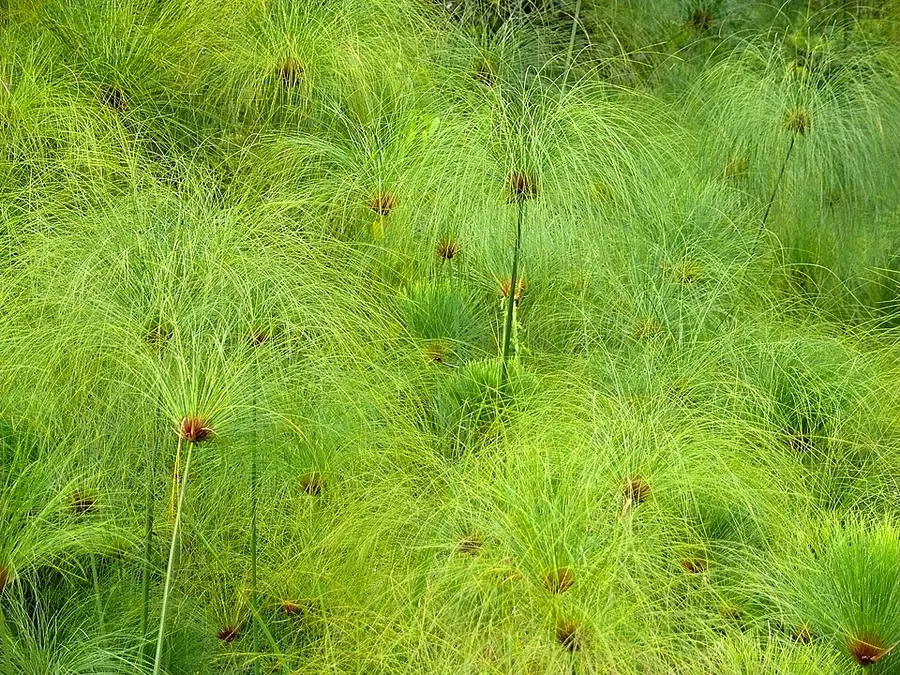
Papyrus supplied the ancient world with its writing surface, and the living plant still shows why. Tall, leafless, three-sided stems arise from a wet base and terminate in a fine spray of thread-like rays, resembling green fireworks arrested at the moment of bursting. Botanically it belongs to the sedge family rather than the grasses, and it grows quickly into a bold clump at a pond edge or in a pot standing in water.
In cultivation it behaves as the marginal aquatic it is in nature, evolved on the wet margins of the Nile. The governing requirement is water: the roots must remain soaked or submerged and never dry, since the tissue is adapted to permanently wet ground. With that and full sun, the plant reaches 5 to 8 feet (150 to 240 cm) in a single warm season, producing new stems faster than nearly any other subject grown at the waterline.
Its limitation is cold tolerance. Papyrus persists outdoors year round only in zones 9 to 11, so beyond that range growers treat it as a bold summer feature, overwintering it under cover or renewing it each spring. In either regime the result is the same distinctive silhouette that has furnished water gardens for thousands of years.
Care
The short version: full sun and a permanently wet root zone. Stand the pot in shallow water or plant it at a pond margin, keep the soil from ever drying, feed through summer, and overwinter it under cover before frost where winters turn cold.
Light
Provide papyrus with full sun to produce the strongest, most upright stems. It persists in partial shade, but the reduced light yields weaker, elongated growth that lodges and flops more readily.
Water
This is the single most important requirement. As a bog aquatic that must never dry out, papyrus needs soil held soaked to boggy or shallow standing water up to about 6 inches deep. In containers, stand the pot in a water-filled saucer or submerge it in a pond, since desiccation is the principal cause of failure in this plant.
Soil
Grow it in rich, fertile clay or loam maintained wet to boggy. It performs best in saturated ground or standing water at a pond or water-garden margin, and it accepts a broad pH range from 6.0 to 8.0.
Temperature
Papyrus is warmth-demanding and thrives between 61°F and 95°F (16°C to 35°C). It has no frost tolerance, so low temperature is the second major hazard alongside drought.
Humidity
High humidity suits it, as expected of a plant rooted in water. No target figure applies outdoors, but under interior conditions it benefits from moist air, and the water-filled saucer it stands in supplies that alongside its water needs.
Feeding
Feed through the warm growing season, about monthly in summer, with a balanced fertilizer or aquatic plant tabs. This regular nutrient supply supports the rapid production of new stems characteristic of the species.
Pruning
Cut dead, browned, or frost-damaged stems to the base and remove spent flower heads. Thinning a congested clump periodically keeps the stand open and upright as it fills in.
Repotting
Because this vigorous clump-former fills a container quickly, step it up every 1 to 2 years in spring. Roots and rhizomes bulging the pot, smaller new stems, or a clump crowding the rim all indicate the plant has outgrown its space.
Size & spacing
Allow for a clump of 5 to 8 feet (150 to 240 cm) in height and 2 to 4 feet (60 to 120 cm) in spread. Site it with that allowance at the waterline so the stand can develop fully without crowding adjacent plantings.
When to plant
Papyrus growth is governed by warmth, and the plant will not survive frost. Start seed or divisions from late winter to spring, transplant into warm water and soil after the last frost in late spring, and expect the greenish-brown flower clusters to open from July through September.
Northern hemisphere
Southern hemisphere
Typical months for a temperate climate: start earlier in warm zones, later where spring frosts linger.
- Sow: Late winter to spring, started warm in wet soil.
- Plant: After all danger of frost has passed and water and soil are warm, late spring.
- Harvest: July to September, greenish-brown flower clusters on the thread-like rays.
Hardiness
USDA hardiness zones: 9–11
Temperature: down to -7°C
Troubleshooting
Nearly every disorder in papyrus resolves to a problem of water supply or cold exposure. Examine the stems first, since browning, lodging, and frost injury register there before they show elsewhere. Match the symptom to the entries below and intervene while the rhizome can still regenerate.
Browning, collapsing stems and their bract heads
This pattern points to drought stress, the leading cause of loss in this species. Because papyrus is a bog aquatic adapted to permanently wet ground, its roots cannot sustain the tall stems once the soil dries or the standing water falls below the root zone, and the stems brown and collapse as a result. Restore shallow standing water or a soaked root zone, then cut the dead stems to the base so the rhizome can push replacement growth.
Fix:
- Move the plant back into shallow standing water or keep soil saturated at all times
- Stand container pots in a water-filled saucer or sink them in a pond
- Cut off fully browned stems at the base to let fresh growth emerge
Whole clump blackens and collapses following a freeze
A sudden collapse after cold indicates frost damage in a tender species hardy only to roughly zones 9 to 11. Frost ruptures the plant's cells, which is why the stems blacken and the clump can die outright once temperatures drop below freezing. Where the plant cannot remain outdoors, overwinter container specimens indoors before the first frost, standing the pot in a water-filled saucer at a bright window in a cool 60°F to 65°F (16°C to 18°C) room, and insulate the rhizome from freezing.
Fix:
- Move container plants indoors before frost; set the pot in a water-filled saucer near a bright sunny window in a cool 60 to 65 degrees F room
- Treat as an annual and replant in spring where it cannot be overwintered
- Cut back cold-damaged stems and protect the rhizome from freezing
Tall stems flopping or leaning over
Leaning stems reflect either mechanical wind loading on a top-heavy stand or weak, etiolated growth produced under insufficient light, where reduced light limits the structural strength the stems need to stand. An undersized container compounds it, because it lacks the mass to anchor a clump this large. Site the plant in full sun and out of strong wind so the stems develop firmly, move it to a larger, heavier container for a stable base, and stake the tallest stems where support is still wanting.
Fix:
- Site plants in full sun and out of strong wind
- Pot into a larger, heavier container to anchor the clump
- Stake or support the tallest stems if needed
Sticky film, webbing, or pests on plants grown indoors
Outdoors papyrus is largely free of serious pests, but specimens overwintered indoors become vulnerable to spider mites, aphids, or mealybugs because the dry, still indoor air stresses the plant and favors these insects. Examine the stems and bracts for webbing or cottony masses, dislodge them by rinsing or wiping, and apply insecticidal soap if the population persists. Raising light and air movement reduces the underlying stress and discourages reinfestation.
Fix:
- Rinse or wipe off pests and improve air flow
- Treat with insecticidal soap if infestation persists
- Improve light and airflow to reduce stress
Toxicity
For a pet-inclusive planting the verdict is favorable: papyrus is not toxic. It is absent from the ASPCA's poisonous-plant listings, and no compound in the stems or seed heads is known to harm cats, dogs, or other animals. The most a pet that ingests a mouthful is likely to experience is a brief, mild digestive upset.
Safe for
People · Cats · Dogs · Horses · Rabbits · Livestock · Birds
Cats None
Considered non-toxic to cats. Ingestion of the stems produces at most a brief, mild digestive upset, with no systemic toxicity on record.
Dogs None
No toxic principle affects dogs. A dog that chews the foliage may show transient, mild gastrointestinal irritation and nothing further.
Horses None
Presents no poisoning risk to horses, since the plant contains no compound known to harm them.
Rabbits None
Safe for rabbits to browse, although the foliage is not part of their usual forage.
Livestock None
Grazing cattle, goats, and sheep near a papyrus stand carries no toxic hazard.
Birds None
Harmless to birds, which may perch within the stand or pick at the airy seed heads without ill effect.
People None
Non-toxic to people. Its historical significance lies in supplying the writing surface of ancient Egypt rather than in any edible use.
No special handling required; keep curious pets from chewing large amounts of foliage to avoid minor stomach upset.
Varieties
The wild species is large, so most growers cultivate a dwarf form or a closely related umbrella sedge in its place. The forms encountered by name are as follows.
'King Tut' / 'Prince Tut' (Cyperus papyrus dwarf selections)
These dwarf selections of the species retain the triangular stems and firework-burst ray heads of the type while reaching only about 4 to 5 feet, well short of the 15 the wild plant attains.
'Baby Tut' / 'Little Tut' (Cyperus involucratus)
A compact umbrella-sedge selection of roughly 1.5 to 2 feet in which the fine ray head of true papyrus is replaced by whorled, leaf-like arching bracts.
Umbrella palm / umbrella sedge (Cyperus alternifolius / Cyperus involucratus)
A smaller relative of 1.5 to 4 feet distinguished by 20 to 25 broad, leaf-like bracts whorled at the stem apex into an umbrella, rather than the thread-like rays that characterize papyrus.
Dwarf papyrus (Cyperus prolifer)
A miniature commonly confused with true papyrus that spreads rapidly by rhizome and has become invasive in Florida.
How to propagate
Papyrus increases readily, and most growers divide an established clump rather than raise new plants from the beginning.
DivisionEasy
Spring · A few weeks in warm, wet conditions
Division is the fastest and most dependable method of propagation. In spring, lift the woody rhizome clump and separate it into sections, then replant them into wet, boggy soil or shallow water, where warmth drives establishment within a few weeks.
SeedModerate
Spring · Several weeks to months
Seed offers an alternative, sown in spring onto warm, wet soil. Establishment is slower by this route, running from several weeks to months, which is why most growers favor division for reliable increase.
Myths
Papyrus is a grass.
The resemblance is superficial: papyrus is a sedge in the family Cyperaceae, and its solid, three-sided stems distinguish it from the round, jointed stems that define a true grass. This is the ancient Egyptian paper plant, and its pith was sliced and pressed into the first papyrus sheets. The diagnostic rule holds: sedges have edges, and papyrus is a sedge.