Ornamental · Poaceae
Northern Sea Oats
Chasmanthium latifolium
A rhizomatous woodland grass built for moist shade, hung with flat oat-like spikelets that persist from summer into winter.
Partial shade
Every 3–7 days
USDA 3–9
2–5 ft · 0.6–1.5 m
Overview
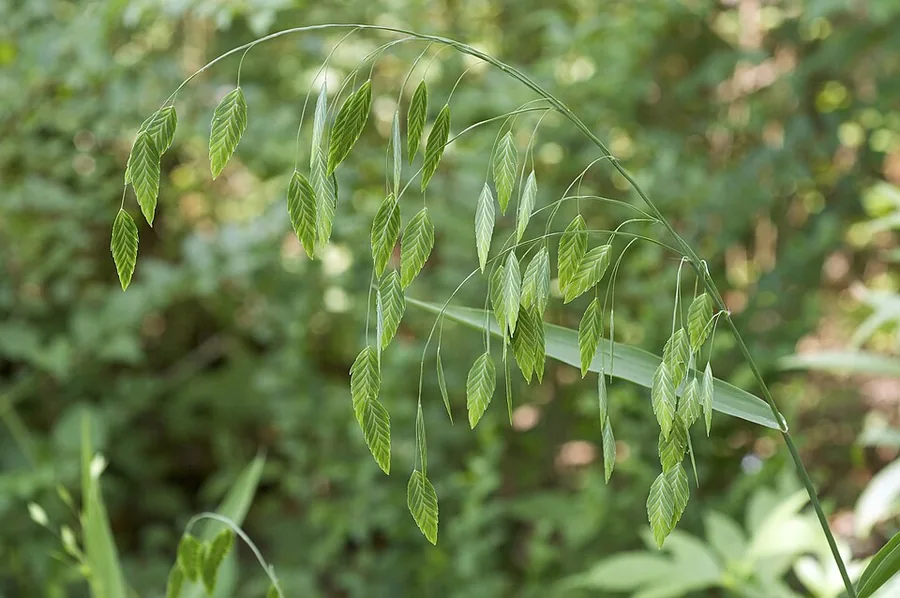
Northern sea oats is a clumping native grass of the woodland edge, adapted to the moist, dappled shade where drought and heat stay in check. Its defining structure is the inflorescence: flat, layered spikelets shaped like oats, held on arching pedicels. The spikelets emerge green during summer, oxidize to a coppery bronze as they mature, then dry to tan and persist on the plant through much of winter.
Its adaptability follows from a broad tolerance. It performs from full sun to full shade and roots in clay, sand, wet ground, or briefly flooded sites, and it is hardy over a wide range. The one non-negotiable is soil moisture. Because the broad leaves transpire fast in sun, foliage scorches at the edges when a sunny position dries out, which is why part shade suits it best.
The same vigor has a cost. It self-sows heavily from those abundant seed heads and creeps outward on short rhizomes, so a single clump can build into a colony within a few seasons, fastest where moisture, fertility, and some sun coincide. Site it where spread is acceptable, or interrupt the seed cycle by removing the heads before they ripen.
Care
The short version: it grows best in part shade with consistently moist soil, since that combination limits leaf scorch, though it tolerates a wide range of light and soil. Cut the clump to the ground in late winter, and remove the seed heads before they drop to prevent unwanted self-seeding.
Light
This grass grows across the full range from full sun to full shade, an unusual breadth. Part shade is optimal because it moderates transpiration and heat load, keeping the foliage greenest. In full sun the leaves lose water faster than the roots can replace it, so sun-grown plants demand steadier moisture to avoid scorch.
Water
Aim for consistently moist soil, and err wet rather than dry, since the plant is native to streambanks and low ground. It tolerates saturated soil and brief flooding without root injury, so a low, damp position is ideal. Sun exposure raises water demand, so those plantings need irrigating more often to keep the foliage intact.
Soil
Root tolerance is exceptionally wide, spanning clay, loam, sand, and poorly drained wet ground that would rot or starve fussier species. Average to moist, fertile, well-drained soil produces the strongest growth, but the plant adapts well below that ideal. The record specifies no pH requirement, so soil reaction is not a limiting factor.
Temperature
Cold hardiness is extreme, from about -40°F to 100°F (-40°C to 38°C), spanning most temperate climates. The perennial crown dies back and resprouts each spring, so severe winters cause no lasting harm to an established clump.
Humidity
Ambient outdoor humidity meets its needs, so atmospheric moisture is not a management variable. Root-zone moisture through summer heat is the factor that governs foliage quality.
Feeding
This is a low feeder, and heavy fertility works against you. An optional light spring application of balanced fertilizer or compost is sufficient, because rich, fertile conditions accelerate the rhizomatous and self-seeded spread you are usually trying to limit.
Pruning
Cut the clump to the ground in late winter to early spring, before new shoots emerge, to clear the previous season's dead foliage. To suppress reseeding, cut and remove the seed heads before they ripen, which interrupts seed set at the source.
Repotting
Grown in the ground rather than in containers, it has no repotting cycle. The functional equivalent is division every few years, warranted once the clump center thins or a congested crown shows reduced vigor and fewer seed heads.
Size & spacing
Expect a clump of 2 to 5 feet (60 to 152 cm) in height and 12 to 30 inches (30 to 76 cm) in spread. Allow room for the arching habit, and account for lateral rhizomatous expansion beyond the original footprint.
When to plant
The seed carries an innate dormancy, so it germinates best after cold, moist stratification, which mimics winter on the soil surface. Sow in late winter to spring, transplant in spring after frost or again in fall, and the persistent seed heads extend interest from late summer through winter.
Northern hemisphere
Southern hemisphere
Typical months for a temperate climate: start earlier in warm zones, later where spring frosts linger.
- Sow: Late winter to early spring; seed benefits from cold-moist stratification before sowing
- Plant: Spring after frost, or fall
- Harvest: Flowers August to September; showy flat oat-like seed heads emerge green in summer, turn coppery-bronze then tan and persist into winter
Hardiness
USDA hardiness zones: 3–9
Temperature: down to -40°C
Troubleshooting
Northern sea oats has no serious pests or diseases, a function of its tough native constitution, so both of its real problems are self-inflicted: excessive spread and scorch in dry sun. Identify the symptom below and correct the underlying condition rather than the symptom.
Seedlings establishing throughout the garden
The cause is prolific self-seeding: the flat oat-like heads mature and drop viable seed well beyond the parent, and short rhizomes widen the crown at the same time, both accelerated by moist, fertile soil with some sun. Remove the seed heads before they ripen to cut off the seed supply, pull volunteers while young and easily lifted, and divide the clump to check the rhizomatous front.
Fix:
- Cut and remove the seed heads before they ripen and drop to stop new seed
- Pull or dig out unwanted volunteer seedlings while young; they pull easily
- Divide and reduce the clump to contain rhizomatous spread
- Keep stalks cut down low to gradually starve out an established colony
Foliage scorching or bleaching in midsummer
This is leaf scorch, a water-balance disorder in which transpiration in hot, dry, full sun outpaces uptake from dry soil. Plants in part shade with steady moisture show little or none, which confirms the mechanism. Increase watering frequency and depth on sun-grown clumps, mulch to conserve soil moisture, and relocate chronic sufferers to dappled shade.
Fix:
- Provide more frequent, deeper watering for sun-grown plants
- Apply mulch to conserve soil moisture
- Site or transplant into part shade with moist soil for best appearance
Toxicity
This grass is not toxic. It contains no compounds harmful to cats, dogs, horses, livestock, birds, or people, consistent with ornamental grasses generally. The two caveats are mechanical and incidental: heavy grazing of foliage may provoke transient gastrointestinal upset as any bulk of grass can, and grass pollen may act as an allergen for sensitive individuals.
Safe for
People · Cats · Dogs · Horses · Rabbits · Livestock · Birds
Cats None
Non-toxic to cats. Ingesting a large volume of foliage may induce vomiting through simple mechanical irritation, the same benign response any grass produces.
Dogs None
Non-toxic to dogs. A large mouthful can trigger mild vomiting on the same mechanical basis, no different from grazing lawn grass.
Horses Safe
Safe for horses. The grass contains no toxic principles, so incidental grazing in pasture poses no risk.
Rabbits Safe
Safe for rabbits to browse. Introduce any unfamiliar green gradually so the hindgut flora can adjust, a general precaution rather than a toxicity concern.
Livestock Safe
Safe forage for cattle, goats, and sheep. It carries no compounds that would harm ruminant grazers.
Birds Safe
Harmless to birds, and many species forage the ripe spikelets for the small caryopsis inside.
People Safe
Not poisonous to people. The only exposure of note is grass pollen, a common aeroallergen for sensitive individuals.
As with any grass, pets that nibble a lot of foliage may vomit or have mild stomach upset, and grass pollen can be an allergen for sensitive people; the plant itself is not poisonous.
Varieties
The straight species dominates in cultivation, but one named selection is worth distinguishing.
River Mist
The cultivar River Mist is a white-variegated form marked by vertical white and green striping in the blades and whitish seed heads, in contrast to the solid blue-green foliage and green heads of the straight species.
How to propagate
Two methods both rate as easy, and the plant's own reproductive vigor makes the first nearly automatic.
SeedEasy
Sow in late winter to spring; cold-moist stratification improves germination · One to two growing seasons
Sow in late winter to spring after cold, moist stratification, which satisfies the seed's chilling requirement and lifts germination. In practice the species self-sows so readily that transplanting the naturally occurring volunteers is the least labor, and a seedling reaches full size over one to two growing seasons.
DivisionEasy
Spring or early fall · One growing season
Lift and split an established clump in spring or early fall, which propagates the plant and simultaneously reduces a spreading crown. Each division re-establishes within a single growing season, since it retains mature roots.
Myths
Northern sea oats is the protected dune grass that is illegal to harvest at the beach.
The overlap is nomenclatural only. The garden plant is Chasmanthium latifolium, a species of inland streambanks and woodlands. The protected coastal plant is the taxonomically distinct true sea oats (Uniola paniculata), a dune-stabilizing grass that many coastal states legally protect from collection. Cultivating the inland species carries no such restriction.