Ornamental · Goodeniaceae
Fan Flower
Scaevola aemula
Give it full sun and free-draining soil, and fan flower blooms steadily until frost cuts it down.
Full sun
Every 3–7 days
64–95°F · 18–35°C
USDA 10–11
Overview
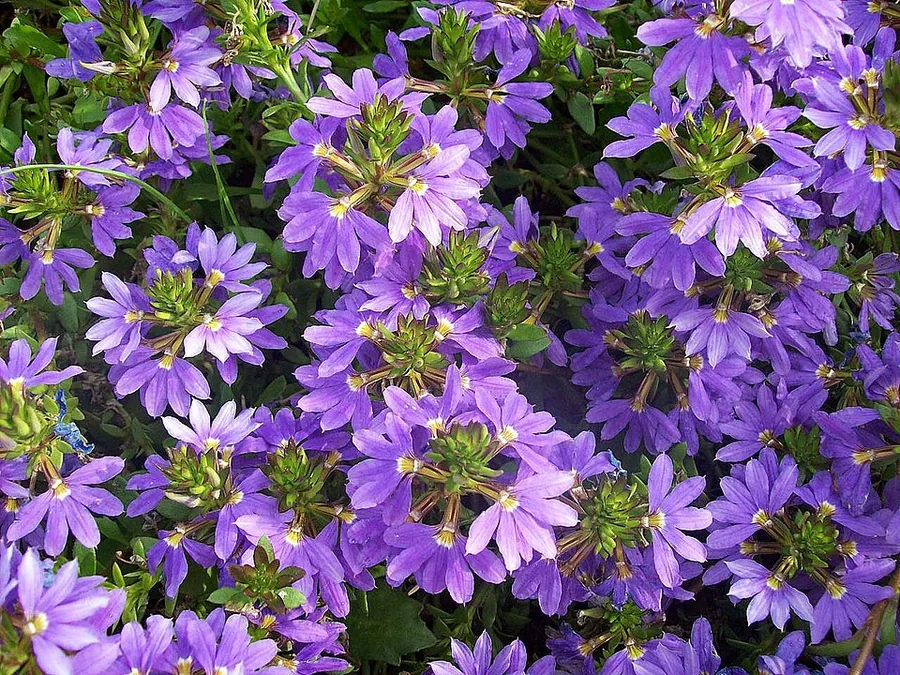
Fan flower takes its common name from the one-sided, fan-shaped flowers that line each trailing stem. The species is native to Australia, and that origin explains its tolerance for heat and lean conditions in cultivation, where it performs in beds, borders, and hanging baskets. Flower color ranges through cool blue, violet, and occasional pink, and bloom continues across the whole season.
In most climates it is grown as a warm-season annual. Botanically it is a tender perennial, cold-hardy only in zones 10 and 11, so outside those zones it is set out in spring and grown until frost ends it. That schedule suits its biology, since it concentrates its display into one long, warm season.
Established plants demand little: full sun, sharp drainage, and regular feeding cover the requirements, and because the flowers are self-cleaning, no deadheading is needed to sustain bloom. The critical limitation is drainage. In soil that stays saturated the roots are deprived of oxygen and decay, so wet feet are the main cause of failure.
Care
The short version: full sun and well-drained soil, water once the surface has dried, and apply a balanced fertilizer every couple of weeks through the growing season.
Light
Grow fan flower in full sun, which drives the heaviest flowering. It tolerates light afternoon shade, but in genuine shade the stems stretch and bloom production falls off.
Water
Water every 3 to 7 days during active growth, allowing the surface layer to dry before rewetting. The species tolerates brief drought far better than saturation, because waterlogged roots lose oxygen, so err toward the drier side.
Soil
Use average, well-drained loam amended with organic matter. It is indifferent to reaction across 6.0 to 8.0, but drainage is the decisive factor, since standing moisture is what triggers root rot.
Temperature
Its preferred range runs from 64°F to 95°F (18°C to 35°C), and it withstands high summer heat without stress. It has no frost tolerance, which is why colder zones treat it as an annual.
Humidity
Ambient outdoor humidity is adequate, so no target level applies. It also withstands humid, muggy summers without disease pressure becoming a problem.
Feeding
Apply a balanced liquid fertilizer about every two weeks in the growing season. Avoid high-phosphorus formulations, which this species responds to poorly.
Pruning
Structural pruning is minimal. Pinch leggy stems to restore density when growth stretches, and since the flowers are self-cleaning, deadheading serves no purpose.
Size & spacing
Mature height runs 9 to 18 inches (23 to 46 cm), with a spread of 12 to 24 inches (30 to 61 cm). That lateral, trailing habit accounts for its performance cascading over container rims and walls.
When to plant
As a frost-tender species, fan flower is grown as a summer annual in most regions. Sow seed indoors 6 to 8 weeks before the last frost, and transplant only after soil temperatures reach 65°F (18°C), since cold soil checks establishment. Bloom then continues from summer until the first frost.
Northern hemisphere
Southern hemisphere
Typical months for a temperate climate: start earlier in warm zones, later where spring frosts linger.
- Sow: 6 to 8 weeks before the last frost date
- Plant: In spring after the last frost when soil temperatures reach 65°F (18°C)
- Harvest: Summer through first frost
Hardiness
USDA hardiness zones: 10–11
Temperature: down to -1°C
Troubleshooting
Fan flower is undemanding, and its few problems nearly all trace to excess moisture or insufficient light. Because the symptoms register early on the roots, stems, and flowers, prompt diagnosis usually allows correction before decline. Match the symptom below to its cause and respond without delay.
Wilting and yellowing with soft, brown roots
Wilting, yellowing, and collapse accompanied by soft brown roots indicate root rot, a consequence of soil that remains wet. Continuous saturation deprives the roots of oxygen, and they decay. Reduce watering, correct the drainage or repot into a fast-draining medium, and discard plants too far gone to recover.
Fix:
- Reduce watering frequency
- Improve drainage or replant into well-drained media
- Remove severely affected plants
Cottony white masses and sticky residue on the stems
Cottony white colonies at the leaf axils, with a sticky residue, are mealybugs, sap-feeding insects that excrete honeydew. Dislodge them with a strong water spray, then treat the survivors with insecticidal soap or horticultural oil. Inspect incoming plants and space stock adequately, since crowding restricts airflow and favors the pest.
Fix:
- Wash off with a strong spray of water
- Spot-treat with insecticidal soap or horticultural oil
Sparse flowering with elongated, weak stems
Few flowers on elongated, weak stems reflect inadequate light or nutrition. In shade or without feeding, internodes lengthen and flowering falls off. Relocate the plant to full sun, fertilize through the season, and pinch the stretched stems to stimulate branching.
Fix:
- Move to a full-sun location
- Fertilize regularly during the growing season
- Pinch back leggy stems to encourage branching
Toxicity
Fan flower is not toxic. No part of the foliage or flowers contains compounds hazardous to cats, dogs, rabbits, birds, grazing animals, or people, so it can be sited near pets and children without restriction.
Safe for
People · Cats · Dogs · Horses · Rabbits · Livestock · Birds
Cats None
Nontoxic to cats. Ingestion will not poison them, although consuming any plant in quantity can cause transient gastric upset.
Dogs None
Nontoxic to dogs. The most a chewed stem is likely to produce is mild, self-limiting digestive upset.
Horses Safe
Horses may graze in its presence without risk, as the plant contains no compounds toxic to equines.
Rabbits Safe
Rabbits are unaffected by the foliage, and an incidental bite presents no hazard.
Livestock Safe
Cattle, goats, and sheep can be pastured with it safely, since it holds no constituents known to harm grazing stock.
Birds Safe
Both wild and pet birds are at no risk, as neither the leaves nor the flowers contain avian toxins.
People Safe
Nontoxic to people. It is cultivated as an ornamental rather than for consumption, so it is not intended for eating.
Varieties
A limited number of named selections are offered, distinguished chiefly by flower color and trailing habit. The following are the most widely available.
Blue Wonder
Blue Wonder produces cool blue to violet fan-shaped flowers continuously on long trailing stems, a habit that suits hanging baskets.
New Wonder
New Wonder is a vigorous trailing selection valued for a heavy display of blue-lavender fan flowers.
Pink Charm
Pink Charm is a dwarf selection reaching about 4 inches tall and 5 inches wide and bearing soft pink flowers.
How to propagate
Fan flower propagates readily, either vegetatively from cuttings or from seed.
Stem cuttingsEasy
During the growing season · A few weeks to root
The most reliable method is a stem cutting taken in the growing season, which roots within a few weeks and yields a clone of the parent. Seed is the alternative, sown indoors 6 to 8 weeks before the last frost.
Myths
Deadheading is required to keep fan flower in bloom.
Spent flowers drop on their own, so no removal of faded blooms is necessary. Fan flower is self-cleaning, and the only intervention it needs is an occasional pinch of an overlong stem.
Fan flower requires rich soil held constantly moist.
The opposite holds. It performs best in well-drained soil and tolerates heat and drought once established. Sustained wetness induces root rot, the most common way the plant is lost.