Houseplant · Araceae
Satin Pothos
Scindapsus pictus
Bright, indirect light and steady warmth preserve the silver leaf variegation, and the plant trails for years once its roots stay evenly moist.
Bright indirect
61–84°F · 16–29°C
USDA 11–12
3–10 ft · 0.9–3 m
Overview
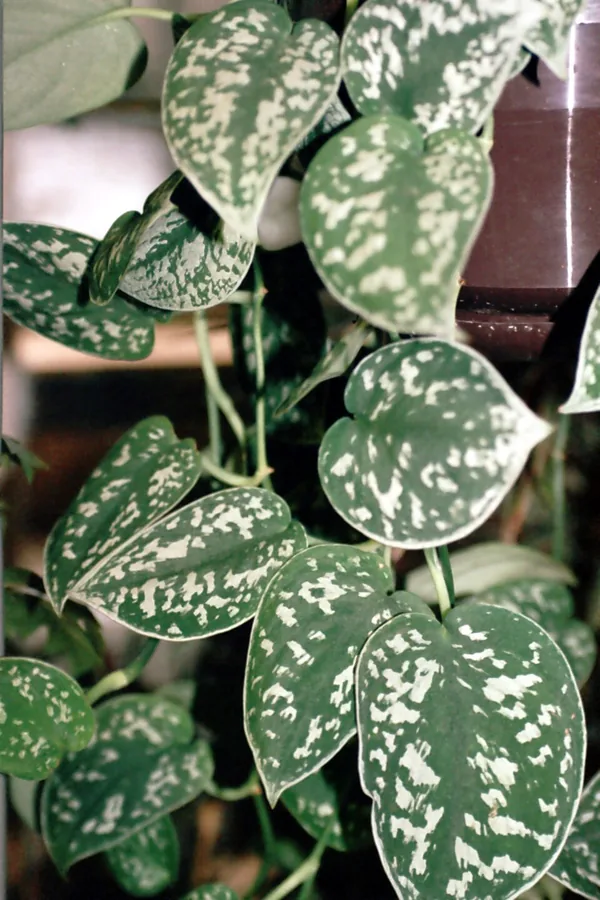
Satin pothos, known botanically as Scindapsus pictus, is a member of the arum family, Araceae, native to tropical Southeast Asia. In the wild it climbs tree trunks toward the canopy, and that same climbing habit lets it trail from a shelf or hanging pot in cultivation. The common name points to the metallic silver patterning laid over its deep green foliage.
Despite the shared common name, the species is not a true pothos. True pothos sits in the genus Epipremnum, whereas this plant is Scindapsus pictus, a related aroid that resembles it in leaf and habit. Mature foliage develops a thick, slightly puckered texture, and the silver markings express most strongly under bright, indirect light.
Cultural success rests almost entirely on water management. Held warm, shaded from direct sun, and watered only once the surface has begun to dry, the plant produces long, well-furnished vines. Persistent saturation is the primary failure point, since waterlogged media deprive the roots of oxygen.
Care
The short version: bright, indirect light and a warm position above 61°F (16°C). Maintain even soil moisture without saturation, use a peaty, free-draining medium, and apply a balanced fertilizer monthly across spring and summer.
Light
Provide bright, indirect light, which the plant requires to develop and hold its silver variegation. It persists in partial shade, but the patterning fades and growth slows as light input drops. Direct sun overwhelms the foliage and scorches the leaf surface.
Water
Keep the medium evenly moist but not saturated, allowing the surface to dry slightly before rewatering. Reduce the frequency in winter, when slowed growth lowers water demand. Continuous saturation is the chief cause of root failure, as it excludes oxygen from the root zone.
Soil
Use a peaty, organic, free-draining mix, held slightly acidic at a pH up to 6.0. An open, aerated structure lets excess water pass through so the roots are never left standing in moisture.
Temperature
Hold the plant between 61°F and 84°F (16°C to 29°C). As a tropical species it has no cold tolerance, and tissue damage begins once temperatures fall below the lower limit of that range, so exclude it from cold drafts.
Humidity
Average indoor humidity is adequate, so no specific target applies. Higher humidity benefits the foliage, and the dry air common in winter frequently precedes spider mite outbreaks, which favor warm, arid conditions.
Feeding
Apply a balanced houseplant fertilizer monthly through spring and summer, the period of active growth when nutrients are taken up. Withhold feeding in the low-light months, when metabolic demand and uptake fall.
Pruning
Pinch the stems periodically to maintain a compact, tidy form and to stimulate denser branching. The removed sections of long vine serve directly as propagation material.
Repotting
Repot every 1 to 2 years, or when roots emerge from the drainage holes and water passes through too quickly, both indicating a root-bound plant. Fresh medium and added volume restore steady growth.
Size & spacing
Under support or left to trail, the stems extend 3 to 10 feet (90 cm to 3 m) with a spread of 2 to 4 feet (60 to 120 cm). Allow the trailing growth vertical or hanging space, or provide a climbing support.
Troubleshooting
Nearly all disorders in satin pothos derive from an irrigation error or from a pest introduced on another plant. Because the foliage registers stress early, careful observation allows correction before damage advances. Identify the sign below, then address its underlying cause.
Blackened, mushy roots with a foul odor
Root rot develops where the medium remains waterlogged and oxygen is excluded from the root zone. Lift the plant, excise all dark, softened roots, and repot into a dry, free-draining mix. Follow with reduced watering and a dry-down between irrigations, as the condition progresses rapidly.
Fix:
- Remove rotted roots
- Repot in dry well-draining mix
- Reduce watering
Yellowing, softening foliage
Soft, yellowing leaves above saturated soil indicate overwatering, compounded by inadequate drainage. Allow the surface to dry before the next irrigation and transfer the plant to a freely draining container. Where the roots have already declined, repot into fresh medium and reduce the watering volume.
Fix:
- Reduce watering
- Improve drainage
- Repot in fresh mix
Fine webbing with stippled, bronzed foliage
Spider mites colonize under warm, dry conditions, producing fine webbing and a stippled, bronzed cast on the leaf undersides. Dislodge the population with a forceful water rinse, then apply insecticidal soap or horticultural oil, repeating weekly to break the cycle. Raised humidity makes the environment less favorable to them.
Fix:
- Rinse forcefully with water
- Apply insecticidal soap or horticultural oil
- Repeat weekly
White cottony masses with honeydew
The white, cottony masses in the leaf axils are mealybugs, confirmed by the sticky honeydew they excrete. Treat each colony with an alcohol-moistened swab, follow with insecticidal soap, and remove heavily infested tissue. Inspecting incoming plants prevents their introduction.
Fix:
- Dab with alcohol swab
- Apply insecticidal soap
- Prune infested parts
Waxy, immobile bumps on stems and leaves
The fixed, waxy, disklike bumps on the stems and leaves are scale insects in their sessile adult stage. Detach them by hand, wipe the site with an alcohol swab, and apply insecticidal soap or oil to control the mobile crawlers. Examination of new plants intercepts them before they spread.
Fix:
- Scrape off by hand
- Wipe with alcohol swab
- Apply insecticidal soap or oil
Dark leaf lesions or gray mold
Brown to black lesions or a gray mold film indicate fungal leaf spot or botrytis, both favored by wet foliage and stagnant air. Remove the affected leaves, keep water off the foliage, and improve air movement around the canopy. Irrigating at soil level and ensuring ventilation prevents recurrence.
Fix:
- Remove affected leaves
- Avoid wetting foliage
- Improve airflow
Curling, limp foliage over dry soil
Curled, limp leaves over dry medium reflect underwatering and tissue water loss. Irrigate thoroughly until water drains from the base, then return to consistent moisture. The leaves typically regain turgor and unfurl once the roots rehydrate.
Fix:
- Water thoroughly
- Maintain even moisture
Silvery streaking with tiny black specks
Silvery streaking flecked with minute black specks is the feeding damage of thrips. Apply insecticidal soap, deploy blue sticky cards to capture the adults, and rinse the foliage to remove the residual insects. Quarantining new acquisitions limits their spread.
Fix:
- Apply insecticidal soap
- Use blue sticky cards
- Rinse foliage
Toxicity
This species is not pet-safe. All tissue contains insoluble calcium oxalate crystals, which penetrate the soft lining of the mouth on chewing and produce immediate burning and swelling. No part is edible, so position it out of reach of pets and young children.
Toxic to
Cats · Dogs · Horses · Rabbits · Livestock · Birds · People
Cats Moderate
In cats, biting the foliage releases calcium oxalate crystals that penetrate the oral lining, producing drooling, pawing at the mouth, vomiting, and swelling of the muzzle.
Dogs Moderate
In dogs, chewing causes immediate oral burning as the crystals contact the tissue, accompanied by drooling, retching, and swelling of the lips and tongue.
Horses Moderate
In horses the crystals irritate the mouth and throat, causing pronounced salivation and swelling, though vomiting is uncommon in the species.
Rabbits Toxic
The foliage is unsafe for rabbits, as the crystals inflame the oral cavity and digestive tract, so trailing stems should be kept beyond their reach.
Livestock Toxic
Grazing livestock that consume the foliage suffer the same oral irritation and gastrointestinal upset, making the plant unsuitable near any stock.
Birds Toxic
In birds, pecking at the leaves can injure the mouth and crop through crystal contact, so the plant is best kept away from areas they occupy.
People Caution
No part of the plant is edible, and ingestion produces burning of the lips, swelling of the tongue, and salivation. Wash the hands after pruning and keep it out of reach of small children.
Chewing sap causes oral irritation; wash hands after handling
Helpline numbers

United States
ASPCA Animal Poison Control: (888) 426-4435 (fee applies)
Poison Control: (800) 222-1222



Canada
Poison Centres: 1-844-764-7669
Varieties
Several named selections differ in leaf form and in the extent of silver patterning. The following are the most commonly offered in the trade.
'Argyraeus'
Bears small leaves margined in silver-white and overlaid with fine gray blotching.
'Exotica'
Distinguished by larger, heart-shaped leaves marked with broad silver splashes.
'Silvery Ann'
Characterized by narrow, lance-shaped leaves heavily overlaid with silver.
Shimmering Falls Silver Splash
Notable for dense silver mottling distributed uniformly across the leaf surface.
How to propagate
The species propagates readily from vegetative cuttings, and a single healthy stem cutting is enough to raise a genetically identical plant.
Stem cuttingsEasy
Spring or early summer · Roots in a few weeks
Sever a 4-inch (10 cm) stem cutting in spring or early summer and root it in water or a moist potting medium. Roots develop within a few weeks, yielding a plant genetically identical to the parent.
Myths
Satin pothos is a true pothos.
Taxonomically it is not. The plant is Scindapsus pictus in the genus Scindapsus, while true pothos belongs to Epipremnum. The two are similar in appearance and culture but represent distinct genera.
Satin pothos is safe for pets.
It is not. The ASPCA classifies it as toxic to cats, dogs, and horses, owing to the insoluble calcium oxalate crystals in its tissue that burn and swell the mouth on contact. It should be kept away from animals.
It thrives in deep shade or low light.
It tolerates reduced light without thriving in it. Bright, indirect light is needed to sustain the silver variegation, while direct sun scorches the leaf surface.
It tolerates cold temperatures.
It does not, since the species is tropical and cold-sensitive. Foliage is damaged below about 61°F (16°C), so it requires a warm position clear of cold drafts.