Tree · Cactaceae
Saguaro
Carnegiea gigantea
Full sun, mineral drainage, and long dormancy build the water-storing column that lets the saguaro reach desert-giant scale.
Full sun
Every 14–30 days
USDA 9–11
33–59 ft · 10–18 m
Overview
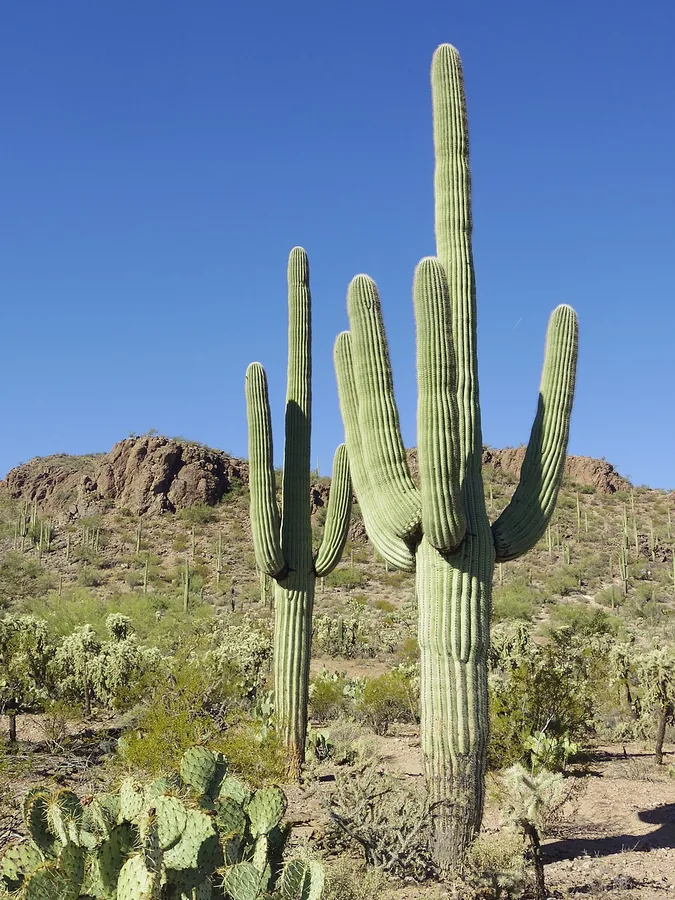
The saguaro is the defining columnar cactus of the Sonoran Desert, and its form follows its environment. It develops as a single ribbed stem that may later branch into upright arms, growing tall enough to overtop a person. Because rainfall in its native range is scarce and seasonal, its growth is slow and measured rather than lush.
This is a plant that operates on a timescale of centuries. Branching is unhurried: a saguaro may need 50 to 75 years to produce a first arm, and some remain unbranched for life. The accordion-like pleats let the stem expand after rain to store water in the tissue, then contract as that reserve is drawn down through drought. White flowers open at night in late spring, and the red fruit that follows has been gathered and eaten for generations in the region.
Successful cultivation depends on matching the native conditions. The saguaro requires hot, frost-free ground with sharp mineral drainage, because its tissue cannot survive sitting in cold, wet soil. Where the site is right it becomes largely self-sufficient. Note that wild plants are legally protected, so a nursery-grown specimen is the correct starting point.
Care
The short version: full sun, gritty mineral soil that drains fast, and infrequent water. Allow the soil to dry through completely between waterings, hold the plant nearly dry over winter dormancy, and shield it from hard frost.
Light
Provide full, all-day sun. The saguaro evolved in open desert with no canopy above it, so maximum direct light drives healthy, dense growth. Young plants benefit from light afternoon shade only until their tissue hardens, after which full exposure suits them.
Water
Water deeply but rarely, and only after the soil has dried completely during warm-season growth, which works out to roughly every 14 to 30 days. The deep-then-dry rhythm mimics desert rainfall and prevents the constant moisture that invites rot. Keep the plant nearly dry through winter, since an established saguaro draws on stored stem water and natural rainfall rather than irrigation.
Soil
Use a gritty, sharply draining mineral soil with a high proportion of rock and sand. Fast drainage keeps water from lingering around the roots, which is the condition the tissue tolerates least. A pH between 6.0 and 8.0 is acceptable, so texture and drainage matter far more than exact acidity.
Temperature
The saguaro withstands extreme heat, to roughly 113°F (45°C), because its water-storing tissue buffers high temperatures. Cold is the true limit. A brief low near 23°F (-5°C) is survivable, but a hard or prolonged freeze ruptures cells and creates the wounds through which rot organisms enter.
Humidity
Keep humidity low, around 10% to 30%, matching the arid air of its range. Moisture-laden air slows the drying the plant depends on and raises the risk of fungal and bacterial rot, so a steamy location works directly against its physiology.
Feeding
Fertilize sparingly with a dilute, low-nitrogen cactus formula through spring and summer. The low-nitrogen choice matters, because excess nitrogen forces soft, watery growth that a slow, rigid cactus cannot structurally support.
Pruning
Do not prune on a schedule. Cutting creates wounds that invite bacterial necrosis, so remove only clearly damaged or diseased arms. On mature specimens, defer to a professional, because the arms are extremely heavy and the spines are hazardous to handle.
Repotting
Repot only young, container-grown plants, at intervals of about every 2 to 4 years while root volume still limits them. Landscape specimens are permanent and are not lifted once established, since disturbance offers no benefit to so slow a grower.
Size & spacing
At maturity the saguaro reaches 33 to 59 feet (10 to 18 m) in height with an arm spread of 2 to 11.5 feet (60 cm to 3.5 m). Site it with generous clearance and treat the position as permanent, because its slow growth and eventual mass make relocation impractical.
When to plant
The saguaro's schedule is governed by heat, since it has no tolerance for a hard freeze. Sow seed during the warm months of late spring and summer when soil temperatures support germination, and transplant only once the last frost has passed. Flowering follows in late spring, with red fruit ripening into early summer.
Northern hemisphere
Southern hemisphere
Typical months for a temperate climate: start earlier in warm zones, later where spring frosts linger.
- Sow: Late spring into summer when soil is warm (21-27°C)
- Plant: Spring after all danger of frost has passed
- Harvest: Late spring to early summer (May-June); white night-opening flowers, followed by red edible fruit
Hardiness
USDA hardiness zones: 9–11
Temperature: down to -7°C
Troubleshooting
Nearly all saguaro disorders originate in excess moisture or cold injury, and both express first on the stem and base. That is where rot organisms establish and where frozen tissue breaks down. Identify the symptom below and intervene early, before the damage moves through the vascular tissue.
Soft, dark, seeping lesions on the trunk or arms
This is bacterial necrosis caused by Erwinia cacticida, which colonizes the interior after entering through frost cracks or open wounds and dissolves the tissue from the inside out. Excise the affected flesh to solid green tissue with a sterilized blade, then allow the wound to dry and callus in open air, which seals it against further infection. On a large plant, consult an arborist before cutting.
Fix:
- Cut out infected tissue back to firm healthy green flesh using sterilized tools
- Allow the wound to dry and callus in open dry air
- Consult an arborist or extension specialist before treating large plants
A softening, discolored base and a leaning stem
This is root and basal rot, the result of overwatering or soil that drains too slowly to let the roots dry. Saturated conditions kill the basal tissue, which loses rigidity and can no longer hold the heavy column upright. Withhold water, let the substrate dry completely, and if drainage is at fault, reset the plant into a gritty mineral mix.
Fix:
- Stop watering and allow the soil to dry completely
- Improve drainage or replant in gritty fast-draining mineral mix
- Cut away rotted tissue where accessible and let it callus
Discolored, constricted bands near the tips after cold
This is frost damage, and it registers first on the growing tips and the most exposed surfaces, where tissue is thinnest and least protected. Delay any cutting, because the full extent is not visible until warmth returns. Once it does, remove only the tissue that has clearly died or begun to rot, and leave the rest to recover.
Fix:
- Do not cut immediately; wait until warm weather to assess the extent of damage
- Remove only clearly dead or rotting tissue once freeze risk has passed
Toxicity
The saguaro carries no toxic principle, and its ripe fruit is edible, so ingestion presents no poisoning risk. The hazards are mechanical rather than chemical. The long, rigid spines can penetrate skin deeply, and a hydrated mature plant weighs several tons, so handling calls for thick gloves, proper tools, and distance for children and pets.
Safe for
People · Cats · Dogs · Horses · Rabbits · Livestock · Birds
Cats None
The flesh contains no toxin, so a cat that samples it will not be poisoned. The clinically relevant hazard is mechanical: a spine can penetrate a paw or the face deeply enough to require veterinary removal.
Dogs None
A dog ingesting the tissue faces no chemical toxicity. The genuine risk is a spine driven into the nose or lodged in the oral cavity, so exposure to the long spines is what warrants management.
Horses None
The cactus is non-toxic to horses. Contact injury remains the concern, since the rigid spines produce painful puncture wounds, which is reason enough to exclude the plant from the paddock.
Rabbits None
A rabbit encounters no toxic compound in the tissue. Its small body is vulnerable to the stiff spines, however, so any low arms should be fenced off to prevent puncture injury.
Livestock None
Cattle, goats, and sheep are not poisoned by saguaro. The exposure of concern is purely mechanical, as crowding animals can drive the spines into mouths and legs.
Birds None
Birds sustain no toxic effect, and numerous desert species excavate nest cavities within the stem. For them the spines present negligible risk.
People None
The plant is non-toxic, and its ripe red fruit has a long history of human harvest and consumption. The one meaningful hazard is the spines, so handling calls for thick gloves and appropriate tools.
The danger is physical, not chemical: large rigid spines can puncture skin and cause painful wounds, and mature plants are extremely heavy.
Varieties
The species is essentially monotypic in cultivation, offered as its standard form alongside one rare growth mutation. These are the two designations you will encounter.
Typical columnar form
In its ordinary form the plant develops one tall central trunk, later branching into its characteristic arms and attaining full tree stature over many decades.
Crested (cristate) Saguaro
A rare crested mutation redirects the apical growing point into a broad flattened fan rather than the normal cylindrical column.
How to propagate
Propagation is by seed, which germinates readily but establishes slowly, so the limiting factor is time rather than technique.
SeedModerate
Warm season, late spring through summer · Germinates in 1-3 weeks but takes several years to reach a transplantable size
The saguaro is raised from seed sown fresh onto a gritty substrate and held warm and lightly moist through the warm season of late spring and summer. Germination occurs within 1 to 3 weeks, but establishment is the slow phase, since a seedling needs several years of incremental growth before it reaches transplantable size.
Myths
It is illegal to own or grow a saguaro.
Cultivation is fully lawful. Arizona statute governs only the removal, harvest, or destruction of native plants in the wild, not their propagation or sale, so legally grown and nursery-raised specimens are unrestricted. The protection applies to wild populations, not to plants you raise yourself.
A saguaro's exact age can be read from its arm count.
Arm production is too variable to serve as a chronometer. Because a saguaro may take 50 to 75 years to form its first arm and some never branch, arm number correlates only loosely with age. It indicates that a plant is old, not how old.