Houseplant · Cactaceae
Easter Cactus
Rhipsalidopsis gaertneri
Provide a cool winter rest and a position it can hold, and the Easter cactus responds with scarlet, star-shaped spring blooms.
Bright indirect
Every 7–14 days
50–77°F · 10–25°C
USDA 10–12
Overview
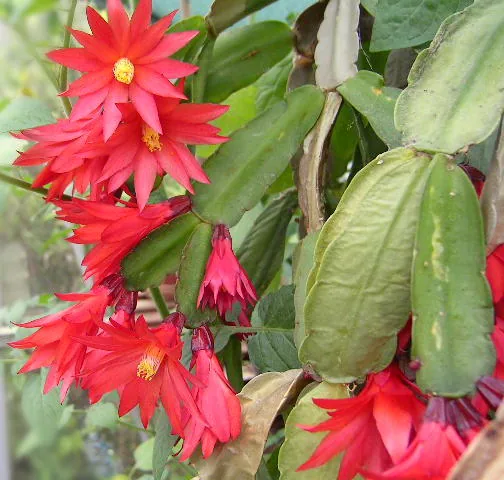
The Easter cactus flowers in spring, near the holiday it is named for, producing scarlet stars at the tips of its flat, jointed segments. It sits within the cactus family, yet its native habit is that of a forest epiphyte rooted on tree branches in the Brazilian rainforest rather than in open desert substrate. That ecology dictates its culture: shaded light, steady moisture, and humidity suit it, while the dry heat a cactus name implies does not.
Growers frequently confuse it with the Thanksgiving and Christmas cacti, but the distinctions are diagnostic. Its segment margins are rounded and scalloped rather than clawed, and anthesis falls in spring rather than in the depths of winter. It is also the slower and more demanding grower of the group, which explains why a fully flowering specimen reads as a genuine achievement.
Its single non-negotiable requirement is a cool, short-day rest through late autumn and winter, with reduced temperatures and reduced water. That dormancy is the cue that initiates the buds, because the plant sets flowers in response to the cooler, shorter days. Omit the rest, or relocate the plant once buds form, and the result is abscission rather than bloom.
Care
The short version: bright indirect light and no direct sun, with the top few cm of mix allowed to dry between waterings. Impose a cool, drier rest from autumn through winter to initiate buds, and once buds appear, hold the plant in place.
Light
Site it in bright, indirect light and exclude direct sun, which scorches the tissue and reddens the segments. It persists in medium light or partial shade, but flowering improves with the brightest position short of direct sun, because higher light supports stronger bud set.
Water
Allow the top few cm of mix to dry, then water thoroughly and let the pot drain, on a cycle near every 7 to 14 days. As a forest cactus rather than a desert one, it tolerates neither a bone-dry rootball nor waterlogging, the latter of which induces root rot quickly. Reduce water through the autumn-to-winter rest, then keep the regime steady once buds set, since an abrupt change triggers bud abscission.
Soil
Grow it in a well-drained, organic-rich mix that retains some moisture without remaining saturated, such as a cactus or epiphyte blend that matches its epiphytic roots. It favors slightly acidic conditions, a pH of 5.5 to 6.5, consistent with its rainforest origin.
Temperature
It performs across ordinary room temperatures of 50°F to 77°F (10°C to 25°C) through the year. Holding it toward the cool end of that range in autumn and winter, combined with shorter photoperiods, is the stimulus that drives bud initiation.
Humidity
Average household humidity is adequate, and no specific figure applies. Given its rainforest provenance it benefits from slightly higher atmospheric moisture, so a grouping of plants or a nearby pebble tray offsets the dry air of heated winter rooms.
Feeding
Apply a balanced, diluted liquid houseplant fertilizer roughly monthly, beginning after flowering and continuing through the summer growth. Withhold feed in autumn so the plant can enter its rest unimpeded, since active feeding works against the dormancy that sets buds.
Pruning
Once flowering ends, twist or pinch off a few terminal segments to stimulate branching and a denser habit, because removing the apex encourages new growth points. The detached segments are viable propagation material and root readily as cuttings.
Repotting
Repot only every 3 to 4 years, after flowering, and only when genuinely crowded, since the plant flowers best slightly pot-bound. Roots emerging from the drainage holes, a mix that dries unusually fast, and stalled growth with few new segments all indicate the rootball has filled the pot.
Size & spacing
It remains compact at roughly 6 to 12 inches (15 to 30 cm) tall with a spread of 12 to 16 inches (30 to 40 cm), the segments arching as they elongate. That arching habit suits a hanging pot or a shelf edge where the stems can cascade.
Troubleshooting
Most Easter cactus disorders reduce to two mechanisms: a moisture regime that swings too wet or too dry, and disturbance of the plant while it is in bud. Reading the early symptoms below lets you correct the cause before flower or root loss becomes irreversible.
Segments going limp, soft, or red at the base
Soft, reddish segments most often indicate root rot arising from a saturated medium, though identical wilting follows a rootball taken bone dry. Tug a segment and inspect the roots, since mushy brown roots confirm rot while firm white roots in dust-dry mix confirm drought. Excise the dead roots and repot into fresh, fast-draining mix for rot, or rehydrate thoroughly and drain for drought.
Fix:
- If rotted, unpot, cut away mushy roots, repot into fresh well-drained mix, and water sparingly
- If drought-stressed, water thoroughly and let excess drain
- Salvage healthy segments as cuttings if the base is lost
Flower buds abscise before opening
Bud drop is the characteristic Easter cactus disorder, and it stems from change rather than neglect. After buds form, relocation, rotation, drafts, or a revised watering schedule provoke the plant to abort them, because the species is highly sensitive to disturbance during bud development. Fix a single position, hold the top few cm just moist, and leave the plant undisturbed until anthesis.
Fix:
- Leave the plant in one spot once buds appear and avoid turning it
- Keep watering even and the top few cm just moist while budded
- Shield from heat vents, cold drafts, and doorways
White cottony tufts or sticky film at the joints
Cottony deposits in the segment joints identify mealybugs, while small bumps with a sticky honeydew film indicate scale. Both reproduce rapidly indoors, so isolate the specimen on detection to limit spread. Remove the insects with a cotton swab charged with 70 percent alcohol, then apply insecticidal soap on repeat until the infestation clears.
Fix:
- Dab pests with a cotton swab dipped in 70 percent isopropyl alcohol
- Treat with insecticidal soap, repeating per label
- Isolate the plant until clear
Toxicity
For a household with pets, the verdict is favorable: the Easter cactus is not toxic. The ASPCA records the whole holiday cactus group as safe for cats and dogs, and the plant poses no poisoning risk to people, horses, or other animals. The only likely effect is transient gastrointestinal upset if a pet ingests a large quantity of the fibrous segments.
Safe for
People · Cats · Dogs · Horses · Rabbits · Livestock · Birds
Cats Safe
The ASPCA records the holiday cactus group as non-toxic to cats, so ingestion does not poison the animal. A cat that consumes a large mouthful of the fibrous stems may drool or experience brief gastric upset, and nothing beyond that.
Dogs Safe
Dogs face no genuine hazard from this plant. Where one chews off and swallows a large piece, the coarse plant tissue can provoke short-lived vomiting that resolves without intervention.
Horses Safe
No component of the plant is toxic to horses, though as a small indoor cactus it seldom enters their environment.
Rabbits Safe
It is safe for rabbits. The fleshy segments contain no toxin, so an exploratory nibble causes no harm.
Livestock Safe
It holds no toxic compounds, so grazing animals are not endangered by it.
Birds Safe
Pet birds may perch and peck near it without risk, as the segments carry nothing harmful.
People Safe
It is harmless to people, children included. It is not a culinary plant, but a tasted segment presents no poisoning risk.
Fibrous plant material can still cause mild stomach upset or vomiting if a pet eats a large amount.
Varieties
Nearly all material sold as Easter cactus derives from two species and their hybrids, and these are the names worth recognizing.
Rhipsalidopsis gaertneri (type)
The original species bears scarlet, star-shaped spring flowers on flat segments whose margins carry rounded, scalloped, faintly bristled teeth.
Rhipsalidopsis rosea and its hybrids
This smaller pink-flowered species hybridizes freely with R. gaertneri, producing the pink, salmon, and white-flowered Easter cactus cultivars in cultivation today.
How to propagate
The Easter cactus propagates readily from its own segments, so a single specimen yields several clones once the cuttings have rooted.
Stem cuttingsEasy
After flowering in late spring or early summer · Roots in about 2 to 4 weeks; flowering-size plant in 1 to 2 years
Take cuttings immediately after flowering, in late spring or early summer, when the plant is actively growing. Twist off a unit of 2 to 3 jointed segments, allow the cut surface to callus for a day or two to limit rot, then insert it in barely moist, well-drained mix under bright indirect light. Roots form within 2 to 4 weeks, though the young plant requires a year or two of growth before reaching flowering size.
Myths
Easter, Thanksgiving, and Christmas cactus are the same plant marketed at different times.
They are three distinct plants. Easter cactus blooms in spring with rounded, scalloped segment margins and star-shaped flowers, whereas the Thanksgiving and Christmas cacti are Schlumbergera that bloom in late autumn and winter on segments with pointed or toothed margins. The Easter cactus is additionally the slower and more exacting grower of the three.
Holiday cacti are poisonous to pets.
The ASPCA classifies holiday cactus as non-toxic to cats and dogs. The maximum effect is a brief upset stomach from the fibrous tissue, which is mechanical irritation, not actual poisoning.
The Easter cactus has always held a single settled scientific name.
Its classification has shifted repeatedly, placing it in Rhipsalidopsis, Hatiora, and Schlumbergera at different times. That is why it appears in commerce under all three names, each pairing the genus with the epithet gaertneri.