Houseplant · Cactaceae
Cholla Cactus
Cylindropuntia fulgida
Give it full sun and sharp drainage, then keep your distance from those barbed, grabbing joints.
Full sun
USDA 8–11
3–13 ft · 1–4 m
Overview
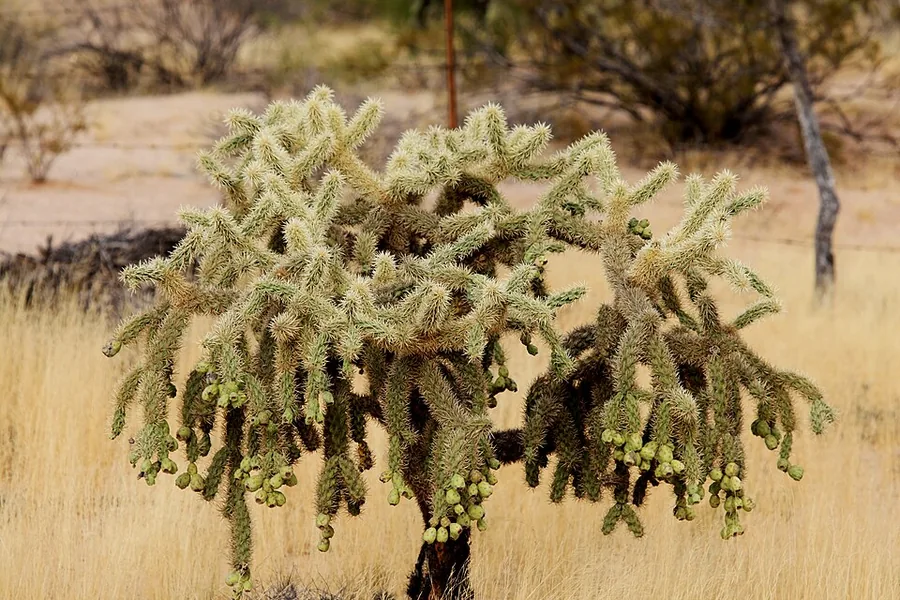
Cholla is a desert cactus engineered for heat and drought, its cylindrical joints stacking segment on segment into a small spiny tree. It grows wild across the arid Southwest, where it endures a wide thermal swing of 23°F to 104°F (-5°C to 40°C). Growth is slow, and over years it builds toward 3 to 13 feet (1 to 4 m) in height.
The defining trait is the loose attachment of its joints. The slightest brush pulls a barbed segment free, and it travels off on skin, fur, or fabric, the behavior that earned the name jumping cholla. That same easy release is the plant's reproductive strategy, since dropped joints root where they land and start new plants.
Once established, cholla demands remarkably little. Sun, sandy ground, and minimal water are enough for it to shrug off conditions that finish most plants. The genuine effort lies in respecting the spines and placing it where no one passes within reach.
Care
The short version: full sun, a gritty fast-draining mix, and water only after the soil has dried completely. It tolerates a huge temperature range and asks for almost nothing beyond sharp drainage and a wide berth from its barbed joints.
Light
Cholla demands full sun, the same flood of light it receives in the open desert. It will accept some partial sun, but anything dimmer leaves the tissue weak and far more vulnerable to rot, because a sun-starved plant cannot dry quickly or grow firmly.
Water
Water sparingly, and only once the soil has dried completely through. This cactus stores its own moisture and rots fast when roots sit wet, since saturated tissue cannot breathe, a risk that climbs sharply in cool or dim spells, so always lean toward the dry side.
Soil
Use a gritty, sharply drained sandy or cactus mix that releases water rather than holding it, the single most important defense against root rot. Any pH from 6.0 to 8.0 suits it, a span that covers most desert ground.
Temperature
Cholla withstands an unusual range, roughly 23°F to 104°F (-5°C to 40°C). That hardiness is what lets it grow outdoors across USDA zones 8 through 11, where many cacti would not survive.
Humidity
This plant is built for low humidity, so dry desert air is exactly right. Damp, still air encourages rot by keeping tissue moist, which is why there is no target figure to chase beyond keeping conditions dry.
Feeding
Feed lightly through spring and summer growth with a dilute low-nitrogen cactus fertilizer, just once a season. Anything richer forces soft, fast growth that is weak and rot-prone, the opposite of what a desert cactus needs.
Pruning
Cholla calls for little cutting, only the removal of dead or damaged joints. Always work with long tongs or thick gloves, because the barbed joints break free at the lightest touch and embed in skin.
Repotting
Repot only every 2 to 4 years, or sooner if the plant outgrows its pot or grows top-heavy. Roots escaping the drainage holes, or soil that dries unusually fast, are the signals that the roots have filled the container.
Size & spacing
A mature cholla stands 3 to 13 feet (1 to 4 m) tall and spreads 3 to 7 feet (100 to 200 cm) wide. Allow generous clearance so no one brushes the barbed joints in passing.
Troubleshooting
Cholla seldom falters, and when it does the joints tell the story. Soft dark segments and shriveled ones signal opposite problems, too much water against too little, so read the tissue before adjusting anything. Keep tongs in hand throughout, since the barbs catch at a touch.
Soft, darkening joints collapsing from the base upward
Soft, blackening tissue at the base is rot working through the roots and stems, driven by water lingering in a mix that cannot drain. Saturated roots suffocate and break down, the decay climbs into the joints, firmness goes, and a foul odor sets in. Cut off all water, take the rotted joints back into clean green tissue with tongs, let those wounds dry to a callus that seals out new infection, then settle the plant into a dry gritty mix.
Fix:
- Stop watering immediately
- Cut away rotted joints with tongs well into healthy tissue
- Allow cuts to callus and repot into dry gritty mix
Joints turning wrinkled, puckered, and thin
When the joints pucker and thin, the plant is running on stored water it can no longer replace, either because the soil has gone bone dry for a long stretch or because dead roots cannot draw moisture up. Return to a deep but infrequent soak through the growing season so the tissue can refill, and examine the roots to confirm they are still firm and able to do their job.
Fix:
- Resume a deep but infrequent watering schedule
- Check roots are intact and functional
Toxicity
No part of this cactus poisons people or animals, so chemical toxicity is not the issue here. The danger is strictly mechanical. The barbed, detachable joints seize and embed in skin, mouths, and fur at the faintest contact, they hurt, and they resist removal, so the prudent course is to keep people and pets clear and handle the plant only with tongs.
Safe for
People · Cats · Dogs · Horses · Rabbits · Livestock · Birds
Cats None
There is no compound here that can poison a cat. The threat is mechanical: a cat that bats at the barbed joints can catch them in its paws and face, and a loose segment can lodge in the mouth or on the tongue.
Dogs None
A dog gains nothing toxic from chewing or sniffing this plant, but the detachable spined segments grip on contact and bury their barbs in the muzzle, lips, and paw pads, which is genuinely painful and demands careful removal.
Horses None
Horses face no poison from any part of it. The risk is that a grazing horse drives the barbed spines into its lips and gums, so the plant belongs nowhere a horse can reach.
Rabbits None
Poisoning is not a concern for rabbits, yet the spines are a real threat to small soft mouths and feet, and a scatter of fallen joints can hem in and trap a hopping rabbit.
Livestock None
Cattle, goats, and sheep take no poison from it, but the chain-fruit segments latch onto legs and faces, and spines embedded around the mouth can keep an animal from feeding at all.
Birds None
No part of this cactus poisons birds. Certain desert species even nest among the spiny joints for the protection the barbs provide, so the only thing to watch is their physical sharpness.
People None
None of it is poisonous to people. The barbed joints are the entire hazard: they break free at the lightest brush and lodge painfully in skin, and pulling them back out is slow and difficult, so reach for the plant only with long tongs.
The real danger is physical: detachable, barbed spine joints (the 'jumping cholla') cling to and embed in skin at the slightest brush, are very painful, and are difficult and hazardous to remove. Keep well away from people and pet traffic and handle only with tongs.
Varieties
Cholla sits within a large genus, and a couple of close relatives appear often enough to be worth recognizing by name.
Cylindropuntia fulgida var. mamillata
Recognized by noticeably smoother joints and far fewer spines than the heavily armed typical form.
Cylindropuntia bigelovii (teddy bear cholla)
A near relative wrapped in dense golden spines, with joints that shed even more readily than those of the chain-fruit cholla.
How to propagate
Cholla nearly propagates itself, since its loose joints root wherever they drop. You can put that habit to deliberate use, or begin from seed if patience allows.
Stem cuttingsEasy
Spring to summer during active growth · 4 to 8 weeks to root
Rooting a detached joint is the simplest and most reliable method, and it succeeds best in spring or summer while the plant is in active growth. Hold the cut joint aside until the wound dries into a callus, which keeps rot out, then stand it upright in gritty mix, where roots form in 4 to 8 weeks. Handle it only with tongs, since the barbs grab skin at the slightest contact.
SeedModerate
Spring in warm conditions · Several months to a year for seedlings to establish
Seed is the slower and less dependable route. Sow in spring and hold the seeds at steady warmth, the trigger desert germination depends on, then expect a long wait, because the seedlings need several months to a year to build into sturdy young plants.
Myths
Cholla jumps and throws its spines at you.
Nothing about this plant jumps or launches anything. The barbed joints are attached so loosely that the faintest brush, or even a static spark, frees one and transfers it onto whatever made contact. The plant itself never moves; you carry a segment off before you register touching it, and that illusion is precisely where the jumping name began.