Houseplant · Cactaceae
Old Lady Cactus
Mammillaria hahniana
Give it bright sun, gritty soil, and a dry winter rest, and this woolly little cactus crowns itself with pink flowers.
Full sun
45–84°F · 7–29°C
USDA 9–11
4–12 in · 10–30 cm
Overview
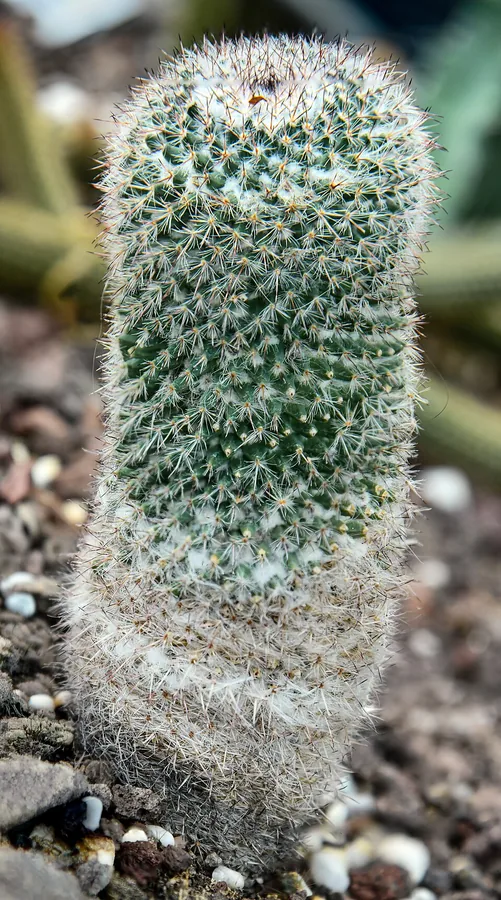
The old lady cactus is a small, globose desert species clothed in dense white hairs that lend it a powdered appearance. Native to the arid hills of northeastern Mexico, it remains compact, reaching only 4 to 12 inches (10 to 30 cm) in height before it begins clustering into a colony of offsets. That slow, restrained growth rate is a large part of why it ranks among the most manageable cacti for a sunny windowsill.
Beneath the wool lie fine spines and bristles, and in spring a mature specimen encircles its crown with pink to purplish-red flowers. That ring of bloom is the source of its other name, birthday cake cactus. Supply adequate light and impose a proper cool winter rest, and the flowering recurs each year, because the cool, dry dormancy is what sets the buds.
This is a tolerant plant governed by one non-negotiable rule: it will not endure standing moisture. Overwatering accounts for most losses, since saturated tissue rots, so sharp drainage and restraint between waterings carry the whole regimen. Meet that condition and the remainder of its culture is close to hands-off.
Care
The short version: bright direct light, a gritty fast-draining medium, and water applied only after the soil has dried out completely. Reduce water sharply for a cool, dry winter rest, since that dormancy is what triggers the spring flowers.
Light
Provide full, direct sun, ideally at a south- or west-facing window supplying several hours daily, because this desert species photosynthesizes best at high light. Under bright indirect light it survives, but insufficient sun drives it to stretch, lose color, and withhold flowers.
Water
Let the medium dry out completely, then irrigate thoroughly and discard whatever collects in the saucer, since the roots take up water only when it is present and rot when it lingers. Water sparingly in summer and almost not at all through the cool winter rest. Standing water at the roots is the fastest route to loss.
Soil
Use a gritty, sharply drained cactus mix so water passes through rather than saturating the roots. A pH between 6.0 to 7.5 is entirely suitable. Texture outweighs the exact figure, because loose, fast-draining grit is the actual defense against root rot.
Temperature
The plant is comfortable across 45°F to 84°F (7°C to 29°C) through the year. A cooler winter interval toward the lower bound is what induces bud set for spring, so avoid holding it warm year-round.
Humidity
Low ambient humidity matches this desert species, so no target figure applies. Dry air is the correct condition here, whereas damp, stagnant air promotes rot and pest establishment.
Feeding
Apply a dilute low-nitrogen cactus fertilizer such as 5-10-5 once monthly through the spring and summer growing season, when the plant can use it. Suspend feeding entirely in winter, since a dormant cactus makes no use of applied nutrients.
Pruning
The plant requires no routine pruning. Remove only spent flowers, and detach offsets when propagating or thinning a crowded colony. Wear thick gloves or use folded paper, because the spines and bristles embed readily.
Repotting
Repot every 2 to 3 years in spring, or whenever the colony outgrows its pot. The signals are roots emerging from the drainage holes, offsets pressed against the rim, and a medium that dries almost immediately after watering.
Size & spacing
Expect a compact specimen only 4 to 12 inches (10 to 30 cm) tall that slowly broadens into a colony up to 20 inches (50 cm) across as offsets accumulate at the base. That slow, restrained habit lets it hold a place on a crowded windowsill.
Troubleshooting
Nearly every disorder in this cactus originates at the roots or presents as stretched, flowerless growth, both of which trace to water or light. Read the early signals and you can intervene before rot becomes established. Match the symptom below, then act while the correction still has effect.
Soft, browning base and a plant that loses its footing
A soft, discolored base signals root and basal rot, the endpoint of waterlogged tissue once a soggy mix or overwatering keeps moisture against the roots. Because the pathogen spreads through wet tissue, withhold water at once, unpot the plant, and excise every soft, blackened section with a clean blade to stop it advancing. Allow the sound tissue or offsets to callus over several days so the wound seals, then repot in dry gritty mix and water only sparingly until new roots establish.
Fix:
- Stop watering immediately
- Unpot and cut away all soft, rotted tissue with a clean blade
- Let healthy tissue or offsets callus for several days, then repot in dry gritty cactus mix
- Resume watering only sparingly once re-established
White cottony tufts or fine webbing over the plant
Cottony white masses sheltered within the wool indicate mealybugs, which exploit the dense hairs as cover, while fine webbing over dull, stippled tissue indicates red spider mites, favored by hot, dry air. Since both spread to neighboring plants, isolate the specimen, then dissolve the mealybugs' waxy coat by dabbing them with a cotton swab in 70 percent isopropyl alcohol. Rinse the mites off to break their webbing, follow with insecticidal soap or horticultural oil, and repeat weekly to catch each hatch until the plant clears.
Fix:
- Isolate the plant from others
- Dab mealybugs with a cotton swab dipped in 70 percent isopropyl alcohol
- Rinse off mites and treat with insecticidal soap or horticultural oil
- Repeat weekly until the infestation clears
No flowers, or pale, stretched growth off its round form
Growth that leans toward the window and elongates into a pale, narrow column is etiolation, the plant reaching for light it is not receiving and laying down weak, stretched tissue in the process. An absent spring flower ring traces to a warm, moist winter that never imposed the cool, dry rest this species needs to initiate buds. Restore a bright south- or west-facing exposure, then enforce a cool, dry dormancy around 45°F to 55°F (7°C to 13°C) with minimal water through winter before resuming normal care in spring.
Fix:
- Move to a bright south- or west-facing window with several hours of direct sun
- Give a cool, dry winter rest around 7 to 13°C with minimal water
- Resume normal watering and feeding in spring
Toxicity
For a household with pets and children the record is reassuring: this cactus contains no toxin, and the ASPCA classifies its close relatives as non-toxic to cats, dogs, and horses. The hazard is strictly mechanical. Those soft-looking white hairs conceal fine spines and bristles that embed in skin, paws, and mouths, so keep the plant out of easy reach and handle it deliberately.
Safe for
People · Cats · Dogs · Horses · Rabbits · Livestock · Birds
Cats None
No systemic poisoning follows if a cat bites the plant, because the genus carries no toxin. The mechanical risk is what counts: the fine spines and bristles embed in the mouth, tongue, or paws and cause genuine irritation, so position the pot beyond pouncing range.
Dogs None
A curious dog faces no toxic compound in this cactus. The concern is purely physical, since a nose or mouth pressed into those fine bristles leaves sore, prickled skin that often needs tweezers to remove.
Horses None
A horse can share space with the plant and absorb no toxic effect. Should it mouth the cactus, bristles embed in the muzzle and lips, a mechanical irritation rather than a poisoning.
Rabbits None
No chemical hazard reaches a rabbit from this species. The dense spination makes it an unrewarding thing to gnaw, and the only real issue is bristles catching in the mouth or fur.
Livestock None
Cattle, goats, and sheep take on no poisoning from grazing this cactus. The bristles and spines irritate the mouth on contact, which is why it belongs behind glass rather than in a paddock.
Birds None
The plant presents no toxin to birds by any route. A pet bird can still snag a fine spine while investigating, so site it where beaks and feet cannot reach.
People None
Handling or even tasting the plant introduces no poison to a person. The single drawback is mechanical: the fine hairs and spines fracture and embed in skin with ease, so wear thick gloves or use folded paper when repositioning it.
The main hazard is physical rather than chemical: the dense white hairs, bristles, and fine spines can lodge in skin, paws, and mouths. Handle with thick gloves or folded paper and keep the plant out of reach of pets and children.
Varieties
The species resolves into two accepted subspecies separated mainly by hair and spination. These are the two you are most likely to encounter under name.
Mammillaria hahniana subsp. hahniana
The nominate form carries the long white hairs of the species and produces its spring crown of pink to purplish-red flowers.
Mammillaria hahniana subsp. woodsii
Formerly ranked as a distinct species, this accepted subspecies is separated on its spination and its sparser covering of hair.
How to propagate
Two routes propagate this cactus, one fast and one slow: detach the offsets it produces on its own, or raise it from seed for a longer but rewarding project.
Offsets & pupsEasy
Spring to summer during active growth · About 4 to 8 weeks to root after callusing
Because a mature plant clusters freely, division of an offset is the reliable route: detach one by twisting or cutting in spring or summer while the plant is in active growth and best able to seal and root. Let the wound callus for a few days to close it against rot, then set the offset in dry gritty mix, where it roots in about 4 to 8 weeks.
SeedModerate
Early spring, sown warm at about 19 to 24°C · Several months to a year or more to reach a handleable size
Seed is the slower method and demands patience given the species' slow growth. Surface-sow on a gritty medium in early spring, hold it warm at around 66°F to 75°F (19°C to 24°C) and humid to drive germination, and expect several months to a year before the seedlings reach a handleable size.
Myths
Cacti thrive on neglect and need almost no water.
During active growth the species draws on a thorough soak each time the soil has dried out completely, since the roots take up water only when it is available and the tissue swells to store it. Withhold water too long and the stem shrivels as reserves deplete, yet leave water at the roots and the tissue rots. The working pattern is a deep drink followed by a complete dry-out.
Old lady cactus is poisonous to pets.
The genus Mammillaria contains no toxin, and the ASPCA classifies close relatives as non-toxic to cats, dogs, and horses. The genuine hazard is mechanical, the spines and bristles, which embed in skin, paws, and mouths.