Houseplant · Cactaceae
Golden Barrel Cactus
Echinocactus grusonii
Match its desert origins with strong light and restrained watering, and this golden globe asks for very little.
Full sun
50–86°F · 10–30°C
USDA 9–11
12–35 in · 30–90 cm
Overview
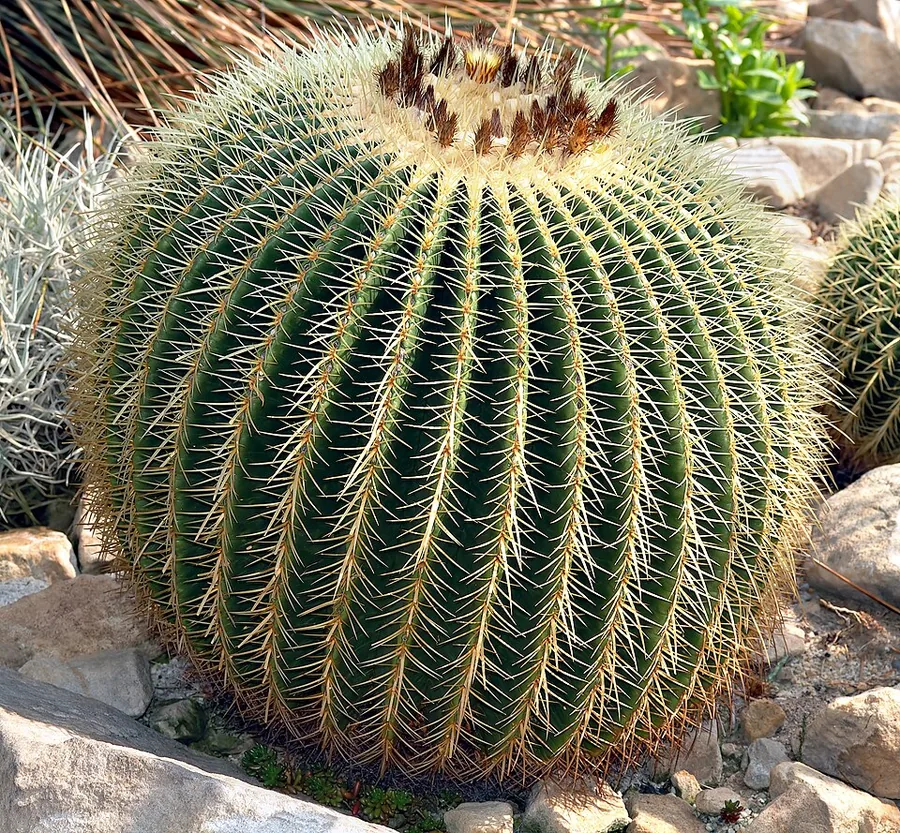
The golden barrel cactus is among the most recognizable members of the Cactaceae in cultivation, a near-spherical green body ribbed from apex to base and armed with stiff golden-yellow spines. Its origin in the deserts of central Mexico explains its cultural needs directly: strong light and free drainage are what its native habitat provides, so a bright window and a fast-draining pot reproduce those conditions indoors.
Growth is slow, which is why a specimen remains a manageable size for years before it approaches its mature 12 to 35 inches (30 to 90 cm) across. That measured pace is an asset in a container. Kept in strong light, the plant retains its form and coloration across successive seasons with minimal intervention.
Its single intolerance is standing moisture, a trait inherited from a desert lineage adapted to drink heavily and then dry completely. Match watering to that pattern and the golden barrel behaves as one of the more low-maintenance cacti available to the indoor grower.
Care
The short version: provide the strongest sunlight available, a gritty mix that drains fast, and water only when the soil is bone dry. Hold it nearly dry through winter, and handle it with thick gloves to avoid the spines.
Light
Provide the strongest light available, ideally full sun at a south-facing window, since the plant evolved under desert insolation. It persists in bright indirect light, but under insufficient illumination the body elongates, pales, and loses its characteristic round form.
Water
Irrigate only when the soil is bone dry, then water thoroughly and allow complete drainage, since the roots take up what they need and gain nothing from residual moisture. Through winter dormancy keep the medium nearly dry. Standing water is the single most lethal factor for this cactus, driving the rapid and often fatal rot that begins at the roots and base.
Soil
Grow it in a gritty, sharply drained cactus mix that never remains saturated, because drainage is what protects the roots from rot. A pH anywhere from 6.0 to 7.5 is suitable, so the physical structure of the medium is a greater priority than its precise acidity.
Temperature
The plant is comfortable across a broad range, from 50°F to 86°F (10°C to 30°C). Ordinary indoor warmth maintains it, though a cooler and drier rest in winter better mirrors the dormancy of its native climate.
Humidity
Low humidity is precisely what this desert species requires, so there is no target figure to meet and misting is unnecessary and counterproductive. Ambient household air suits it well.
Feeding
Feed only during the active growing period of spring and summer, at roughly monthly intervals. Apply a dilute, low-nitrogen cactus fertilizer, since excess nitrogen promotes soft growth, and suspend feeding once growth slows for winter.
Pruning
No routine pruning is warranted, since the plant maintains its own form and there is nothing to shape. Cutting is justified only to remove damaged, rotted, or diseased tissue, and the blade used should be clean and sharp to limit infection.
Repotting
Repot infrequently, roughly every 3 to 4 years or when the plant becomes rootbound. The indicators are roots emerging from the drainage holes, the body lifting within the pot, and soil that dries unusually fast, and thick gloves are advisable during the operation.
Size & spacing
This is a slow, compact grower reaching 12 to 35 inches (30 to 90 cm) in both height and spread at maturity. Given the years required to attain that size, a single specimen stands well on its own as a focal plant.
Troubleshooting
A well-sited golden barrel is seldom troubled, and the few disorders it develops trace back to water or light rather than pests. The base and the newest growth are where deviations first register, so inspect those. Detected early, most problems resolve.
Soft, discolored decay advancing from the base
The cause here is root and base rot, a consequence of moisture the roots cannot shed fast enough, whether from overwatering or a mix that retains it. Because the pathogens advance through soft tissue, recovery depends on removing every affected part: lift the plant, excise the rotted tissue with a clean blade, and let the wounds callus before returning it to dry gritty mix. Withhold water until new roots form, since a plant without functioning roots cannot use it and will only rot further.
Fix:
- Withhold water immediately
- Unpot and cut away all rotted tissue with a clean blade
- Allow cut surfaces to callus, then replant in dry gritty mix
- Resume watering only once roots re-establish
Pale, elongated growth gone out of round
This is etiolation, the growth response of a light-starved cactus extending toward a stronger source. Because the deficit shows only in tissue formed under it, the new growth emerges paler and taller than the dense ribbing beneath, and that elongated tissue does not revert. Relocate the plant to your strongest light and increase direct exposure over a week or two, since tissue grown in shade sunburns if it meets full sun without acclimation.
Fix:
- Move to the brightest available position
- Introduce direct sun gradually to avoid scorch
Toxicity
For households with pets, the record is reassuring: the golden barrel cactus contains no toxins and is safe around cats, dogs, and other animals. The hazard it does present is mechanical rather than chemical. Its stiff golden spines can inflict a painful puncture, so site the plant beyond reach and handle it with thick gloves or a folded band of newspaper.
Safe for
People · Cats · Dogs · Horses · Rabbits · Livestock · Birds
Cats None
No compound in this cactus is toxic to a cat, so ingestion poses no chemical risk. The hazard is mechanical: the spines can puncture an inquisitive paw or nose, which is reason enough to keep the plant beyond reach.
Dogs None
A dog gains nothing toxic from chewing this plant, since it carries no poison. The concern is purely mechanical, the stiff spines penetrating the mouth or a pawing foot, so position the pot where a dog will not collide with it.
Horses None
No toxic constituents are present for a horse. The single risk is mechanical, the sharp spines wounding the soft skin of the muzzle.
Rabbits None
The tissue contains nothing that would poison a rabbit. Even so, the golden spines are far too sharp for so small an animal to investigate at close range.
Livestock None
Goats, sheep, and cattle face no poisoning from this plant, as it holds no toxins. A mouthful of spines, by contrast, would cause real injury, so grazing near it is not advisable.
Birds None
No toxin here would affect a bird. The only mechanical hazard is a landing among the stiff spines.
People None
The plant is safe in any home, since none of its tissue is poisonous. The one precaution is mechanical: respect the spines during handling and move it with thick gloves or a folded band of newspaper.
The plant is densely armored with stiff, sharp golden spines that can cause painful puncture wounds. Handle with thick gloves or a folded band of newspaper and site it away from walkways, children, and pets.
Varieties
The great majority of golden barrels in cultivation are the straight species, though a small number of named forms circulate among collectors.
Echinocactus grusonii var. albispinus
Its spines are white to pale rather than the typical golden-yellow, which shifts the entire plant toward a frostier appearance.
Echinocactus grusonii 'Intertextus'
It is a more compact form distinguished by flattened spines that interweave tightly across the ribs.
How to propagate
Increasing a golden barrel is a slow undertaking, a direct consequence of the plant's own unhurried growth rate and its reluctance to offset.
SeedModerate
Spring, in warm, bright conditions · 1 to 2 years to reach a recognizable seedling
Seed is the primary means of raising this cactus. Sown in spring under warm, bright conditions, germination is reliable enough. What the method demands is patience, since a seedling needs 1 to 2 years to develop into a recognizable little barrel.
Offsets & pupsModerate
Spring to summer when offsets are firm · Several months to root after callusing
Offsets are the exceptional route, because this species rarely produces them. Should a firm pup emerge in spring or summer, sever it cleanly, allow the cut to callus, and set it in dry gritty mix, since callusing seals the wound against the rot that would otherwise take hold. Root formation then takes several months.
Myths
Its ubiquity in commercial trade implies a secure, abundant wild population.
Commercial abundance and wild abundance are two different measures. In its native Mexican range it is endangered and rare, its wild populations severely reduced by habitat loss and over-collection even as nursery propagation keeps it on every shelf.
Its water-storing body makes irrigation entirely unnecessary.
The thick body does store water, but that reserve supplements rather than replaces an occasional deep soak through the growing season. Overwatering is the real killer, because moisture that stands around the roots and base drives the rot that kills the plant.