Houseplant · Cactaceae
Christmas Cactus
Schlumbergera × buckleyi
Provide bright, indirect light and cool fall nights, and this long-lived epiphyte initiates buds and blooms on cue for the holidays.
Bright indirect
55–81°F · 13–27°C
USDA 10–12
6–12 in · 15–30 cm
Overview
The Christmas cactus is an epiphytic forest cactus rather than a desert species. In habitat it grows on tree branches in the Brazilian rainforest, anchoring its roots in pockets of accumulated leaf litter, and that origin explains its preference for steadier moisture than the xerophytic cacti most people associate with the family. Under cultivation indoors it remains small and is notably long-lived, persisting for decades and frequently passed between gardeners across generations.
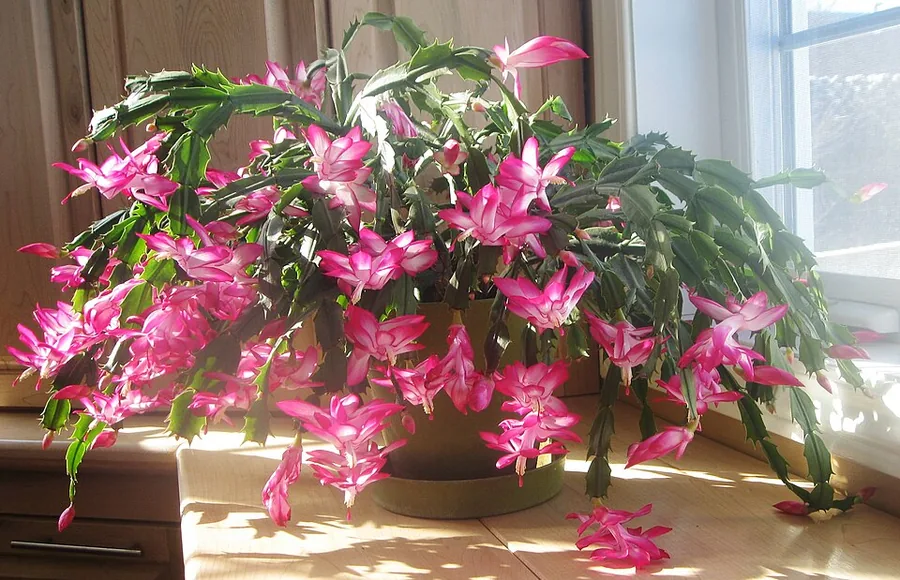
Its defining trait is the photoperiodic control of flowering. As daylength shortens and night temperatures fall, the plant registers the cue and initiates buds, which open into arching, tubular blooms in pink, red, white, or coral around the holiday season. The flattened, jointed segments are modified stems, and their cumulative weight produces the soft, cascading habit that suits a hanging basket or a shelf edge.
Cultural needs are modest once the photoperiod requirement is understood. Maintain bright, indirect light, water when the upper portion of the mix dries, and avoid disturbing the plant unnecessarily. A specimen left slightly pot-bound and undisturbed reliably flowers better than one repotted often, since root restriction favors reproductive over vegetative growth.
Care
The short version: supply bright, indirect light, water once the top of the mix dries, and provide a period of cool nights with long, uninterrupted darkness in fall to initiate the buds.
Light
Provide bright, indirect light for most of the year. The plant tolerates medium light or light shade, but intense direct summer sun causes photodamage that scorches the segments and induces red pigmentation. An east-facing or shaded west-facing window meets its requirements.
Water
Water once the top half of the mix dries, then water thoroughly. As a forest cactus it requires more moisture than a desert species yet must not remain in saturated soil. Once buds form, maintain the medium evenly moist, because moisture stress at that stage triggers bud abscission.
Soil
Use a well-drained, organic-rich potting mix, a cactus or succulent blend amended with additional grit. A pH of 5.5 to 7.0 is appropriate. Drainage is the critical factor, since persistent water at the roots induces the rot that kills these plants.
Temperature
Standard interior temperatures of 55°F to 81°F (13°C to 27°C) suit it year-round. The exception is fall, when cool nights near 55°F to 60°F (13°C to 16°C) form part of the stimulus that initiates flowering.
Humidity
Average household humidity is adequate, so no target value applies. Given its rainforest origin it benefits from slightly elevated atmospheric moisture, achieved by grouping it with other plants or placing it on a pebble tray.
Feeding
Fertilize monthly through spring and summer during active growth with a balanced houseplant fertilizer at half strength. Withhold feeding by late summer to promote fall flowering, and transition to a low-nitrogen, high-phosphorus formulation as bloom season approaches.
Pruning
After spring flowering, pinch or twist off a few terminal segments to stimulate branching and a denser habit. The removed segments are viable cuttings and root readily into new plants.
Repotting
Repot only every 3 to 4 years. Flowering is best when the plant is slightly pot-bound, so an oversized pot favors vegetative growth at the expense of bloom. Roots emerging from the drainage holes or soil that dries almost immediately indicate it is time.
Size & spacing
A mature specimen remains compact at 6 to 12 inches (15 to 30 cm) tall but spreads 12 to 24 inches (30 to 61 cm) wide as the jointed stems arch and trail. That pendent habit lends itself to a hanging basket or an elevated shelf.
Troubleshooting
Nearly all Christmas cactus problems reduce to water, light, or the photoperiod and temperature it needs to flower. The plant signals each one clearly through dropped buds, softened stems, or pigment change in the segments. Identify the symptom below and correct the underlying condition before a minor lapse forfeits the season.
Flaccid stems above a substrate that stays saturated
Wilting in the presence of wet soil signals root rot, the consequence of overwatering or a dense mix that holds water and starves the roots of oxygen. Lift the plant and inspect the roots; brown, soft tissue rather than firm and white confirms it. Let the plant dry, excise the rotted roots, repot into fresh fast-draining mix, and discard standing water from the saucer so the root zone never sits submerged.
Fix:
- Allow the plant to dry out
- Repot into a fresh, fast-draining mix and trim away rotted roots
- Empty saucers so the pot never stands in water
Buds yellow and abscise before opening
Bud drop is an abscission response, and it nearly always follows an abrupt change once buds have set, be it a cold draft, the warm air off a vent, or a lapse in watering. Because the buds are sensitive while forming, hold the plant in one stable position and keep the medium evenly moist throughout. Refrain even from rotating it, since a shift in light orientation at this stage is enough to provoke the drop.
Fix:
- Keep the plant in a stable spot away from heat vents and cold drafts
- Keep the growing medium evenly moist once buds appear
- Avoid moving or rotating the plant while in bud
Vegetatively healthy plant that fails to set buds
A plant that won't bloom is typically held too warm and too bright through fall, which suppresses flower initiation. This species is a short-day plant, so buds form only after a run of cool nights near 55°F to 65°F (13°C to 18°C) coupled with 12 or more hours of uninterrupted darkness nightly for roughly 6 weeks. A light interruption resets the dark period, which is why even a lamp switched on during that interval prevents flowering.
Fix:
- Provide cool nights of about 55 to 65°F
- Give 12 or more hours of continuous darkness each night for roughly 6 weeks starting in fall
- Avoid interrupting the dark period with artificial light
Segments developing yellow or red pigmentation
Yellow or red flushing in the segments is photodamage from too much direct light, most pronounced in summer when irradiance peaks. Relocate the plant to bright, indirect light and provide shade through the hottest months to reduce the load on the tissue. The discoloration generally resolves once the segments are out of harsh direct sun.
Fix:
- Move the plant to bright, indirect light
- Provide light shade during hot summer months
Toxicity
For pet-keeping households the verdict is reassuring: the Christmas cactus is safe. The ASPCA classifies it as non-toxic to cats and dogs, and it contains no compound that endangers other animals or people. A pet that ingests a quantity of the fibrous stems may experience a brief, mild gastrointestinal upset, which is the full extent of the effect.
Safe for
People · Cats · Dogs · Horses · Rabbits · Livestock · Birds
Cats None
The plant contains no toxin that affects cats. Where a cat ingests a substantial amount of the fibrous stems, expect at most transient vomiting or loose stool, a mechanical rather than toxic effect.
Dogs None
Dogs are not at risk of poisoning from this plant. Ingestion of a large quantity of stem tissue may produce only short-lived gastrointestinal upset that resolves without intervention.
Horses None
No constituent of this plant is toxic to horses, and its small indoor stature keeps it outside a horse's normal access in any case.
Rabbits None
Rabbits can consume the segments without toxic effect. As with any fibrous forage, an excessive portion may loosen the gut for a day, but the tissue carries no poison.
Livestock None
The plant holds no toxin of concern to goats, sheep, or cattle. As an indoor specimen, it seldom comes into contact with farm species regardless.
Birds None
Pet birds incur no poisoning risk from the stems or flowers, so an occasional peck warrants no concern.
People None
The plant is non-toxic to people, young children included. It is not a culinary species, so there is no cause to taste it, though an inquisitive bite presents no hazard.
Varieties
Three holiday cacti circulate under one common name, and they are distinguished reliably by segment morphology and flowering period. The following are the species encountered in the trade.
Thanksgiving cactus (Schlumbergera truncata)
Its segment margins bear pointed, claw-like teeth and it flowers near Thanksgiving, and the species accounts for most plants sold under the Christmas cactus name.
True Christmas cactus (Schlumbergera × buckleyi)
It is identified by rounded, scalloped segment margins and a pendulous habit, with anthesis occurring closer to Christmas than in its earlier-flowering relative.
Easter cactus (Rhipsalidopsis / Hatiora gaertneri)
It sits in a distinct genus, distinguished by rounded segments edged with fine bristles and a spring flowering period.
How to propagate
Few houseplants propagate as readily. A detached segment cutting roots with minimal intervention, which accounts for how widely these plants are shared.
Stem cuttingsEasy
Late spring to early summer after flowering (about May to June) · Roots form in about 2 to 8 weeks
Propagate from cuttings in late spring to early summer, after flowering has finished, roughly May to June when the plant resumes vegetative growth. Detach a cutting of 2 to 5 joined segments by twisting, allow the cut surface to callus for a day to limit rot, then insert it into a moist, well-draining medium. Rooting follows in about 2 to 8 weeks, and a humidity cover raises the local humidity to accelerate the process.
Myths
The three holiday cacti are a single plant, so segment shape and bloom time carry no significance.
These are taxonomically distinct plants, separable by segment morphology and flowering season. Thanksgiving cactus bears pointed, claw-like teeth and flowers in late November, true Christmas cactus shows rounded, scalloped margins and opens nearer Christmas, and Easter cactus is a separate genus that flowers in spring. Most plants sold as Christmas cactus are actually Thanksgiving cactus.