Houseplant · Cactaceae
Bunny Ear Cactus
Opuntia microdasys
Bright sun and a dry, gritty pot meet nearly every need of Opuntia microdasys.
Full sun
Every 14–28 days
50–86°F · 10–30°C
USDA 9–11
Overview
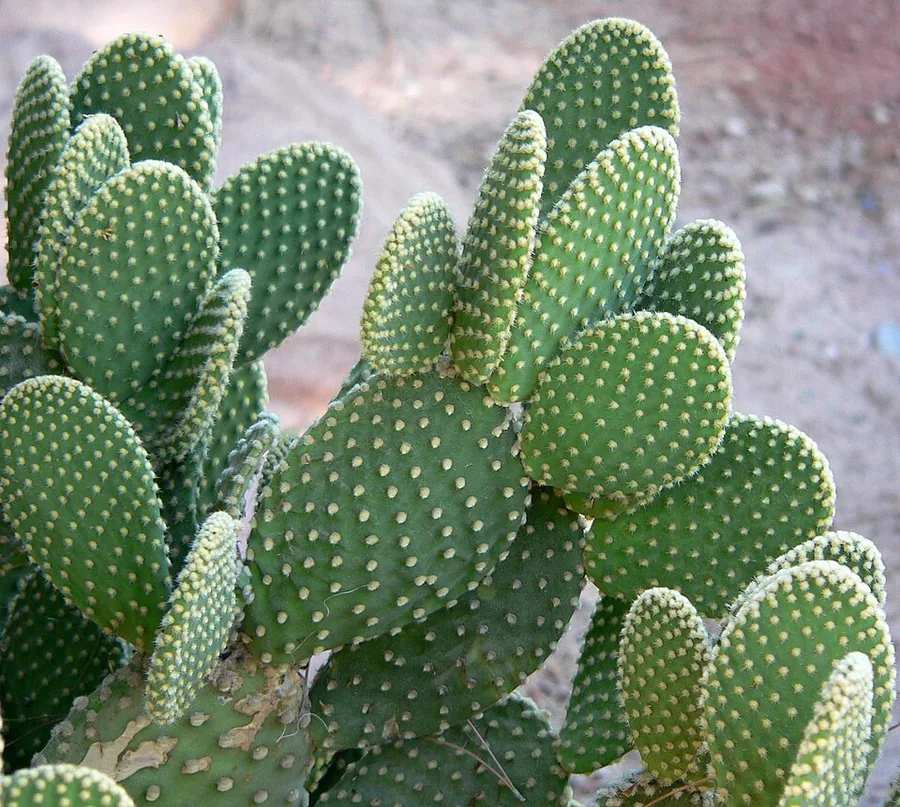
The common name traces to the flat, paddle-shaped pads that develop in opposing pairs and stand erect like a rabbit's ears. Native to the Mexican deserts, Opuntia microdasys is a slow grower that forms a low, branching clump and reaches roughly 12 to 24 inches (30 to 60 cm) under indoor conditions. Mature specimens produce pale yellow flowers in late spring and summer, though bloom is incidental to its appeal as a foliage curiosity.
The deceptively soft surface of the pads is no fuzz at all. Each polka-dot tuft is a cluster of glochids, fine barbed bristles that detach at the lightest contact and embed in skin, lips, and eyes. Because the barbs resist removal, the species is one to observe and to handle with gloves rather than touch.
Cultural requirements are modest. Bright light, a sharply draining substrate, and extended dry intervals between waterings keep the plant in good health, and excess moisture is by a wide margin its principal cause of failure through root and stem rot.
Care
The short version: supply the strongest direct sun available, a gritty and sharply drained substrate, and irrigation only after the soil has dried out completely. Handle the plant exclusively with gloves or tongs.
Light
Provide the strongest direct sun available, ideally a bright south-facing window, because the species evolved under full desert exposure. Bright indirect light is tolerated, but inadequate light induces elongated, pale pads in place of the dense, compact form full sun maintains.
Water
As a desert species it should be allowed to dry out completely, then irrigated deeply until water runs from the drainage holes. In practice that falls near every 2 to 4 weeks during active growth and considerably less in winter dormancy. Standing moisture is the most direct route to rot.
Soil
Grow it in a gritty, sharply drained sandy or cactus substrate that retains no water at the root zone. A pH between 6.0 to 7.5 is suitable, and incorporating additional perlite or coarse sand further improves drainage.
Temperature
The species is comfortable from 50°F to 86°F (10°C to 30°C), a range that encompasses most interiors throughout the year. Keep it above freezing, as frost damages the soft pad tissue.
Humidity
Low ambient humidity matches this desert native precisely, so no target figure applies. Dry air is preferable, whereas still, humid conditions predispose the plant to rot.
Feeding
Apply a diluted, low-nitrogen cactus fertilizer monthly through spring and summer. Suspend feeding entirely in autumn and winter during rest, since forcing growth in dormancy is counterproductive.
Pruning
Pruning is largely unnecessary. Remove a pad only to shape the plant or to take a cutting, and always work with thick gloves and tongs, because the glochids release at the lightest touch and anchor in skin.
Repotting
Repot only every 2 to 3 years, in spring, once roots emerge from the drainage holes or pads press against the rim. Tongs and a collar of folded newspaper allow safe lifting, and the gritty substrate should be renewed at the same time.
Size & spacing
Indoors it remains a compact clump, advancing slowly to about 12 to 24 inches (30 to 60 cm) in height and a comparable spread. Its slow rate means a single pot serves for several years before additional room is required.
Troubleshooting
The great majority of issues with this cactus reduce to a single misjudgment of water or light. Assess the pads and the substrate before irrigating, because soft pads and shriveled pads indicate opposite corrections. Identify the symptom below and intervene early, since rot in particular advances quickly.
Pads softening, browning, and collapsing at the base
Soft brown pads signal root and stem rot, the predictable result of saturated, slow-draining soil that starves the roots of oxygen and lets pathogens take hold. Because the decay spreads through the vascular tissue, speed matters: halt watering, lift the plant, and excise every affected section back to firm green tissue with a clean blade. Move it into fresh gritty mix and withhold water until the medium is fully dry, which denies the rot the moisture it needs.
Fix:
- Stop watering immediately
- Remove the plant and cut away rotted tissue with a clean blade
- Repot into fresh gritty cactus mix
- Allow soil to dry fully before watering again
Elongated, pale, light-starved growth
Pads that elongate, thin out, and bend toward the window are undergoing etiolation, the plant's response to insufficient light as it invests in length to reach a brighter source. Relocating it to the brightest window or to full sun corrects the deficit. Increase the light over a week or two rather than abruptly, since soft, light-deprived tissue has no protective conditioning and will scorch under sudden direct sun.
Fix:
- Move to the brightest available window or full sun
- Introduce direct sun gradually to avoid scorch
Pads thinning and developing wrinkles
Thinning, creased pads point to underwatering, because the plant has drawn down its stored water reserves after an extended dry period and the tissue has lost turgor. A deep, thorough soak refills those reserves, so water until the excess drains away. Turgor returns over a few days and the pads plump out, after which you can resume watering only once the mix has dried again.
Fix:
- Water thoroughly and allow to drain
- Resume regular deep watering once soil dries
Toxicity
On chemical toxicity the verdict is favorable: the species contains no toxin and is not listed by the ASPCA as harmful to cats or dogs. The hazard is mechanical rather than poisonous. The glochids, those deceptively soft tufts of barbed bristles, detach on contact and embed painfully in skin, mouths, and eyes, so site the plant beyond the reach of pets and children and handle it only with gloves.
Safe for
People · Cats · Dogs · Horses · Rabbits · Livestock · Birds
Cats Safe
The species contains no toxin, so ingestion will not poison a cat. The hazard is mechanical: a swat or a bite transfers a load of barbed glochids to the paw, lips, and tongue, and pawing at the mouth or face commonly follows.
Dogs Safe
No compound in this cactus is chemically harmful to a dog. The injury is purely physical, since a sniff or a bite embeds dense barbed glochids in the muzzle and tongue, where the barbs anchor and resist extraction.
Horses Safe
No constituent of the plant will poison a horse. The fine barbed bristles remain a mechanical risk to a grazing nose or mouth, which warrants keeping the plant out of reach.
Rabbits Safe
The plant carries no toxin capable of harming a rabbit. A nibble can still lodge glochids in the lips and mouth, a mechanical injury that justifies keeping it inaccessible.
Livestock Safe
Cattle, goats, and sheep face no chemical toxicity from this cactus. The barbed bristles are the sole hazard, embedding in the mouth and muzzle of any animal that investigates the pads.
Birds Safe
Nothing in the plant is poisonous if a bird ingests it. A probing beak can still catch the fine barbs, so a perch or pet bird is best kept away from the pads.
People Safe
The plant is non-toxic, yet bare-handed contact is inadvisable. The deceptively soft tufts are glochids that release on contact and embed in fingers, lips, and eyes, where they are painful and slow to extract, so thick gloves or tongs are the correct precaution.
The pads are covered in dense tufts of glochids, tiny barbed bristles that look soft and fuzzy but detach at the slightest contact and lodge painfully in skin, lips, mouth, and eyes. They are difficult to remove. Handle only with thick gloves or tongs and keep away from curious pets and children.
Varieties
Apart from the standard golden-glochid form, a small number of named selections are encountered, separated chiefly by glochid coloration.
Opuntia microdasys var. albispina
It bears white glochid tufts in place of the typical golden yellow, lending the pads a frosted, polka-dot appearance.
Opuntia microdasys 'Rufida'
It carries reddish-brown glochids and is at times treated as a distinct species, Opuntia rufida.
How to propagate
Vegetative propagation is straightforward because a single pad carries everything needed to root, so one established plant readily yields further specimens at no cost.
Stem cuttingsEasy
Spring to summer during active growth · 2 to 6 weeks to root
A detached pad propagates readily because each one carries the reserves and meristematic tissue needed to form roots, so take cuttings in spring or summer while growth is active. Twist or sever a pad with tongs and allow the wound to callus over several days, a step that seals the cut against rot before it meets the medium. Set the calloused pad in dry gritty mix, where it roots in 2 to 6 weeks, and keep gloves or tongs in use at every stage to keep the glochids off your hands.
Myths
Its fuzzy appearance means it is soft and safe to handle.
The tufts that read as soft are glochids, dense clusters of fine barbed bristles that release on the lightest contact and embed in skin, lips, and eyes, where they are painful and slow to extract. Bare-handed handling is never advisable. Thick gloves or tongs are the correct tool for every interaction with the plant.