Houseplant · Cactaceae
Fairy Castle Cactus
Acanthocereus tetragonus
A slow, sculptural cactus that runs on bright light and very little water, thriving on neglect rather than attention.
Full sun
Every 14–21 days
50–86°F · 10–30°C
USDA 9–11
Overview
The fairy castle cactus takes its name from a cluster of upright, turret-like stems that accumulate over years into a small green castle. Botanically it is the monstrose form of Acanthocereus tetragonus, a growth mutation selected for its irregular, branching architecture rather than for flowers. Its slow rate and high tolerance for lapses in care make it well suited to a sunny window and a hands-off grower.
Adapted to desert conditions, it stores water in its ribbed, three- and four-angled stems, which is why it tolerates long dry intervals between waterings and resents constant moisture. Indoors it remains small for years, yet with adequate light and time it can exceed a foot in height. The stems carry clusters of sharp spines, the single feature that warrants real caution on an otherwise undemanding plant.
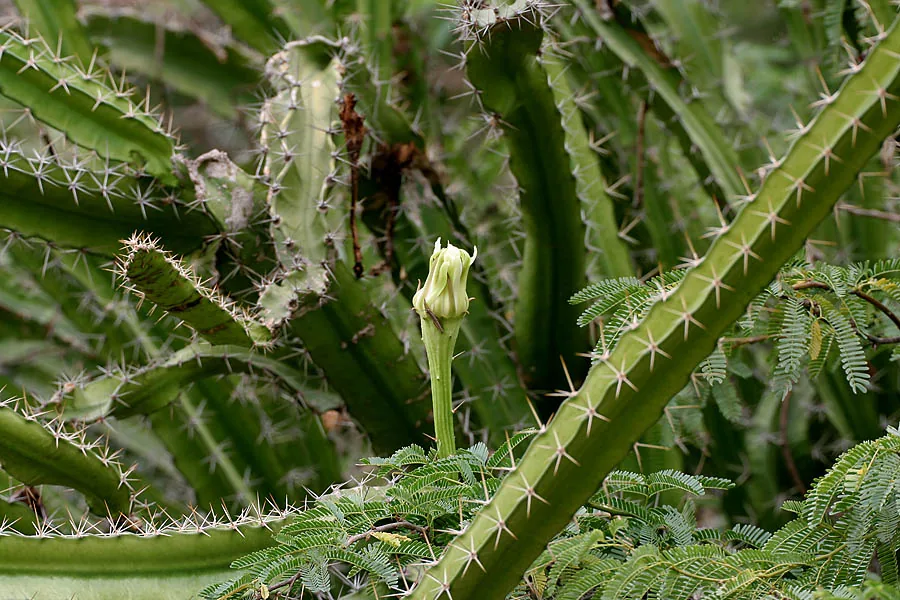
Many retail specimens arrive with a brightly colored flower fixed to the apex, and that bloom is not genuine. The monstrose form seldom flowers under indoor conditions, and the true flower of the species is large, white, and night-opening, characteristics nothing like the small dyed button placed on the crown.
Care
The short version: supply the strongest light available, water only after the soil has dried completely, grow it in a gritty fast-draining medium, and keep skin away from the spines.
Light
Provide the brightest position available, ideally a south- or west-facing window delivering several hours of direct sun. Bright indirect light will sustain it, but under insufficient light the stems etiolate, stretching pale and thin as the plant invests in length to reach a better light source.
Water
Water thoroughly, then withhold until the soil is completely dry, which falls at roughly every 2 to 3 weeks in spring and summer. In winter, when growth halts, give only enough to keep the stems from shriveling. Never leave the pot in standing water, because saturated medium starves the roots of oxygen and triggers the rot that kills this plant.
Soil
Use a fast-draining cactus or succulent mix, for example equal parts potting soil and coarse sand or grit. It is tolerant across a pH range of 6.0 to 7.5, so reaction is not the controlling factor. Drainage is, because the medium must shed water rapidly rather than hold it against the roots.
Temperature
Standard interior temperatures suit it well, across a band of 50°F to 86°F (10°C to 30°C). The species has no frost tolerance, since its tissues are not cold-hardened, so keep it indoors or move it in well ahead of the first cold nights.
Humidity
Low humidity around 20% to 40% matches its desert origin and is ideal. Misting serves no purpose here, and sustained moist air around the stems favors the fungal rot to which the plant is already predisposed.
Feeding
Feed sparingly during the growing season, from late spring into early fall, at about monthly intervals. A diluted low-nitrogen cactus fertilizer such as a 5-10-5 is appropriate, because excess nitrogen drives soft, weak tissue that is more vulnerable to the sap-feeding pests this plant attracts.
Pruning
Pruning is seldom required and is essentially sanitation and shaping. Excise any damaged, rotted, or unwanted segments with a clean, sharp blade, and wear thick gloves throughout to avoid the spines.
Repotting
Repot every 2 to 3 years, preferably in spring as growth resumes and the plant can recover quickly. Roots emerging from the drainage holes, a top-heavy habit, or soil that dries unusually fast after watering all indicate the root system has outgrown the container.
Size & spacing
Growth is slow indoors and the plant stays compact for years, though in time it ranges from 6 inches to nearly 6 to 71 inches (15 to 180 cm) in height with a spread near 6 to 12 inches (15 to 30 cm). Allow some clearance and position it where no one will brush against the spines.
Troubleshooting
Nearly every disorder in this cactus resolves to a fault in water or light. Soft, discolored stems signal excess moisture at the roots, while pale, elongated growth signals a light deficit. Identify the pattern below and correct the underlying condition before the damage advances.
Soft, discolored lesions near the base of the stems
These are the field signs of root and stem rot, which traces to moisture held too long around the roots. Cease watering, lift the plant, and excise every soft, discolored segment with a clean blade. Allow the healthy cuttings to callus for several days, repot them in dry, fast-draining medium, and resume watering only sparingly until the root system re-establishes.
Fix:
- Stop watering immediately
- Remove the plant and cut away all rotted tissue with a clean blade
- Let healthy cuttings callus for several days, then repot in dry, fast-draining mix
- Resume watering only sparingly once re-established
Cottony deposits or hard scale nodules on the stems
The cottony tufts are mealybugs and the fixed brown bumps are scale, both sap-feeding insects. Treat each one with a cotton swab dipped in 70% isopropyl alcohol, repeating weekly until none remain. Isolate the plant during treatment, and reduce feeding, since the soft growth that follows overfertilization is precisely what these pests colonize.
Fix:
- Dab insects with a cotton swab dipped in 70% isopropyl alcohol
- Repeat treatment weekly until no pests remain
- Isolate the plant from others while treating
Etiolated, pale stems angling toward light
This is etiolation, the elongation a cactus undergoes when it stretches toward an inadequate light source. Relocate it to a bright south- or west-facing window with several hours of direct sun, and rotate the pot periodically so growth develops evenly rather than to one side. The etiolated tissue will not revert, but subsequent growth forms tight and firm once light is sufficient.
Fix:
- Move to a brighter spot with several hours of direct sun
- Rotate the pot regularly so growth stays even
Toxicity
On toxicity the record is clear: this cactus contains no poison, and the wild species bears edible fruit, so ingestion poses no chemical risk to a pet, child, or grazing animal. The hazard is mechanical. The stems are armed with sharp spines that puncture skin and paws, so the plant should sit out of reach and be handled only with thick gloves.
Safe for
People · Cats · Dogs · Horses · Rabbits · Livestock · Birds
Cats Safe
Ingestion carries no toxic risk for a cat. The hazard is mechanical, since the spines can pierce a curious nose or lodge in a paw, so position the pot beyond a climber's reach.
Dogs Safe
A dog will not be poisoned by chewing the stems, but a mouthful of spines can pierce the lips and tongue. Place the plant well beyond an inquisitive snout.
Horses Safe
No toxin in this plant threatens a horse. A grazing muzzle can still meet the spines, which is sufficient reason to keep it clear of the barn and paddock.
Rabbits Safe
Rabbits face no chemical hazard from the plant. The sharp spines are the sole concern, so do not site it where a rabbit ranges or might nibble.
Livestock Safe
Cattle, goats, and sheep cannot be poisoned by it. The stiff spines are the point of concern, since a curious animal may lodge one in its mouth.
Birds Safe
The plant itself will not harm pet birds, and the wild species yields edible fruit. Keep a perching bird away from the spines, which can abrade delicate feet and skin.
People Safe
Nothing in the plant is toxic to handle or, in the case of the ripe wild fruit, to consume. The spines are the only caution, since they puncture skin readily, so wear thick gloves when moving or pruning it.
Handle with thick gloves or a folded strip of newspaper wrapped around the stem, and remove any embedded spines from skin promptly. The danger is mechanical, not chemical.
Varieties
What the trade sells under this name is a single mutation offered in a couple of forms. The two below are the ones most often encountered.
'Fairy Castle' (monstrose)
A slow-growing mutation in which numerous irregular, turret-like stems produce the castle outline, the form encountered on nearly every shelf, though it flowers indoors only rarely.
'Ming Thing'
A compact blue-green cultivar composed of short, tightly packed columns that cluster closely instead of extending upward.
How to propagate
Vegetative increase from the plant's own segments is straightforward, whereas seed is slow and unreliable. Take cuttings or offsets during the warm growing season, and allow the cut surfaces to callus fully before any contact with soil.
Offsets & pupsEasy
Spring to summer during active growth · 4 to 8 weeks
The most reliable method is to detach one of the small offsets or side branches in spring or summer during active growth. Allow the cut end to callus for a few days, set it in dry cactus mix, and withhold water until rooting occurs, a process of 4 to 8 weeks.
Stem cuttingsEasy
Spring to summer · 4 to 8 weeks
Remove a stem segment in spring or summer, wearing thick gloves against the spines, and let the wound dry and callus for 1 to 2 weeks before potting, which closes the surface and limits rot. Set in dry mix, the cutting typically roots within 4 to 8 weeks.
SeedDemanding
Warm season · Several months to over a year
Seed rarely justifies the effort, because the monstrose form does not come true and reverts to the plain species. Sown in the warm season, germination and growth are slow, requiring several months to over a year to yield a usable plant.
Myths
The showy flower at the apex of a fairy castle cactus is an authentic bloom.
The colored flower is a sales fixture, a dried strawflower or dyed paper flower glued to the apex to improve appeal. The monstrose 'Fairy Castle' rarely flowers indoors, and the species' actual flowers are large, white, and night-opening, wholly unlike the small dyed button on the crown. Remove the false bloom, because it holds moisture against the stem and can initiate rot.
Acanthocereus tetragonus is toxic to companion animals and humans.
Cacti contain no toxic principle, and this species does not appear on the ASPCA toxic plant lists. The wild form even produces edible ripe fruit. The genuine risk is purely mechanical, the spines that puncture skin and paws, not any chemical toxicity.