Shrub · Cactaceae
Dragon Fruit
Hylocereus undatus
Supply this climbing cactus with sun, a load-bearing post, and a pollination partner, and it returns night-blooming flowers and bright pitaya.
Full sun
Every 7–14 days
180–270 days
USDA 10–11
Overview
Dragon fruit is borne on a sprawling climbing cactus in the genus Hylocereus, cultivated through the warm tropics and subtropics for its striking fruit. The plant sends out long, fleshy, three-sided green stems that scramble over any surface they meet and require a strong post or trellis to bear their weight. It also travels under the names pitaya, pitahaya, strawberry pear, and the Honolulu queen.
The flowering biology is what distinguishes it. The large white blooms open for a single night, which is why the plant is also called night-blooming cereus. Many of the common white-fleshed types are self-incompatible, meaning a plant cannot fertilize its own flowers, so a lone specimen can bloom beautifully and never set fruit unless a second genetic type grows close enough to exchange pollen.
This is a long game rather than a quick harvest. A cutting can spend 4 to 6 months simply forming roots and the better part of a year reaching fruit, and a mature vine grows heavy enough to demand serious support. Provide sun, sharp drainage, and a solid structure to climb, and it produces for years.
Care
The short version: full sun, fast-draining soil, and a strong trellis for the stems to climb. Water through flowering and fruiting but let the soil dry between rounds, hold it nearly dry in cool weather, and plant a second compatible clone so the self-incompatible flowers can actually set fruit.
Light
Dragon fruit performs best in full sun, though it accepts partial sun or light shade. Shade-grown cuttings scorch if forced into bright light before their tissue can adjust, so hold them under about 30% shade for the first few months and raise the exposure by degrees.
Water
Water steadily through flowering and fruiting, then allow the top half of the soil to dry before watering again, roughly every 7 to 14 days. As a drought-tolerant cactus, it should be kept nearly dry through cool winter weather, since saturated roots in cold soil lose oxygen and rot.
Soil
Plant in well-drained sandy loam enriched with organic matter, because sharp drainage is precisely what keeps the stems and roots from rotting in standing moisture. A pH of 6.0 to 7.0 suits it, placing it right around neutral.
Temperature
It favors steady warmth, anywhere from 50°F to 100°F (10°C to 38°C), and frost will injure or kill the tissue. Delay planting until the soil has warmed past about 65°F (18°C) in spring.
Humidity
Average air is fine, somewhere around 40% to 60%, with no need to manage the figure closely. Good airflow matters more than damp air, since crowded, wet stems create the conditions that invite canker and rot.
Feeding
Feed through the active season from spring into fall with a balanced 6-6-6 carrying micronutrients. Keep early applications light and increase them as the plant matures and supports more stem mass.
Pruning
Prune one to three times a year to remove weak, damaged, or diseased stems and keep the canopy open to air. Once a stem reaches the top of the trellis, pinch the tip, which halts upward extension and redirects the plant into the branching, fruiting growth you want.
Repotting
Dragon fruit usually goes directly into the ground, but in a container repot every 1 to 2 years until it establishes. After that, move it to its permanent position against a strong post, because the mature plant becomes far too heavy to relocate.
Size & spacing
Stems climb from 6.5 to 20 feet (2 to 6 m) and the plant spreads 3 to 10 feet (1 to 3 m) wide, so allow generous room. Site it 15 to 25 feet from trees, buildings, and power lines, and anchor the whole structure with a sturdy post and trellis.
When to plant
Dragon fruit is a tropical cactus with no frost tolerance, so cold dictates the calendar. Set plants out in spring once the danger has passed and the soil has warmed, watch for night-blooming flowers from late spring through fall, and harvest fruit from summer into early winter.
Northern hemisphere
Southern hemisphere
Typical months for a temperate climate: start earlier in warm zones, later where spring frosts linger.
- Plant: After all frost danger in spring once soil is warm (above 65°F).
- Harvest: Night-blooming flowers from late spring through fall; fruit ripens summer to early winter.
Hardiness
USDA hardiness zones: 10–11
Temperature: down to -1°C
Troubleshooting
Most dragon fruit problems register on the fleshy stems, whether from fungal disease, excess water, or harsh sun, while a persistent absence of fruit nearly always traces to pollination. Reading these signs early lets you intervene before a small issue spreads. Match the symptom below, then act while the response still helps.
Sunken orange-brown lesions developing on stems and fruit
Those marks are stem and fruit canker, a fungal disease that enters through wounds and travels on splashing water, which is why overhead irrigation feeds its spread. Excise and burn every affected stem and fruit, switch to ground-level watering, and apply a labeled fungicide where the lesions persist. Prevention rests on disease-free planting stock and open spacing so air can dry the stems.
Fix:
- Remove and destroy infected stems and fruit
- Avoid overhead irrigation
- Apply a labeled fungicide
Yellowing stems turning soft and collapsing at the base
Soft brown tissue at the soil line points to stem and root rot, which sets in when excess water sits in poorly drained soil and starves the roots of oxygen until they die back. Cut watering immediately and trim the failed segments until the blade meets firm green flesh. A fast-draining medium plus a dry-down between waterings removes the conditions the rot depends on.
Fix:
- Reduce watering
- Improve drainage
- Cut away rotted segments back to firm green tissue
Heavy flowering that yields almost no fruit
Many dragon fruit clones are self-incompatible, meaning a plant cannot fertilize itself, so a single specimen blooms freely and sets nothing. Planting two or three different genetic types together restores the cross-pollination the flowers require. Because the blooms open only at night, transferring pollen by hand after dark or at first light is often what completes the set.
Fix:
- Plant 2 or 3 different genetic types
- Hand-pollinate flowers at night or early morning
Bleached, scalded patches forming on the sun-facing side
This is sunburn, and it strikes when shade-grown cuttings are moved into full sun before their tissue can adjust. Hold young plants under roughly 30% shade for the first 3 to 4 months and raise the light gradually so the stems harden. Scorched tissue will not green up again, but growth that emerges after acclimation comes in undamaged.
Fix:
- Provide about 30% shade for the first 3-4 months
- Acclimate plants to sun gradually
Toxicity
For a household with animals, the verdict is reassuring: dragon fruit is non-toxic. The ASPCA lists pitaya as safe for cats and dogs, and the ripe fruit is grown for people to eat. The single caution is mechanical, the small spines on the stems that can prick skin, so wear gloves when you handle or harvest.
Safe for
People · Cats · Dogs · Horses · Rabbits · Livestock · Birds
Cats None
The ASPCA classifies dragon fruit as non-toxic to cats, so an exploratory nibble carries no poisoning risk. The practical hazard is mechanical: the fine spines along the stems can prick a cat's mouth, which is reason enough to discourage chewing.
Dogs None
Dogs are equally safe, as the ASPCA places dragon fruit on its non-toxic list. The only thing to guard against is the bristly areoles on the stems, which can scratch a nose or mouth.
Horses Safe
No part of the plant is poisonous to a horse. The fleshy stems do carry small spines that can irritate the lips, so there is no benefit in letting a horse browse them.
Rabbits Safe
Rabbits run no toxic risk from dragon fruit, and a taste of the ripe flesh is a harmless occasional treat. The spiny stems, however, are not suitable for a rabbit to gnaw.
Livestock Safe
Cattle, goats, and sheep can graze near dragon fruit with no poisoning concern. The spines remain the sole nuisance, capable of pricking the mouth of any animal that tries to strip the stems.
Birds Safe
Birds can take a portion of the ripe fruit with no harm whatsoever. Keep them off the stems, where the fine bristles can snag a beak or feet.
People Safe
The fruit is cultivated for the table and is entirely safe to eat, seeds included. Wear gloves while handling or harvesting the stems, since the areoles hold small spines that prick bare skin.
Stems are nearly spineless but bear areoles with small spines and bristles that can prick skin; wear gloves when handling, training, or harvesting.
Varieties
Growers select dragon fruit as much for how it fruits as for how it tastes, since pollination behavior decides yield. These are the types worth knowing before planting.
White-fleshed types (H. undatus)
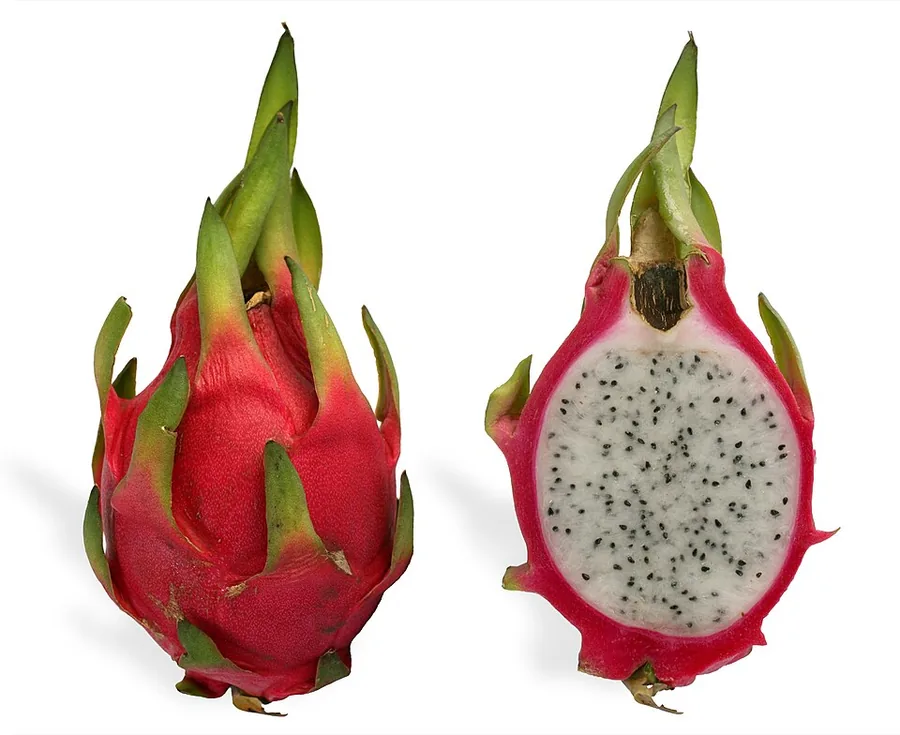
The familiar pink-to-red skinned fruit carrying white pulp studded with tiny black seeds. Many of these clones are self-incompatible, so they depend on a compatible partner to set fruit.
Vietnam White ('Vietnam #1')
A selected white-fleshed clone valued for its large pink fruit, measuring 13% to 19% soluble solids in CTAHR trials, which marks a notably sweet selection.
Self-fertile selections
Breeding programs in Taiwan and Vietnam developed productive pitaya that set fruit on a single plant, removing the requirement for a second clone.
Companions
Plant near
Second compatible dragon fruit clone: A different genetic type provides the cross-pollination needed by self-incompatible H. undatus cultivars.
How to propagate
Nearly every grower starts dragon fruit from a stem cutting, which roots quickly and stays genetically true to the parent. Seed is possible but slow, and the seedlings will not reproduce the original plant.
Stem cuttingsEasy
Warm season (spring to summer) · Roots in 4-6 months; fruit in 6-9 months
Cuttings are the standard method for propagating dragon fruit, taken across the warm months from spring through summer. Sever 6 to 15 inch (15 to 38 cm) stem sections, allow the cut wounds to cure for a few days so they callus over and resist rot, then set them into a well-drained mix. Roots form in about 4 to 6 months and fruit can follow within 6 to 9, and once established the stems extend as much as 3 cm a day.
SeedModerate
Warm season · Up to 7 years to fruit
The tiny black seeds sown in the warm season germinate readily. The drawback is time and unpredictability: seedlings develop slowly, may need up to 7 years to reach fruiting, and will not come true to the parent, so seed is seldom chosen for a working crop.
Myths
Dragon fruit plants are toxic or dangerous to pets.
The ASPCA lists pitaya as non-toxic to both dogs and cats, so a curious pet faces no poisoning risk. The hazard is purely mechanical: the small spines on the stems can prick a mouth or paw.
A single dragon fruit plant will always fruit on its own.
Numerous H. undatus clones are self-incompatible and flower heavily yet set no fruit in isolation, because a plant cannot pollinate itself. Grow a second genetic type nearby and be ready to transfer pollen by hand at night, which is frequently the step that turns a flower into fruit.
Dragon fruit grows as a tree.
For all the height it reaches, this is a climbing, sprawling cactus rather than a tree. It produces long fleshy stems that clamber over whatever they reach, so it has to lean on a strong post or trellis to stay upright.