Tree · Rosaceae
Quince
Cydonia oblonga
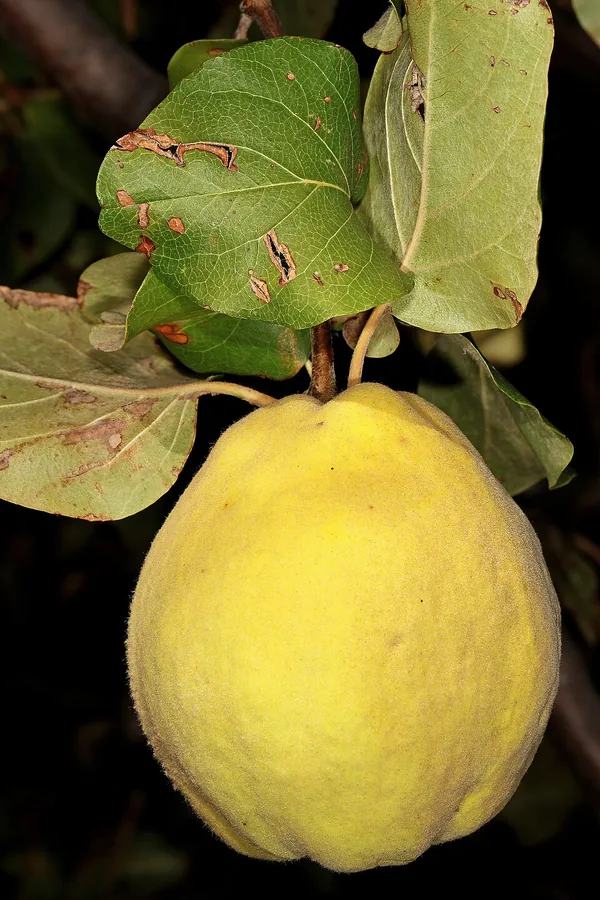
Slow-growing and astringent on the branch, quince converts patient care into fragrant golden pomes rich in the pectin that sets jelly.
Full sun
Every 7–14 days
USDA 5–8
10–15 ft · 3–4.6 m
Overview
Quince, Cydonia oblonga, is an old-world pome tree cultivated for centuries before apples and pears dominated the orchard. It stays small, seldom exceeding 10 to 15 feet (3 to 4.5 m), and flowers in late spring, opening pale pink blossoms. By autumn it carries fragrant golden pomes whose aroma can fill a room.
The fruit is a culinary one, not a dessert apple. Raw flesh is hard and astringent, but cooking softens it, drawing out sweetness and a deep rose color, and its high pectin content is what sets jelly and the Spanish paste membrillo so reliably. The species sits within the rose family, Rosaceae, alongside apples, pears, and plums.
Success with quince rests on two facts about the tree. It grows slowly and establishes at its own pace, and it is extremely susceptible to fire blight. Site it in full sun with well-drained soil and free air movement, prune judiciously, and a single specimen will crop for many years.
Care
The short version: site quince in full sun and well-drained soil, irrigate deeply during establishment and fruit fill, prune to an open center in late winter, and monitor for fire blight from bloom onward.
Light
Quince fruits best in full sun, where a long day of light builds sugars and ripens the crop. It tolerates partial shade, but reduced light lowers both fruit set and flavor.
Water
Irrigate deeply during establishment and again through fruit development, on the order of every 7 to 14 days as weather dictates, allowing the top half of the soil to dry between waterings. An established tree withstands short drought, but consistent moisture yields the best fruit, since water stress during fill degrades quality.
Soil
Plant into fertile, well-drained loam that is slightly acidic, around a pH of 6.0 to 7.0. Quince adapts to a range of soils, but drainage is non-negotiable, as roots standing in water invite trouble.
Temperature
The species is cold-hardy to roughly -20°F (-29°C) and withstands heat to 95°F (35°C). A temperate winter chill is part of what conditions the tree to bloom and set fruit, so the dormant cold period is functional, not merely tolerated.
Humidity
Average outdoor humidity near 40% to 70% is adequate. Air movement matters more than the reading itself, because stagnant, humid air around the canopy is what favors the fungal diseases to which quince is prone.
Feeding
An annual balanced fertilizer or compost topdressing in early spring meets the tree's needs. Restrict nitrogen deliberately, because excess nitrogen drives the soft, succulent growth that fire blight colonizes most readily.
Pruning
Prune during late winter dormancy to an open-center, vase form that admits light and air to the interior. Remove suckers, crossing limbs, and deadwood, and cut out any fire-blight-damaged wood well below the canker margin, disinfecting tools between cuts to avoid spreading the bacterium.
Repotting
Quince is a field tree and rarely needs repotting. Establish it once in a permanent site with adequate room, and it remains there for its lifespan.
Size & spacing
A mature quince attains 10 to 15 feet (3 to 4.5 m) in height and spreads 9 to 12 feet (2.7 to 3.7 m). Allocate that full footprint at planting so light and air penetrate the entire canopy.
When to plant
Quince is cold-hardy across zones 5 to 8 and is best planted dormant. Establish bare-root or container trees in early spring, or in fall where winters remain mild. Bloom follows in late spring, and fruit matures through fall, ready to harvest around October ahead of the first hard frost.
Northern hemisphere
Southern hemisphere
Typical months for a temperate climate: start earlier in warm zones, later where spring frosts linger.
- Plant: Plant bare-root or container trees in early spring while dormant, or in fall in mild-winter regions.
- Harvest: Blooms late spring (April to May); fragrant golden pome fruit ripens in fall (about October) and is harvested before the first hard frost.
Hardiness
USDA hardiness zones: 5–8
Temperature: down to -29°C
Troubleshooting
Almost every quince disorder is fungal or bacterial in origin, and most respond to airflow, sanitation, and well-timed pruning that reduce inoculum and drying time. Fire blight is the exception that can kill an entire tree, so learn its signs first. Identify the symptom below, then intervene before it advances.
Blossoms and shoot tips blacken and bend into a hook
Quince ranks among the most fire blight-susceptible trees in cultivation, and the causal bacterium enters through open flowers and succulent shoots during warm, wet spring conditions. Infected tips die back and curl into a shepherd's crook. Prune well below the lesion, 20 to 30 cm beneath any visible canker, sterilize tools between cuts to prevent transmission, and withhold nitrogen so the tree is not producing the tender tissue the pathogen exploits.
Fix:
- Prune out blackened, shepherd's-crook shoots 20 to 30 cm below visible cankers, disinfect tools, avoid excess nitrogen, and consider bloom-time bactericide sprays.
Distorted, crusty lesions develop on the fruit
Quince rust is a heteroecious fungus, requiring two hosts, quince and a nearby juniper or cedar, to complete its life cycle. Spores released at bloom infect and deform the developing fruit. Eliminate alternate juniper hosts within range where practical to break the cycle, and apply protective fungicide during flowering.
Fix:
- Remove nearby alternate juniper hosts where practical and apply protective fungicides during bloom.
Dark leaf spots precede premature defoliation
Leaf blight is a fungal disease favored by wet weather, producing dark leaf spots and driving early leaf drop before fall. Rake and destroy fallen leaves to remove the overwintering inoculum at the base, improve air circulation to shorten the time leaves stay wet, and apply fungicide only where defoliation becomes severe.
Fix:
- Rake and destroy fallen leaves, improve air circulation, and apply fungicides if defoliation is severe.
A white, powdery coating films the foliage
Powdery mildew appears as a white, dusty coating under humid conditions with poor air movement, and it seldom causes lasting damage. Prune to improve airflow through the canopy, and reserve fungicide for cases where the coating spreads across much of the tree.
Fix:
- Prune for airflow and treat with fungicide if widespread.
Toxicity
The cooked flesh of quince is safe and is the portion used for jelly and membrillo. The seeds are the concern, since they contain cyanogenic compounds, as do the pips of apples, cherries, and other Rosaceae. Intact seeds generally pass through undigested, but chewing them in quantity liberates cyanide, so keep cores away from pets and grazing stock and do not consume the pips.
Toxic to
Cats · Dogs · Horses · Rabbits · Livestock · Birds
Safe for
People
Cats Mild
The flesh presents no meaningful hazard, and a cat that samples a windfall is unaffected. The risk resides in the seeds, whose chewed pips can release cyanide and produce drooling, brick-red gums, and labored breathing when a cat ingests a substantial number.
Dogs Mild
Because intact pips generally pass through undigested, a dog would need to crush a large quantity of seed to be affected. Note drooling, dilated pupils, or heavier breathing after a dog chews into the cores, and remove fallen fruit.
Horses Mild
The specific hazard is windfall quince in a pasture, since horses may swallow whole fruit and grind the seeds while chewing. Large amounts of crushed seed can cause weakness, rapid breathing, and reddened gums, so clear dropped fruit from grazing areas.
Rabbits Mild
Cores and seeds should be kept out of reach, as the cyanogenic pips are not appropriate in a rabbit's diet. A small quantity of cooked or raw flesh is harmless, but the seeds carry the risk.
Livestock Mild
Goats, sheep, and cattle can consume fallen fruit and the enclosed seeds, which is where the cyanide is concentrated. Remove windfalls near grazing areas to prevent the animals from ingesting large quantities of seed.
Birds Mild
Backyard hens and other birds can peck the soft flesh without harm. The seeds are the portion to exclude, so do not discard cores or split fruit into the run.
People Cooked fruit safe
Cooked quince is a culinary staple, turning sweet and pink in jelly and membrillo with no concern. The seeds should not be eaten, and children should be taught to spit out the hard pips rather than chew them.
Keep seeds and cores away from pets and children; the hard astringent flesh is eaten cooked, and jelly or membrillo made from the flesh is safe.
Helpline numbers

United States
ASPCA Animal Poison Control: (888) 426-4435 (fee applies)
Poison Control: (800) 222-1222



Canada
Poison Centres: 1-844-764-7669
Varieties
Only a few quince cultivars appear in home orchards, and most are selected for cooking quality rather than fresh eating. The names below are the ones worth knowing.
Pineapple
A California selection prized for tender flesh and a pineapple-like note in the flavor, which suits it well to cooking.
Smyrna
Produces large, intensely fragrant fruit that cooks down to an excellent texture.
Orange
Also marketed as Apple quince, this long-grown standard bears round, orange-yellow fruit traditionally made into jelly.
Champion
A late-ripening cultivar bearing large, pear-shaped fruit with a more delicate flavor than most.
How to propagate
Quince is propagated vegetatively because seedlings do not reproduce the parent's traits. Each method below yields a genetic copy of the selected tree.
GraftingModerate
Named varieties are budded or grafted onto rootstock rather than raised from seed, which preserves their identity. Quince also functions in the reverse role, serving as a widely used dwarfing rootstock for pears.
Stem cuttingsModerate
Hardwood cuttings taken from the dormant tree in winter root with moderate reliability and develop into plants identical to the parent.
LayeringModerate
A low stem is pinned to the soil to root while still attached to the tree, or the plant is stooled to generate multiple shoots at once. This is the traditional nursery technique for increasing quince rootstock.
Myths
Quince and flowering quince are the same plant.
The two share a common name but belong to different genera. True quince is the small Cydonia oblonga tree grown for its large, fragrant golden fruit, whereas flowering quince is Chaenomeles, an ornamental shrub grown for showy spring bloom and small hard fruit. One is a fruit tree, the other a landscape shrub.
Quince can be eaten raw off the tree like an apple.
Most quince is hard, sour, and strongly astringent when raw. Cooking is the transformation, developing sweetness and a deep pink color, and the fruit's high pectin is precisely why it sets jelly and membrillo so well.