Houseplant · Araceae
Pothos
Epipremnum aureum
Forgiving, quick to grow, and content in a dim corner, pothos is the hardest houseplant to kill.
Bright indirect
Every 7–14 days
70–90°F · 21–32°C
USDA 10–12
Overview
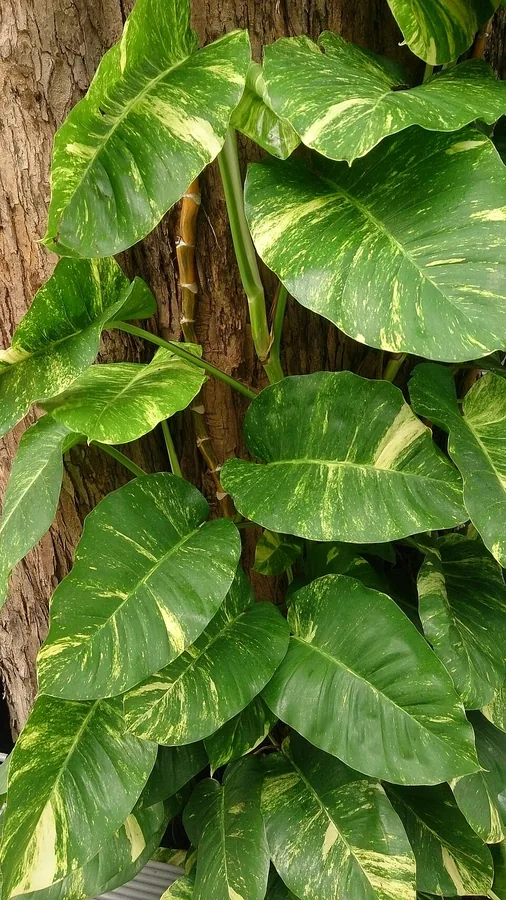
A member of the arum family native to the South Pacific islands, pothos behaves as a heavy climbing vine in the wild, hauling itself up tree trunks as a thick-stemmed climber. Brought indoors, the stems stay thinner and tend to trail rather than climb, which suits a shelf or a trained pole. Its forgiving temperament and heart-shaped foliage account for its ranking among the most widely kept houseplants worldwide.
The appeal lies in its modest needs. Low light poses no problem, a skipped watering does no lasting harm, and the plant pushes on through conditions that would stall something fussier. Hang the pot and the vines spill downward; pinch the growing tips back instead and the plant branches into a denser, rounder habit.
Two limitations are worth understanding before you commit. Every part of the plant is toxic to cats and dogs, so it belongs out of reach of curious pets. And in frost-free regions it turns invasive once it escapes a pot, which is why it stays an indoor plant across most of the country.
Care
The short version: give it bright indirect light, though it manages on much less, and water only once the top half of the soil has dried so the roots can breathe between drinks. Pot it in a well-drained mix, hold it in steady warmth away from cold drafts, and pinch the vines back when they run leggy.
Light
Pothos grows best in bright indirect light, but it tolerates medium light, partial shade, and even a low-light corner, which is the source of its easy reputation. The plain green types cope best with the dimmest spots, since they carry the most chlorophyll. Keep it out of harsh direct sun, which scorches the leaf tissue.
Water
Let the top half of the soil dry out before watering again, which usually lands every 7 to 14 days. Waterlogged soil drives the air from the root zone and is the fastest way to kill a pothos, so when in doubt, wait. Always empty any water that collects in the saucer so the roots never stand in it.
Soil
A well-drained peaty potting mix is all it asks, and any standard houseplant blend serves. Drainage is the point, since roots held in wet soil lose their oxygen and rot. Use a pot with holes in the base and the plant handles the rest.
Temperature
Hold it within 70°F to 90°F (21°C to 32°C), the range of most warm homes. It has no frost tolerance and stalls in the cold, when growth and metabolism slow to a halt. Keep it clear of chilly drafts and unheated rooms through winter.
Humidity
Ordinary room moisture is plenty, with no percentage worth aiming for. Foliage tends to come in a touch lusher where the air carries more moisture, one reason the plant thrives near a shower or a sink. Watch the parched air of a heated winter room, though: it scorches the leaf tips and favors spider mites, which multiply fastest when conditions turn dry.
Feeding
Feed once a month through the spring-to-fall growing season with a diluted balanced houseplant fertilizer, since active growth is when the plant can use the nutrients. Half the label strength is plenty and guards against salt buildup. Ease off through winter, when growth slows and the plant draws little.
Pruning
Trim or pinch the stems any time the vines overreach or thin out toward the crown. Make the cut just above a leaf node and the dormant bud waiting there breaks into a new side shoot, which thickens the plant over time. Hold onto each piece you remove, since it roots readily as a free cutting.
Repotting
Step it up into a slightly larger pot every 1 to 2 years, or sooner once it outgrows the current one. Roots circling the rootball, pushing out the drainage holes, or soil that dries within a day all signal a rootbound plant. Go up only one pot size so the surrounding fresh soil does not stay wet and sour.
Size & spacing
As a houseplant the vines reach 3 to 10 feet (90 cm to 3 m) long and spread about 3 to 6 feet (90 to 180 cm) across. Give a hanging plant clearance for the vines to fall, or train them along a wall or up a moss pole.
Troubleshooting
Most pothos trouble begins at the roots and reads on the leaves, and overwatering is behind more of it than any other cause. Catch the early signs and you can correct course before a plant declines. Match what you see below, then act while the fix still has time to work.
Mushy, dark roots with a foul smell
Root rot follows when soil stays wet long enough for the roots to suffocate and decay, and it is the one pothos disorder that can kill a plant quickly. The trigger is overwatering in a mix that holds too much water against the roots. Lift the plant from its pot, cut back every root that has gone black and slimy, then repot into fresh, well-drained mix and hold off on water until it recovers.
Fix:
- Unpot and trim rotten roots
- Repot in fresh well-drained mix
- Withhold water until recovery
Yellowing that begins in the oldest, lowest foliage
Yellowing on a pothos is a watering signal, and the cause is almost always overwatering rather than drought. Roots need oxygen, and saturated soil drives the air out of the pore spaces, so the roots can no longer take up water and nutrients; the oldest, lowest leaves yellow first as the plant pulls resources from them. Let the soil surface dry between waterings, and confirm the pot drains freely so water never sits at the base.
Fix:
- Reduce watering frequency
- Check pot drainage
- Let soil surface dry before watering
White cottony fluff in the leaf joints
The small white tufts wedged into the stems and leaf axils are mealybugs, soft-bodied insects that feed on plant sap and shelter where two surfaces meet. Touch each colony with a cotton swab dipped in alcohol, then treat the plant with insecticidal soap. Keep it apart from your other plants until the infestation clears.
Fix:
- Dab with alcohol-soaked swab
- Apply insecticidal soap
- Isolate plant
Small brown bumps stuck along the stems
Hard brown bumps fixed to the stems and leaves are scale insects, and they resist brushing off because each one feeds beneath a protective waxy shell. Lift them with a fingernail or an old toothbrush, then coat the plant in horticultural oil, which smothers the insects under their cover. A single pass rarely reaches every stage, so treat again a week or two later.
Fix:
- Scrape off scale
- Apply horticultural oil
- Repeat treatment
Fine webbing and a speckled, dusty look
Faint webbing over the leaves and a stippled, washed-out surface are the work of spider mites, which breed fastest in hot, dry air. Their feeding leaves the foliage finely speckled and dusty in appearance. Rinse the foliage thoroughly to dislodge the colony, raise the humidity to slow them down, and finish with insecticidal soap or a miticide if any persist.
Fix:
- Rinse foliage
- Raise humidity
- Apply insecticidal soap or miticide
Dark leaf spotting or a coat of gray botrytis fuzz
Dark blotches or a gray, fuzzy coating on the foliage are fungal infections that take hold on wet foliage and stale air. Remove the affected leaves so the infection cannot spread to healthy tissue. Open up space around the plant for better airflow, and water at the soil rather than over the leaves.
Fix:
- Remove affected leaves
- Improve air circulation
- Avoid wetting foliage
Browned, dry margins and tips across the foliage
Browning at the leaf edge is a moisture and stress signal, and overwatering blackens the margins more often than dryness does. Cold drafts and dry indoor air compound it, because chilled or desiccated tissue dies back at the margins where it is thinnest. Even out your watering, keep the plant clear of cold windows and heating vents, and lift the humidity around it.
Fix:
- Correct watering
- Keep away from drafts and cold
- Raise ambient humidity
New leaves coming in solid green
When new leaves arrive without their cream and gold markings, the plant is responding to a shortfall of light. The pale tissue carries no chlorophyll and cannot photosynthesize, so under too little light a variegated pothos reverts to solid green to maximize the leaf area that can feed it. Move it to a brighter position, still out of direct sun, and the next flush of growth holds its pattern.
Fix:
- Move to brighter indirect light
Toxicity
Pothos is an easy plant to live with, but not one to chew. Every part holds microscopic, needle-shaped crystals of calcium oxalate that pierce and irritate the mouth and throat on contact. Keep the vines and any cuttings away from pets and small children.
Toxic to
Cats · Dogs · Horses · Rabbits · Livestock · Birds · People
Cats Moderate
A cat that bites a leaf releases needle-sharp calcium oxalate crystals into the soft tissue of its mouth. Watch for drooling, pawing at the muzzle, vomiting, and difficulty swallowing.
Dogs Moderate
Dogs show the same picture as cats once the crystals embed in the mouth and throat: a burning sensation, heavy drooling, and vomiting after a chew. The sting is immediate, so most dogs back off after a single bite.
Horses Moderate
The same crystals lodge in a horse's mouth and throat lining, producing drooling and difficulty swallowing. Keep trailing vines out of reach in any barn or stable.
Rabbits Toxic
The crystals inflame a rabbit's mouth and gut just as readily, and a rabbit's digestive system tolerates it poorly. Keep pots and trailing vines well beyond any rabbit's reach.
Livestock Moderate
Cattle, goats, and sheep suffer the same mouth and throat irritation from the sap and leaves. Keep the plant clear of grazing animals.
Birds Toxic
The sap and crystals sting a bird's mouth and crop, and a bird's small size leaves little margin. Keep pots and trailing vines away from pet birds and poultry.
People Caution
This is not a food plant, and the sap stings bare skin and the mouth on contact with the crystals. Wash your hands after pruning, and keep cuttings and leaves away from small children.
Sap may irritate skin; wash hands after pruning
Helpline numbers

United States
ASPCA Animal Poison Control: (888) 426-4435 (fee applies)
Poison Control: (800) 222-1222



Canada
Poison Centres: 1-844-764-7669
Varieties
Most pothos sold today are one of a handful of named cultivars, set apart by how their leaves are colored and marked. These are the ones worth knowing by name.
Golden Pothos
The original form carries heart-shaped green leaves marked with broad splashes of golden yellow.
Marble Queen
Heavy white and cream marbling leaves little green tissue to photosynthesize, so the plant grows slower than the rest.
Neon
Neon drops the variegation entirely, holding solid leaves in a bright chartreuse green.
Jade
Jade stays plain throughout, with deep green leaves and little to no marbling.
Pearls and Jade
A sport of Marble Queen, it carries green leaves rimmed in white and silvery gray.
How to propagate
Pothos is among the simplest plants to multiply, and a single healthy vine can yield several new plants at no cost.
Stem cuttingsEasy
Year-round, spring to summer best · Roots in 3-4 weeks
Nothing beats a stem cutting for ease. It works in any season, though warmer temperatures and the longer days of spring and summer speed up the process noticeably. Sever a piece of vine right beneath a node, the spot where root initials sit ready to develop, then settle it in plain water or a pot of damp vermiculite. Roots show up in about 3 to 4 weeks, after which the cutting carries on as a plant in its own right.
Air layeringModerate
During active growth · Several weeks
Air-layering takes more patience but suits a long, mature vine you would rather not cut back. Work during the active growing season, when the stem roots readily while still drawing on the parent plant. Allow several weeks for roots to form before you separate the new plant and pot it up.
Myths
Keeping a pothos indoors measurably purifies household air.
Those headline experiments ran inside small sealed test chambers, conditions nothing like an actual living space. When researchers reviewed the evidence for real homes, the conclusion was that a potted plant barely moves the needle, because everyday air exchange through windows, doors, and the heating system dwarfs anything a few leaves can scrub. You'd need hundreds of plants per square yard to match a single cracked window.
Pothos grows fine with no light at all.
Its reputation for toughness comes from holding on in dim corners, but every plant needs some light to drive photosynthesis. In deep shade the growth slows to a crawl and the variegation fades, since the plant cannot afford pale, non-feeding tissue. A spot with bright indirect light keeps it full and patterned.
Light needs do not differ between variegated and solid green pothos.
The white and cream sections hold no chlorophyll, so a variegated plant captures less energy per leaf and has to compensate with brighter light. Put it in the same dim corner that suits a solid green pothos and the new leaves emerge plain. Bright indirect light is what holds the variegation.
Pothos contains nothing that can hurt a cat or a dog.
Every part of the plant holds sharp, insoluble calcium oxalate crystals that pierce soft tissue the instant a pet bites down. The ASPCA lists pothos as toxic to both cats and dogs on that basis. Hang it well out of reach if animals share the room.
Outdoor planting of pothos carries no risk in any climate.
Where winters never freeze, an escaped plant can scale mature trees and blanket the ground, crowding out native vegetation. That risk is why UF/IFAS classifies pothos as a Category II invasive in Florida and steers homeowners away from setting it loose in the yard. Keep it in a pot where the cold or the walls hold it in check.
Sources
- ASPCA Animal Poison Control
- NC State Extension Plant Toolbox
- Missouri Botanical Garden Plant Finder
- University of Wisconsin-Madison Division of Extension
- UF/IFAS Extension Charlotte County
- UF/IFAS Assessment of Non-native Plants
- Drexel University (Cummings & Waring, J. Exposure Science & Environmental Epidemiology)
- Royal Botanic Gardens Kew, Plants of the World Online