Ornamental · Portulacaceae
Moss Rose
Portulaca grandiflora
Built as a succulent for heat and drought, moss rose flowers hardest in the poorest, driest, sunniest ground you can give it.
Full sun
Every 7–14 days
59–95°F · 15–35°C
USDA 2–11
Overview
Portulaca grandiflora is a low, spreading succulent from South America, and its physiology explains its reputation. Water-storing leaves and stems let it ride out heat and drought that would wilt a conventional annual, while its preference for lean, sharply drained soil reflects roots that resent standing moisture. That combination makes it a natural for rock gardens, bed edges, and containers exposed to full afternoon sun.
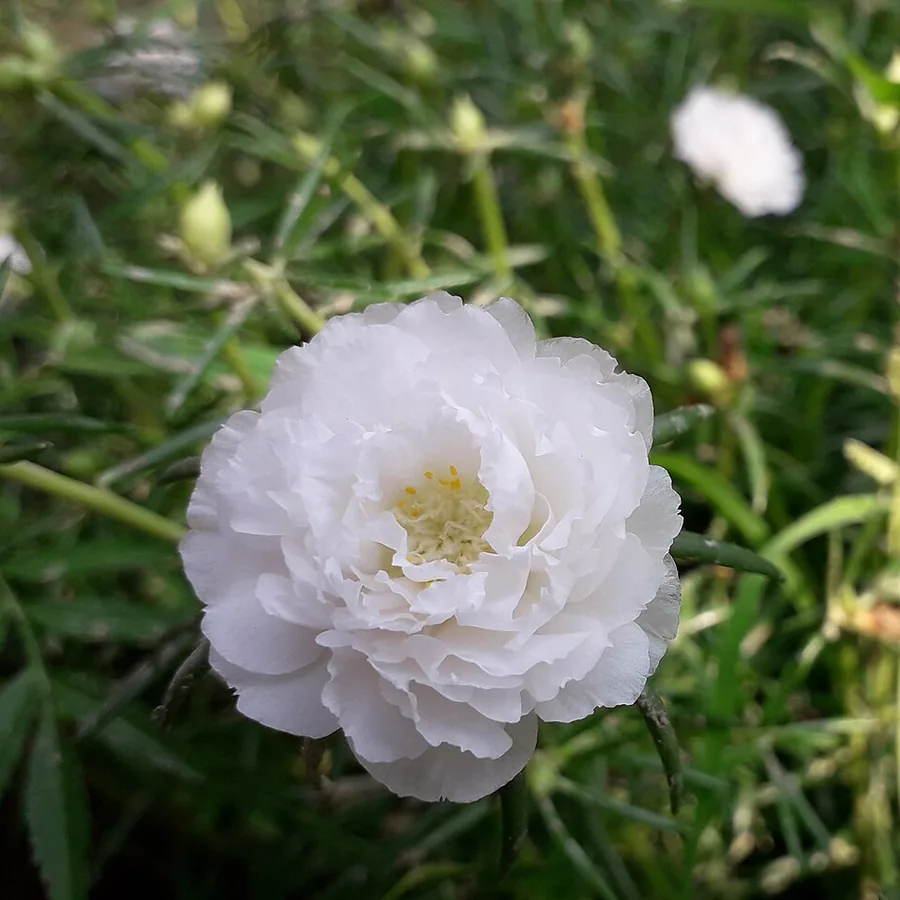
The display comes entirely from the flowers, which open in saturated pinks, oranges, reds, yellows, and whites, frequently as double forms that mimic small roses and give the plant its common name. Their opening is light-driven: bright, direct sun triggers them to unfold, and they close under shade, cloud cover, and the falling light of afternoon. That photoresponse is the origin of the alternate name, the eleven o'clock plant.
Good culture here means restraint. Poor, fast-draining ground and full sun suit its succulent habit, and water should come only after the soil has dried. Overwatering, rich soil, and heavy feeding all work against it: saturated roots invite rot, and surplus nitrogen pushes vegetative growth at the expense of the flowers you actually want.
Care
The short version: full, direct sun with dry, sharply drained sandy soil. Water only after the profile dries, keep feeding minimal, and let the plant's heat tolerance carry the season.
Light
Site moss rose in full, direct sun, ideally 6 or more hours daily. Flower opening is a direct response to strong light, so shaded plantings stay closed and produce little color regardless of health; sun intensity, not fertility, governs the display.
Water
As a succulent, moss rose stores its own moisture, so the soil should dry completely between waterings, on the order of every 7 to 14 days. Saturated soil deprives the roots of oxygen and invites rot, which is why overwatering, not drought, is the usual cause of death.
Soil
Plant into sandy, fast-draining soil; even lean, low-fertility ground suits it, because sharp drainage matters far more to this species than nutrient content. A soil pH of 5.5 to 7.5 is acceptable, with the emphasis on structure that sheds water quickly.
Temperature
Moss rose performs across a warm band of 59°F to 95°F (15°C to 35°C), in keeping with its warm-climate origins. It carries no frost hardiness, so exposure to freezing temperatures is lethal; delay planting until the cold season has fully passed.
Humidity
Low ambient humidity is not merely tolerated but preferred, so no target figure applies. Dry air and free airflow limit the leaf and stem moisture that fungal rots exploit, which is why still, humid sites cause trouble.
Feeding
Feed sparingly, if at all. Moss rose flowers best under mild nutrient stress, and excess nitrogen diverts growth into foliage and suppresses flowering. Lean soils need no supplement; poorer ground is served by a single light feeding across the summer.
Pruning
Pinch leggy stems to redirect the plant into branching and denser growth. Deadheading is unnecessary because moss rose is self-cleaning and reseeds without help, so spent flowers need no attention.
Repotting
Because it is grown as an annual, repotting rarely arises; nursery starts are simply potted up at transplanting. In containers, roots circling the wall, soil that drains almost instantly, or stalled growth indicate the plant has outgrown its volume.
Size & spacing
Expect a low, mat-forming habit: 4 to 8 inches (10 to 20 cm) in height and a spread of 6 to 12 inches (15 to 30 cm). Space plants so the mats close without overlapping, which preserves airflow through the canopy and reduces the humidity that favors rot.
When to plant
Moss rose is a warm-season annual with no frost tolerance, so its schedule tracks soil temperature more than the calendar date. Sow under cover in late winter, transplant once the ground has warmed past the danger of frost, and it will flower from summer into early autumn for as long as the heat holds.
Northern hemisphere
Southern hemisphere
Typical months for a temperate climate: start earlier in warm zones, later where spring frosts linger.
- Sow: 6 to 8 weeks before the last spring frost
- Plant: After all danger of frost has passed and soil has warmed
- Harvest: Summer through early fall
Hardiness
USDA hardiness zones: 2–11
Temperature: down to -46°C
Troubleshooting
Most disorders in moss rose reduce to two variables the grower controls: soil moisture and light. Excess of the first and shortage of the second account for nearly every complaint, and both announce themselves early in the stems and flowers. Read the signs below and correct the growing conditions before the damage becomes structural.
Basal stem collapse: soft, blackened, rotting tissue
Softening, blackening, and collapse at the stem base indicate root and stem rot, a condition brought on by overwatering or soil that drains poorly. The diagnostic signs are a mushy, discolored crown and soil that remains saturated for extended periods. Reduce irrigation, amend the bed with sand or grit to raise its porosity, and remove any plant whose tissue has rotted through, since it will not recover.
Fix:
- Reduce watering and allow soil to dry
- Improve drainage with sandy or gritty soil
- Remove and discard severely rotted plants
Vigorous foliage, few flowers
Abundant foliage with scarce bloom points to one of two deficits: insufficient direct sun or an excess of nitrogen. Flower opening requires on the order of 6 hours of hard, direct light, and high nitrogen favors leaf production over reproductive growth. Relocate the plant to full sun and withhold fertilizer, and flowering usually resumes.
Fix:
- Move to a full-sun location
- Stop or reduce fertilizing
Toxicity
Moss rose is mildly toxic, so some caution around pets and grazing animals is warranted. The foliage and stems contain soluble calcium oxalates, a class that binds calcium in the body; small amounts typically cause only drooling and gastric upset, while a large ingestion can produce weakness and measurable strain on the kidneys. Keep it from cats, dogs, horses, and other animals, and note that its edible relative purslane carries the same compounds and is best eaten in moderation.
Toxic to
Cats · Dogs · Horses · Rabbits · Livestock · Birds · People
Cats Mild
In a cat, a small quantity generally produces only salivation and mild gastric upset. A larger ingestion can bring heavier drooling and weakness, and a substantial dose places measurable strain on the kidneys through the oxalate load.
Dogs Mild
Dogs that ingest a few stems usually show no more than drooling and digestive upset. Heavier grazing warrants closer observation for weakness or intermittent vomiting as the oxalate dose accumulates.
Horses Mild
In horses, a small quantity typically causes little beyond salivation and a dulled appetite. Sustained grazing is the greater concern: accumulating soluble oxalates bind circulating calcium and can leave the animal weak.
Rabbits Caution
Rabbits should be kept from moss rose entirely. The same soluble oxalates that trouble other animals make it unsuitable for a species with such a sensitive digestive tract, so keep it out of hutches and exercise runs.
Livestock Caution
Cattle, sheep, and goats seldom graze moss rose by preference. On overgrazed or bare ground, however, a hungry animal may consume enough for the oxalates to cause salivation and weakness, so fencing is prudent where stock have access.
Birds Caution
Both companion and outdoor birds can be affected by the oxalates, so moss rose is best positioned well away from cages and enclosures.
People Caution
For people, garden moss rose is not a food and should be left in the bed. Its relative Portulaca oleracea, common purslane, is eaten as a vegetable, but it too contains oxalates and belongs in the diet only in moderation.
Common purslane (Portulaca oleracea) is eaten by people but also contains oxalates and should be consumed in moderation.
Helpline numbers

United States
ASPCA Animal Poison Control: (888) 426-4435 (fee applies)
Poison Control: (800) 222-1222



Canada
Poison Centres: 1-844-764-7669
Varieties
Garden moss rose is dominated by a handful of named series, each bred toward a specific trait: heavier doubling, wider color, or flowers that stay open under weaker light. The three below are the ones a grower is most likely to encounter.
Sundial Series
A compact, double-flowered selection notable for early daily opening and for holding its bloom in low light longer than most cultivars manage.
Margarita Series
A vigorous, heat-tolerant double developed to sustain flowering across bedding and container plantings through the hottest part of summer.
Happy Hour Series
A mounding form that produces large, fully double flowers in an exceptionally broad spread of colors.
How to propagate
Moss rose propagates readily by two routes, sexual and vegetative, and both succeed with little intervention. Its fine seed and easy-rooting stems make increase almost automatic once the plant is established.
SeedEasy
Start indoors 6 to 8 weeks before last frost or direct sow after frost; self-sows readily · 2 to 4 weeks to germinate and establish
Seed is the primary route and the most reliable. The seed is minute and requires light to germinate, so it is surface-sown and left uncovered rather than buried. Start it under cover 6 to 8 weeks before the last frost or sow directly once the soil is warm; germination and establishment take 2 to 4 weeks, after which the plant self-sows dependably.
Stem cuttingsEasy
During the active summer growing season · 1 to 2 weeks to root
Vegetative propagation is equally straightforward during the summer growth period. Detach a firm stem, give the cut surface a few hours to dry and callus so the base does not rot, then insert it into a gritty, free-draining medium. Rooting follows within roughly 1 to 2 weeks.
Myths
Because purslane is an edible vegetable, portulaca poses no risk to pets.
Botanical kinship does not confer edibility for animals. The ASPCA classifies Portulaca species as toxic to cats, dogs, and horses on the basis of soluble calcium oxalates, and culinary purslane contains the identical oxalates. The plant should stay out of reach of pets.
Moss rose flowers remain open throughout the day.
The flowers open only under bright, direct sun and fold shut in shade, under cloud, and as afternoon light fades. This light-dependent closing is precisely what gave rise to the name eleven o'clock plant.