Tree · Rosaceae
Plum
Prunus domestica
Site it in full sun with deep soil and an annual prune, and a plum crops heavily for years.
Full sun
Every 7–14 days
USDA 4–9
10–20 ft · 3–6 m
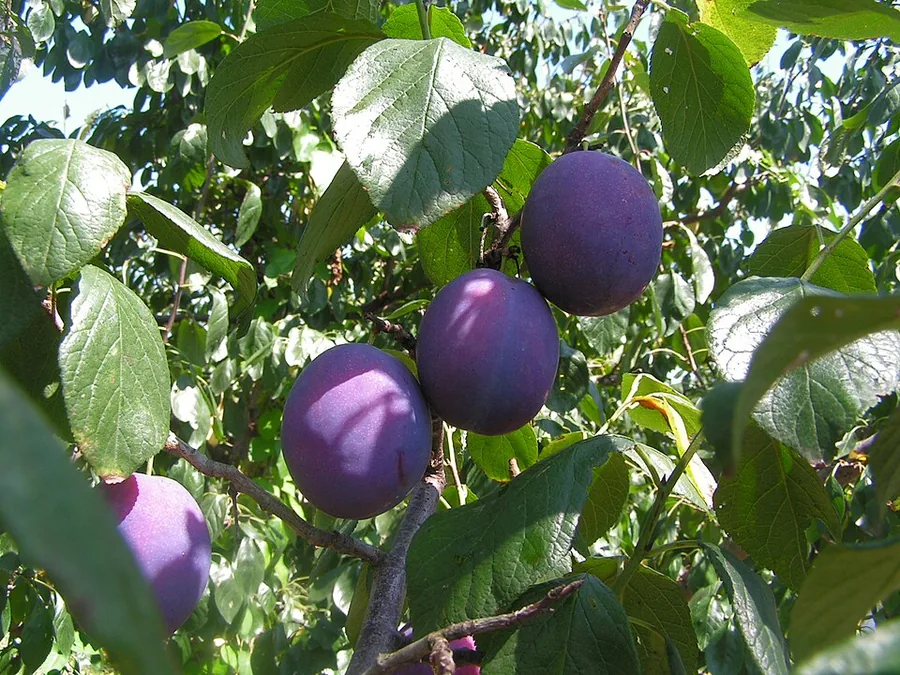
Overview
A plum tree rewards a grower who understands what it is doing. It belongs to the rose family with cherries, peaches, and apricots, and it divides into two horticultural groups: the cold-hardy European plums used for prunes and cooking, and the Japanese plums that ripen earlier and hold more juice for fresh use. Both are sun-demanding and require deep, well-drained soil, because their roots will not tolerate the standing water that drives root and crown rot.
The critical decisions are made at planting, since pollination is what governs the crop. Some European plums are self-fruitful and set fruit alone, while most Japanese plums need a second compatible cultivar in simultaneous bloom to fertilize the flowers. With pollination arranged, a healthy tree comes into bearing in about 3 to 5 years and then fruits for decades.
That longevity is paid for with disciplined care, most of it aimed at the canopy. Plums are prone to a defined set of problems, from black knot in the wood to brown rot in the fruit, and an open, well-thinned canopy is the single practice that reduces the moisture and inoculum they depend on. Combine that with removal of dropped fruit and dead wood, and the tree stays productive.
Care
The short version: full sun, deep and well-drained soil, and steady moisture as the fruit fills out. Prune each winter to keep the canopy open, feed lightly in early spring, and provide a compatible pollinizer for any variety that requires one.
Light
Plums require full sun, ideally 6 or more hours a day, because that light both ripens the sugars in the fruit and dries the canopy after rain to limit disease. They tolerate a little partial sun, but shade costs both the crop and the open growth that keeps humidity and pathogens down.
Water
Let the top half of the root zone dry between waterings, then irrigate deeply, since deep watering encourages the root depth that carries an established tree through drought. Young trees need regular water, while mature trees size and set fruit far better under even moisture during fruit development. Avoid saturated ground, which starves roots of oxygen and invites root and crown rot.
Soil
Plant in deep, well-drained loam amended with organic matter, which supplies both drainage and the reserves the tree draws on. A pH of 6.0 to 7.0 keeps nutrients available, and the one condition to avoid is heavy, waterlogged soil that rots the roots and crown.
Temperature
Plums are cold-hardy, withstanding roughly -29°F to 95°F (-34°C to 35°C), and European types in particular endure hard winters. The vulnerability is not midwinter cold but a late frost during bloom, which kills the open flowers and eliminates that season's fruit.
Humidity
Ambient humidity in the 40% to 70% range is adequate, so it is not a figure to manage directly. What matters is air movement, because prolonged leaf wetness in a dense canopy is the condition brown rot and black knot exploit.
Feeding
Apply fertilizer once in early spring before growth resumes, using a balanced product or a nitrogen source, so the nutrients are available as the tree breaks dormancy. Restraint is warranted, because excess nitrogen forces soft growth that fruits poorly and is more prone to disease.
Pruning
Prune annually in late winter during dormancy, when cuts heal cleanly and the structure is visible. Train Japanese types to an open vase and European types to a modified central leader, removing dead, diseased, and crossing wood, excising any black knot galls, and thinning the canopy so light and air reach the fruit.
Repotting
Plums are field-grown rather than potted, so repotting rarely applies. The exception is a dwarf tree in a large container, which needs its medium refreshed or a move to a larger pot every 2 to 3 years to renew its limited root volume.
Size & spacing
A standard plum reaches 10 to 20 feet (3 to 6 m) tall with a nearly equal spread, so spacing has to anticipate the mature canopy. Set trees far enough apart that grown canopies do not touch, since that separation maintains the airflow that suppresses disease.
When to plant
Plum management is keyed to phenology. Plant bare-root, grafted trees in early spring while they are dormant and the soil is workable, expect bloom in early to mid spring, and harvest from late summer into early fall as the fruit softens and develops color.
Northern hemisphere
Southern hemisphere
Typical months for a temperate climate: start earlier in warm zones, later where spring frosts linger.
- Plant: Early spring while dormant as bare-root, grafted trees, after the soil can be worked; container trees can go in from spring to early summer.
- Harvest: Blooms early to mid spring; European plums ripen late summer to early fall (about August to September), while Japanese plums often ripen somewhat earlier.
Hardiness
USDA hardiness zones: 4–9
Temperature: down to -34°C
Troubleshooting
Most plum disorders present in the wood, the blossoms, or the ripening fruit, and each has a window in which intervention is still effective. Because these problems build on carryover inoculum and pests, early identification lets sanitation or pruning contain them. Match the symptom below, then act within that window.
Coal-black woody galls girdling twigs and limbs
The woody rings encircling a twig are black knot, caused by a fungus that colonizes actively growing spring shoots and forms perennial galls, which is why the same limbs reinfect year after year. Because the pathogen lives in the wood, sanitation is the control: cut each knot out in late winter, taking the branch 6 to 8 inches below the swelling to reach clean tissue, then burn or bin the prunings. Disinfect the saw between cuts so it does not carry inoculum, and remove nearby wild plums or cherries that serve as a reservoir.
Fix:
- Prune out knots in late winter, cutting at least 6 to 8 inches below each gall, and destroy the prunings.
- Disinfect pruning tools between cuts and remove any infected wild plums or cherries nearby.
Collapsed blossoms and fruit rot bearing tan spore tufts
Blighted blossoms followed by soft fruit rot bearing tan spore tufts indicate brown rot, a fungus that favors warm, wet conditions at bloom and again near harvest, which explains the two waves of damage. Because the mummies overwinter as an inoculum source, the flowers collapse and the rot spreads through ripening fruit unless that carryover is broken. Remove and destroy every rotted fruit and clinging mummy, and in a wet season apply a labeled fungicide once at bloom and again as the fruit colors, timing the sprays to the periods of infection.
Fix:
- Remove and destroy rotted fruit and mummies during the season and at cleanup.
- Apply a labeled fungicide at bloom and again as fruit ripens in wet seasons.
Crescent oviposition scars on fruit with premature drop
A crescent scar on young fruit is the oviposition mark of the plum curculio, a weevil that inserts eggs into the developing plum, and the tunneling larva is what triggers the early drop. Because each windfall carries a C-shaped grub that would otherwise complete its cycle, gathering and destroying dropped fruit removes the next generation at its source. Follow that sanitation with a labeled insecticide at petal fall, when the adults are active and vulnerable, to protect the fruit still on the tree.
Fix:
- Collect and destroy dropped, infested fruit to interrupt the life cycle.
- Apply a labeled insecticide at petal fall and shuck split when adults are active.
Curled, sticky leaves with sooty mold
Curled, yellowing leaves under a sticky film point to aphids feeding on the soft new growth, and the honeydew they excrete is what draws ants and supports the black sooty mold that follows. Because natural enemies usually suppress light populations on their own, a hard jet of water dislodges a small colony, and insecticidal soap or horticultural oil handles heavier ones with little harm to beneficials. Preserving the lady beetles and lacewings already at work is the reason to hold off on stronger sprays.
Fix:
- Wash light infestations off with a strong jet of water or use insecticidal soap or horticultural oil.
- Preserve natural enemies such as lady beetles and lacewings and treat only when populations are high.
Toxicity
The ripe flesh is edible, but the rest of the tree is not, and the reason is chemistry. Leaves, stems, bark, and pits contain cyanogenic compounds that release cyanide when the tissue is chewed or wilted, and wilting concentrates the toxin, which is why prunings are most dangerous to grazing animals. Keep pets and livestock away from clippings and fallen pits, and never allow a stone to be cracked open.
Toxic to
Cats · Dogs · Horses · Rabbits · Livestock · Birds
Safe for
People
Cats Toxic
A taste of ripe flesh usually causes no more than mild stomach upset in a cat, because the flesh lacks the toxin. The hazard is the cyanide released when a cat chews leaves, twigs, or a cracked pit, so drooling, bright red gums, or labored breathing signal an emergency.
Dogs Toxic
The frequent problem with dogs is a crunched fallen pit, which matters on two counts: the kernel and wilting leaves release cyanide, and the intact pit can obstruct the gut. Vomiting, panting, or weakness after chewing the tree warrants a prompt veterinary call.
Horses Toxic
Horses face elevated risk because wilted leaves blown into a paddock are readily eaten, and wilting is exactly what concentrates the cyanide. Onset is rapid, bringing brick-red gums, dilated pupils, staggering, and collapse within minutes, so prunings and fallen branches must stay out of reach.
Rabbits Toxic
Plum leaves, bark, and twigs are not safe browse for a rabbit, since the same cyanogenic compounds accumulate as the foliage wilts. Withhold prunings entirely and provide known rabbit-safe greens instead.
Livestock Toxic
Cattle, goats, and sheep are most often poisoned by wilted leaves from a fallen or pruned branch, because drying is what concentrates the cyanide. Distress, gasping, and collapse can follow within an hour, so grazing stock must be fenced away from any plum prunings.
Birds Caution
Birds consume the ripe flesh safely, as many fruit-eaters do in the wild, since the flesh is not the toxic part. The pits and leaves are, because a bird that cracks the kernel ingests cyanide, so only pitted flesh should be offered.
People Ripe fruit safe
Ripe plums are a wholesome fruit, safe fresh or cooked, because the flesh carries no cyanogenic risk. The pit is the exception, holding cyanide that is released if it is cracked, so spit it out and keep children from chewing it.
The hazard is the wilting leaves, twigs, and the pits (cyanide), not the ripe flesh. Keep pets and livestock away from prunings, wilted foliage, and fallen pits; pitted ripe plum flesh is a safe occasional treat in moderation.
Helpline numbers

United States
ASPCA Animal Poison Control: (888) 426-4435 (fee applies)
Poison Control: (800) 222-1222



Canada
Poison Centres: 1-844-764-7669
Varieties
Hundreds of plum cultivars are in cultivation, but a small group accounts for most home orchards. The following are the ones worth knowing by name and by their pollination behavior.
Stanley
A widely planted, self-fruitful European prune plum that reliably sets blue freestone fruit suited to drying, cooking, and fresh eating.
Damson
A small, tart, blue-black European plum valued mainly for jams, preserves, and cooking rather than for fresh consumption.
Santa Rosa
A popular Japanese plum bearing juicy reddish-purple fruit that is only partly self-fruitful and yields best with a compatible pollinizer nearby.
Methley
An early, heat-tolerant Japanese plum that is self-fruitful and sweet, which makes it well suited to warmer regions.
How to propagate
Plums are not grown from seed the way an annual is, for genetic reasons. Named trees are propagated by grafting onto rootstock, and seed is reserved mainly for raising those rootstocks or for breeding new selections.
GraftingModerate
T-budding in late summer when bark slips, or whip grafting onto rootstock in late winter while dormant. · Bears fruit in roughly 3 to 5 years depending on rootstock and cultivar.
Because named plums do not come true from seed, they are propagated vegetatively by budding or grafting onto plum rootstocks, which impart the tree's eventual size, vigor, and tolerance of the site's soil. Match the technique to the season: T-bud in late summer while the bark still slips and the cambium separates cleanly, or whip graft onto dormant rootstock in late winter. The resulting tree comes into bearing in about 3 to 5 years, with the exact timing set by the rootstock and cultivar.
SeedModerate
Cold-moist stratify the cleaned pits over winter, then sow in spring. · Several years to fruit, and seedlings are not true to type.
Seed propagation serves rootstock production and breeding rather than reproducing a named plum, because the offspring segregate and will not match the parent. Clean the pits and give them a cold, moist stratification over winter to satisfy dormancy, then sow in spring. Expect several years to first fruit and a seedling that is not true to type.
Myths
All plums require a second tree for any fruit set.
Pollination requirement follows the type, so a single rule does not apply. Many European plums such as Stanley are self-fruitful and crop alone, whereas most Japanese plums and a few European ones require a compatible cultivar in simultaneous bloom to set fruit well. Confirm the variety's needs before planting a lone tree.
Prunes derive from a distinct fruit species, not from plums.
The two are the same fruit, since prunes are simply dried plums. They come from particular freestone European cultivars whose flesh dries down around the pit without spoiling, which is precisely why only some plums are suited to drying.
Plum pits are harmless to chew.
The pits, along with the leaves and stems, contain cyanogenic compounds that release cyanide when crushed or chewed, so chewing a pit is not harmless. A swallowed pit can also obstruct the gut, so it should be spat out and kept away from pets and children.