Houseplant · Araceae
Pink Princess Philodendron
Philodendron erubescens 'Pink Princess'
Consistent warmth, bright filtered light, and evenly moist soil keep this chimeral cultivar producing its pink-splashed foliage.
Bright indirect
65–85°F · 18–29°C
USDA 10–12
2–60 ft · 0.6–18.3 m
Overview
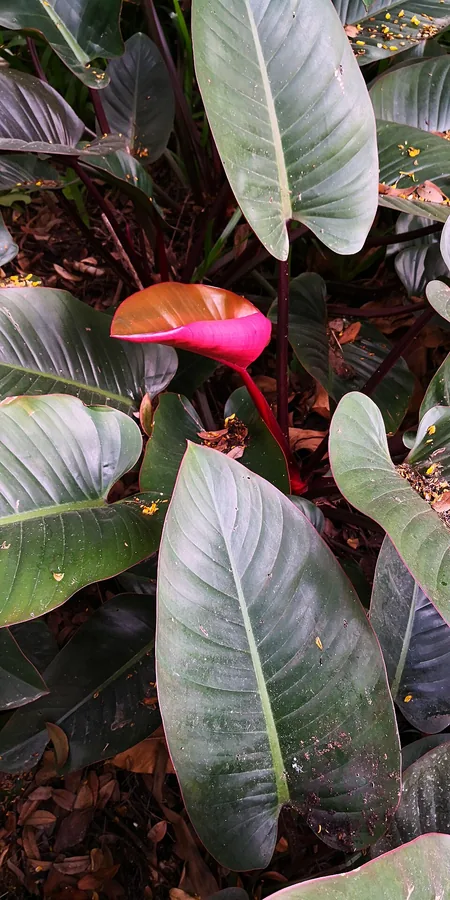
The Pink Princess is a climbing philodendron in the arum family, valued for the bubblegum-pink sectors that break up its dark green, heart-shaped leaves. The distribution of pink differs from leaf to leaf, so no two emerge alike. That variability is the draw, and it is also the reason the cultivar rewards a grower who understands what drives it.
The color comes from a chimeral variegation, meaning the pigment-lacking tissue occupies only one cell layer of the plant and is not transmitted dependably to each new leaf. A stem can revert to uniform green and, because that green tissue grows faster, overtake the pink if nothing is done. Reading the new growth and pruning at the correct node is the mechanism by which the color is retained.
Indoors the cultivar stays tractable, generally near 3 feet (90 cm) trained on a moss pole or trellis, though the species will ascend far higher in habitat. Provide warmth, bright indirect light, and a freely draining medium, and it advances at a steady, moderate rate.
Care
The short version: bright indirect light, warmth between 65°F and 85°F (18°C to 29°C), and a moist but free-draining medium, with reverted green stems pruned back to a pink node so the variegation persists.
Light
Site it in bright indirect light near a window but clear of the direct beam, which scorches the leaf surface. Light also drives pigment expression, so a position that is too dim yields weak, predominantly green growth rather than strong variegation.
Water
Hold the medium evenly moist but never soggy, letting the excess drain fully after each watering. Waterlogged soil starves the roots of oxygen and is the quickest route to root rot, so favor drainage over frequency.
Soil
Grow it in a rich, well-draining medium based on organic matter such as loam or silt. An acidic to neutral pH suits it, and drainage governs root health more than the precise recipe, since standing water induces rot.
Temperature
It performs in a warm room between 65°F and 85°F (18°C to 29°C). Shield it from cold drafts and chilled winter windowsills, because the cultivar has no cold tolerance and chilling injures the tissue.
Humidity
The plant favors high humidity and responds with fuller, healthier foliage. It will acclimate to average room air, but a humidifier or a nearby pebble tray raises local moisture and keeps it at its best.
Feeding
Apply a balanced liquid houseplant fertilizer at half strength monthly through spring and summer, its active growth phase. Withhold feed in the darker months, when reduced growth means the plant takes up little.
Pruning
Prune to shape the plant and, more critically, to protect the pink. When a stem reverts to all green, cut it back to a node still bearing pink, otherwise the faster green growth overtakes the variegation.
Repotting
Repot in spring once it becomes root-bound, indicated when roots fill the pot or emerge from the drainage holes. Advance only one pot size, so the surplus fresh mix does not stay wet around the roots and invite rot.
Size & spacing
24–720 in (61–1829 cm) tall
Troubleshooting
Most disorders in the Pink Princess register first in the foliage and roots, and the primary drivers are watering and light. Identify the early signs and the corrections are straightforward. Match the symptom below to the cause, then intervene before it advances.
Chlorotic, wilting foliage paired with a medium that stays saturated
When soil stays saturated, the root zone loses oxygen and root rot sets in, which is why the plant wilts even with wet soil. The rot follows overwatering or a mix that drains poorly, and infected roots go from firm and pale to soft and brown. Move it into a fresh, fast-draining mix, excise the rotted roots, and reduce watering frequency so the medium can breathe again.
Fix:
- Reduce watering frequency
- Repot into a fresh, well-draining, organic-rich mix
- Trim away rotted roots
Emerging leaves reverting to solid green with no variegation
The pink is a chimeral variegation, so it occupies only part of the plant's tissue and is not carried reliably into new growth. Non-chimeral all-green tissue grows more vigorously and outcompetes the variegated portions, and insufficient light compounds the loss. Prune the reverted stem back to a node that still bears pink, then supply bright indirect light so variegated growth can regain ground.
Fix:
- Prune the reverted stem back to a node that still bears pink variegation
- Provide bright indirect light
Necrotic spotting and lesions advancing through the foliage
Discrete lesions, some bordered by a yellow halo, indicate a fungal or bacterial leaf spot. These pathogens establish where air is stagnant and the leaf surface stays wet long enough for spores to germinate. Remove the affected leaves to reduce inoculum, open the space around the plant for airflow, and keep the foliage dry when watering.
Fix:
- Remove affected leaves
- Improve air circulation
- Avoid wetting the foliage
Stippled leaves, honeydew, webbing, or cottony deposits
Webbing, cottony masses, and sticky residue are diagnostic of sap-feeding pests: spider mites, mealybugs, aphids, scale, and thrips. Fine webbing marks mites, cottony masses mark mealybugs, and honeydew is the sugary excretion left as they draw sap. Dislodge them by wiping or rinsing, treat with insecticidal soap or horticultural oil, and isolate the plant to interrupt spread to neighbors.
Fix:
- Wipe off or rinse away pests
- Treat with insecticidal soap or horticultural oil
- Isolate the affected plant
Bleached, scorched tissue on light-exposed foliage
Bleached or crisped tissue on the illuminated side is sun scorch, the result of direct sun overloading the leaf beyond what it can dissipate. The cultivar performs on bright but filtered light rather than an unobstructed beam through glass. Relocate it away from the window or diffuse the light with a sheer curtain so it receives bright indirect light.
Fix:
- Move to bright indirect light, out of direct sun
Toxicity
This is a toxic houseplant and belongs well out of reach of pets and children. Every part contains insoluble calcium oxalate crystals that sting and burn the mouth on contact when chewed, and the sap can irritate exposed skin. No tissue of this plant is edible.
Toxic to
Cats · Dogs · Horses · Rabbits · Livestock · Birds · People
Cats Moderate
Chewing ruptures cells and releases sharp calcium oxalate crystals that irritate a cat's oral tissue on contact. The result is drooling, pawing at the face, vomiting, and reluctance to swallow as the mouth and tongue become sore and swollen.
Dogs Moderate
A dog that bites the foliage takes in the same stinging crystals directly into the mouth. Expect heavy drooling, retching or vomiting, swelling of the lips and tongue, and difficulty swallowing within a short time.
Horses Moderate
In horses the crystals inflame the mouth and throat, producing drooling, painful swelling, and difficulty swallowing. Because the equine physiology cannot vomit, the irritation is confined to the mouth and gut.
Rabbits Caution
The oxalate crystals irritate a rabbit's mouth as they do in other species, so the plant should be kept out of reach. A single nibbled leaf can leave a rabbit sore-mouthed and unwilling to feed.
Livestock Caution
Grazing animals that mouth the leaves sustain the same burning irritation and drooling. It is not a pasture species, but a curious goat or sheep with access can develop a sore, swollen mouth.
Birds Caution
A bird that bites the foliage encounters the same irritant crystals, with swelling and discomfort in the mouth. Pet birds should be kept away from the leaves and stems.
People Caution
No part of this plant is intended for consumption. A chewed leaf burns the mouth and lips, and the sap can leave skin red and itchy, so wear gloves when pruning and keep it away from small children.
Sap can cause contact dermatitis - wash hands or wear gloves when pruning
Helpline numbers

United States
ASPCA Animal Poison Control: (888) 426-4435 (fee applies)
Poison Control: (800) 222-1222



Canada
Poison Centres: 1-844-764-7669
How to propagate
You can increase your Pink Princess from the plant on hand, but only from tissue that already carries pink. Both methods below are dependable provided the starting material includes a variegated node.
Stem cuttingsModerate
Spring to summer, during active growth · Several weeks to root
Take cuttings in spring or summer during active growth, when the plant roots most readily, and ensure each cutting includes at least one node bearing pink variegation. Because the variegation is chimeral, a cutting drawn from an all-green section produces only green growth. Insert it in a moist medium and allow several weeks for roots to form.
LayeringModerate
Spring to summer, during active growth · Several weeks to root before separating
Layering is the lower-risk method, carried out in spring or summer during active growth. The stem roots while still attached to and supported by the parent, and after the several weeks it takes to root you sever it to grow on as an independent plant.
Myths
Chimeral variegation is fixed, so pink sectors appear reliably on each new leaf.
The pink derives from a chimeral variegation, which is not genetically fixed, so the plant can revert to all green at any stage. Because non-chimeral green tissue grows more vigorously, it will overtake the variegated portions if left unchecked. Prune reverted growth back to a pink node to keep the color coming.
Reverted all-green stems eventually redevelop their pink sectors unaided.
Reversion is one-directional: once a stem turns all green the tissue is stable and does not regenerate its variegation. Cut it back to a node that still shows pink so variegated tissue can resume growth from that point.