Houseplant · Araceae
Philodendron Birkin
Philodendron 'Birkin'
Supply bright, filtered light and steady moisture, and this pinstriped philodendron keeps unfurling clean white-on-green leaves.
Bright indirect
64–84°F · 18–29°C
USDA 10–12
0–3 ft · 0.2–0.9 m
Overview
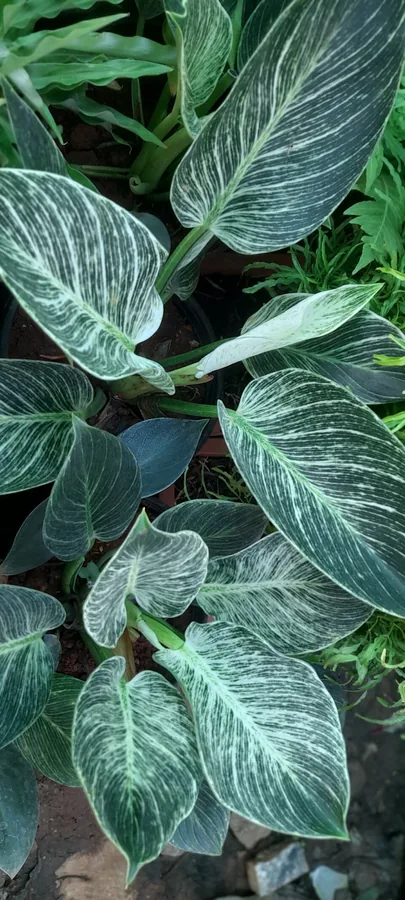
The Philodendron Birkin is an undemanding houseplant valued for foliage carrying fine white pinstripes over deep green. It originated as a spontaneous sport of 'Rojo Congo' rather than a wild species, and that lineage explains its compact, upright habit, which suits a shelf or desk. Under interior conditions it remains small and slow, reaching roughly 3 feet (91 cm) only over an extended period.
As a member of the aroid family, the Birkin needs what most tropical foliage plants need: warmth, bright but indirect light, and air that is not excessively dry. The pinstriping carries the ornamental value, and its expression depends on adequate light. In a dim position the variegation regresses toward plain green while the stems elongate and thin, a direct response to insufficient light.
Its easy reputation rests on real tolerances: it withstands an occasional missed watering and grows slowly enough that it seldom fills its pot quickly. The principal vulnerability is the root system, which rots fast in soggy soil. Manage light and watering correctly and the remaining requirements largely satisfy themselves.
Care
The short version: bright, indirect light to sustain the pinstripes, soil held lightly moist but never soggy, temperatures above 64°F (18°C), and humidity around 50% to 60%.
Light
Provide bright, indirect light to keep the pinstripes sharply defined; medium indirect light is tolerated but the pattern degrades under it. Exclude harsh direct sun, which scorches the leaves, and rotate the pot periodically so growth remains even toward the window.
Water
Hold the soil lightly moist but never waterlogged, letting the top inch dry before rewatering. The plant is far more prone to loss from excess water than from deficit, so empty the saucer and never leave the roots standing in it.
Soil
Use a well-drained, organic-rich mix of loam and sand that retains some moisture without remaining soggy. A slightly acidic to neutral pH of 6.0 to 7.0 suits it, and a pot with drainage holes performs most of the work of keeping the roots sound.
Temperature
Ordinary room warmth between 64°F and 84°F (18°C to 29°C) is ideal. Shield it from cold drafts, frosty windows, and the dry output of a heat vent, none of which it tolerates well.
Humidity
The Birkin prefers humid conditions, ideally around 50% to 60%. Dry indoor air browns the leaf tips, so group it with other plants, stand it over a tray of pebbles and water, or run a small humidifier nearby.
Feeding
Feed monthly through the growing season and withhold in the darker months when growth slows. A standard houseplant fertilizer at the label rate suffices, given a slow grower of modest nutrient demand.
Pruning
Little pruning is required beyond maintaining the plant's shape. Remove any yellowed or damaged leaves at the base, and trim a stray stem to encourage a fuller, more compact form.
Repotting
Repot in spring, and only once the plant is genuinely root-bound, with roots crowding the pot or emerging from the drainage holes. Increase pot size by a single step, since an oversized container retains excess wet soil that promotes root rot.
Size & spacing
Indoors the Birkin stays small and slow, attaining roughly 6 to 36 inches (15 to 91 cm) in height and a comparable spread. Its compact, upright habit demands little clearance, accommodating a shelf, desk, or windowsill readily.
Troubleshooting
Nearly all Birkin problems originate in the roots or register in the leaves, and the underlying cause is generally watering, light, or dry air. Interpreting the early symptoms allows correction before decline sets in. Match the signs below, then act accordingly.
Yellowing leaves and soft, mushy roots
Yellow foliage paired with soft, mushy roots points to root rot driven by a substrate that stays saturated. Waterlogged soil displaces the air roots need, the tissue suffocates and decays, and the leaves lose color as the failing roots stop moving water and nutrients upward. Reduce the watering interval, move the plant into a fast-draining mix, and repot into fresh soil once any root has gone slimy.
Fix:
- Reduce watering
- Improve drainage
- Repot in fresh mix
Fading stripes and stretched, leggy stems
Washed-out pinstripes alongside elongated internodes indicate a plant starved for light. With too little light to sustain the low-chlorophyll white tissue, a Birkin favors solid green and etiolates, stretching toward the brightest source and thinning as it goes. Relocate it to bright, filtered light and the leaves that follow emerge patterned again with tighter spacing.
Fix:
- Move to bright filtered light
Webbing, sticky residue, or tiny insects on the leaves
Sap-sucking pests including spider mites, mealybugs, aphids, scale, and thrips feed on plant fluids and betray themselves through fine webbing or a sticky film. Clean the foliage by wiping it down, then apply insecticidal soap and repeat on a cycle until the population collapses. Inspecting new growth and leaf undersides often matters because early detection contains an infestation before it spreads.
Fix:
- Wipe leaves
- Treat with insecticidal soap
Crispy brown tips on the leaves
Dry, brown leaf margins on a moisture-loving plant usually reflect air that is too dry. Bring the humidity around it into the 50% to 60% band with an adjacent water tray, a cluster of plants, or a small humidifier, which slows the moisture loss driving the browning. Tissue already killed at the tips will not regreen, but leaves formed under better humidity develop clean.
Fix:
- Raise humidity to 50-60%
Toxicity
This species belongs out of reach. As with philodendrons broadly, every part contains insoluble calcium oxalate crystals that produce burning, drooling, and swelling in the mouth on chewing. No tissue is edible, and the sap can irritate bare skin, so handle it with care and keep it away from pets and small children.
Toxic to
Cats · Dogs · Horses · Rabbits · Livestock · Birds · People
Cats Toxic
The oxalate crystals penetrate the moment a cat bites a leaf, so heavy drooling, pawing at the mouth, and vomiting follow, along with a sore, swollen mouth and throat.
Dogs Toxic
Because chewing releases intense oral burning, a dog shows drooling, foaming, and a sudden refusal to eat. Vomiting and a swollen muzzle can develop soon after.
Horses Toxic
The identical crystals irritate a horse's mouth and gut, producing drooling, loss of appetite, and evident discomfort. Site the plant well out of reach in any barn or paddock.
Rabbits Toxic
This foliage is unsafe browse for a rabbit. A single nibble irritates the mouth and stomach, so position the plant where a loose or curious rabbit cannot access it.
Livestock Toxic
Goats, sheep, and cattle respond to the oxalate crystals with oral pain, drooling, and digestive upset. Keep prunings and discarded leaves clear of any grazing area.
Birds Caution
A pet bird that chews the foliage can sustain the same oral irritation and drooling, so treat the plant as off-limits and supply safe greens instead.
People Caution
No part of this plant is edible. Ingestion causes burning lips, a swollen tongue, and drooling, and the sap can irritate bare skin, so wash your hands and keep it away from small children.
Keep away from pets and children; wash hands after handling sap
Helpline numbers

United States
ASPCA Animal Poison Control: (888) 426-4435 (fee applies)
Poison Control: (800) 222-1222



Canada
Poison Centres: 1-844-764-7669
How to propagate
Propagating a Birkin at home is straightforward, and spring or summer, when the plant is actively growing, is the season that gives the best results.
Stem cuttingsEasy
Spring to summer · Several weeks to root
The most reliable increase comes from stem cuttings taken in spring or summer, when active growth speeds rooting. Sever a healthy section carrying at least one node, since roots initiate from nodal tissue, then hold it in water or insert it into moist potting mix and allow several weeks for a viable root system before growing it on independently.
LayeringModerate
Spring to summer · Several weeks
Air layering in spring or summer offers a second route used across the genus, and it roots the stem while it still draws on the parent. Pack moist medium around a node on an attached stem, allow the several weeks roots need to form within that medium, then detach the rooted section below the new roots.
Myths
The Birkin is its own distinct species of philodendron.
It arose as a spontaneous sport of 'Rojo Congo' rather than a true species, and that unstable mutation is precisely why the white pinstriping is never genetically fixed. A Birkin can revert, producing solid green or even deep red leaves, a shift that low light makes more probable. Supply bright, filtered light to keep the variegation expressed.