Tree · Ebenaceae
Persimmon
Diospyros kaki
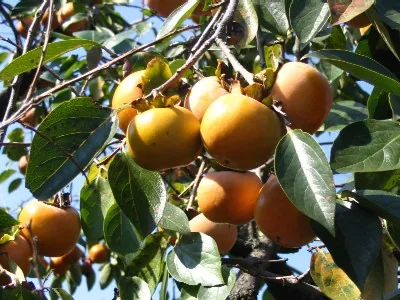
Under full sun and an unhurried timeline, persimmon rewards the grower with bright orange fruit persisting on leafless wood well into fall.
Full sun
Every 7–14 days
USDA 7–10
20–30 ft · 6.1–9.1 m
Overview
Persimmon is a slow, undemanding fruit tree that returns value in two seasons. Its foliage carries the canopy through summer, colors intensely in autumn, then abscises to leave glowing orange fruit displayed on bare wood well into winter. A member of the ebony family, it attains a substantial 20 to 30 feet (6 to 9 m) at maturity, so it requires an open site rather than a confined corner.
The Asian persimmon is the usual choice for home growers, and it divides on a single physiological trait. Astringent cultivars such as Hachiya hold high soluble tannin and stay harsh until they ripen to jelly soft, whereas non astringent cultivars such as Fuyu sweeten and stay crisp and can be eaten firm. Identifying which type you grow fixes the correct harvest window.
After establishment the tree is fairly drought tolerant and needs little feeding or pruning, because a mature root system supplies its own water and its low vigor rarely calls for correction. The patience is front loaded, since a young tree establishes and comes into bearing slowly, then yields fruit across decades.
Care
The short version: full sun and deep, well drained soil, with steady water while the tree is establishing and during fruit set, minimal feeding, pruning confined to cleaning up the framework, and astringent fruit left to ripen fully before harvest.
Light
Persimmon requires full sun for most of the day. Direct light drives the photosynthesis and sugar accumulation that color and sweeten the fruit, and it also produces a more compact, structurally sound tree.
Water
Irrigate regularly during establishment and through fruit development, allowing the top half of the soil to dry between applications so the roots are not held saturated. An established tree is fairly drought tolerant thanks to its deep root system, but it will not endure waterlogged ground, which excludes the oxygen roots need.
Soil
Site it in deep, moist, well drained loam. The species tolerates clay, loam, or sand, so texture is flexible, but it performs best in the slightly acidic band of 6.0 to 6.5, where nutrient availability suits it.
Temperature
Asian persimmon tolerates a broad span, roughly 10°F to 95°F (-12°C to 35°C), matching hardiness zones 7 to 10. It requires accumulated winter chill to fruit reliably, yet its early growth remains vulnerable, since a hard late frost can kill the spring blooms.
Humidity
Ambient outdoor humidity near 40% to 70% meets its needs, so no adjustment is required. Air movement through the canopy is the more relevant factor, because it dries the foliage and suppresses leaf spot.
Feeding
Feed sparingly. A balanced fertilizer in early spring is justified only when growth is visibly weak, because excess nitrogen drives fruit drop by favoring vegetative growth over crop retention.
Pruning
Keep pruning minimal. Remove dead, injured, or crossing branches in late winter while the tree is dormant, train a young tree to a sound framework, and cut off root suckers as soon as they emerge to prevent them diverting energy.
Repotting
As an orchard tree rather than a container subject, persimmon is rarely repotted. Establish it once in its permanent position with room to develop and leave the root system undisturbed.
Size & spacing
Allow generous space. A mature specimen reaches 20 to 30 feet (6 to 9 m) tall and spreads 15 to 25 feet (4.5 to 7.5 m) wide, so position it well clear of buildings, power lines, and neighboring trees to accommodate the full crown.
When to plant
Persimmon follows a slow seasonal cycle governed by temperature. Plant young trees in early spring once hard frosts have ended, then expect bloom in mid to late spring and fruit that colors in fall and persists into early winter.
Northern hemisphere
Southern hemisphere
Typical months for a temperate climate: start earlier in warm zones, later where spring frosts linger.
- Plant: Early spring after the last hard frost, as bare root or container trees.
- Harvest: Blooms mid to late spring; fruit ripens in fall and early winter.
Hardiness
USDA hardiness zones: 7–10
Temperature: down to -18°C
Troubleshooting
Persimmon is a resilient tree with few serious disorders. Most of what appears is cosmetic or a physiological trait of the fruit rather than a genuine threat. Match the symptom below and the corrective measure is usually minor.
Premature yellowing and shedding of unripe fruit ahead of ripeness
A baseline of fruit drop is normal for persimmon, but water stress or an excessive crop load pushes the tree to shed far more than that baseline. Even soil moisture through fruit development steadies the tree and holds the crop. Thinning a heavy set early reduces the demand on each branch so it can carry what remains to maturity.
Fix:
- Keep soil evenly moist during fruit development and thin heavy crops.
Sessile bumps or waxy cottony deposits along the twigs, at times overlaid with black sooty growth
The fixed bumps and cottony tufts are sap feeding insects, scale or mealybugs, and the black film beneath them is sooty mold colonizing the sugary honeydew they excrete. Because the damage is largely superficial, light populations cause no real harm and warrant no action. A heavy infestation responds to horticultural oil, which smothers the insects, after which resident natural predators keep the survivors in check.
Fix:
- Usually minor; treat heavy infestations with horticultural oil and encourage natural predators.
Dark lesions with angular margins spread over the leaf surface
Dark, angular lesions on the foliage indicate fungal leaf spot, a cosmetic disorder that seldom sets a persimmon back. Since the pathogen overwinters in leaf litter, raking and disposing of fallen leaves removes the inoculum, and opening the canopy for better air movement lowers the leaf wetness the spores need. Treatment is almost never justified.
Fix:
- Rake and remove fallen leaves and provide good air circulation; rarely needs treatment.
Pronounced astringency in fruit sampled while still firm
That dry, puckering sensation traces to soluble tannins concentrated in unripe astringent cultivars such as Hachiya, and it reflects the fruit's ripeness, not any fault in cultivation. Allowing astringent types to soften fully to a jelly ripe state lets those tannins render insoluble and the fruit turn sweet. Non astringent cultivars such as Fuyu carry low soluble tannin and eat sweet while still firm.
Fix:
- Let astringent types soften fully before eating; non astringent types such as Fuyu can be eaten firm.
Toxicity
The ripe flesh is a safe, sweet food for people, and no part of the tree holds a chemical toxin. The hazard is mechanical: the hard seeds and large volumes of fruit can consolidate into indigestible phytobezoars, a documented risk for horses and livestock grazing windfalls and for dogs that gorge on dropped fruit. Clearing fallen persimmons and fencing stock away from the tree in the fruiting season removes the exposure.
Toxic to
Cats · Dogs · Horses · Rabbits · Livestock · Birds
Safe for
People
Cats Mild
The flesh contains no chemical toxin, so an exploratory nibble poses no poisoning risk. The hazard is purely mechanical, since a swallowed seed or a stomach loaded with fruit can provoke mild digestive upset.
Dogs Mild
A dog that scavenges windfalls can develop vomiting or loose stool from the seed content and the volume ingested. In rare cases a small dog that swallows several whole fruit, seeds included, concentrates them into an obstruction.
Horses Moderate
Horses represent the principal risk. Sustained grazing on dropped persimmons across fall and winter binds seeds and pulp into a gastric phytobezoar, which in turn drives colic, impaction, lethargy, and weight loss.
Rabbits Mild
Occasional ripe flesh will not poison a rabbit, but the seeds and the sugar load are poorly matched to its digestive system. Restrict persimmon to a rare treat and withhold it entirely from young rabbits.
Livestock Mild
Cattle, sheep, and goats can browse fallen fruit without chemical injury, yet sustained gorging on seedy persimmons invites the same impactions documented in horses. Exclude them from windfalls through the fruiting season.
Birds Mild
Wild birds forage ripe persimmon successfully because they consume the soft flesh and pass the small seeds without difficulty. Pet birds should receive only seedless portions of ripe fruit and never the hard pits.
People Ripe fruit safe
Ripe persimmon is a safe, palatable fruit eaten fresh or dried. Allow astringent types to soften, avoid swallowing the seeds, and moderate the quantity, since consuming a great many on an empty stomach has been associated with bezoars.
Foliage and ripe flesh are not chemically toxic; the hazard comes from swallowed seeds and large amounts of fruit, especially unripe astringent fruit.
Helpline numbers

United States
ASPCA Animal Poison Control: (888) 426-4435 (fee applies)
Poison Control: (800) 222-1222



Canada
Poison Centres: 1-844-764-7669
Varieties
Persimmons divide first by astringency, and that single physiological trait dictates how each is eaten. The names below are the ones most often encountered.
Fuyu
A non astringent Asian cultivar whose low soluble tannin lets the sweet, crisp flesh be eaten while the fruit is still firm.
Hachiya
An astringent Asian cultivar that must ripen fully to a soft, jelly texture before its tannins convert and the pucker disappears.
Jiro
A non astringent Asian cultivar comparable to Fuyu, eaten firm and sweet directly off the tree.
American (Diospyros virginiana)
The native American persimmon withstands cold to roughly minus 20°F to minus 25°F (-29°C to -32°C) and is frequently dioecious, so fruit set usually requires both a male and a female tree.
How to propagate
Persimmon is propagated to fix a known fruit rather than for convenience. Grafting reproduces the cultivar faithfully, while seed is a slower and genetically variable route reserved mainly for raising rootstock.
GraftingDemanding
Named cultivars are propagated by grafting or budding onto seedling rootstock, since these vegetative methods reproduce the parent exactly and preserve the fruit character of a Fuyu or Hachiya that seed cannot. The union demands a steady hand and correct timing, placing it at the demanding end of propagation.
SeedModerate
Persimmon germinates readily from seed, but sexual reproduction segregates the parent traits, so the seedlings are variable and slow to bear and their fruit is unpredictable. That variability is why seed grown trees serve chiefly as rootstock for grafting rather than as bearing trees in their own right.
Myths
Astringency is universal across all persimmon cultivars.
Only the astringent cultivars such as Hachiya must soften before their soluble tannins convert and the flesh sweetens. Non astringent types such as Fuyu and Jiro are crisp and sweet eaten firm, carrying too little soluble tannin to produce the dry, puckering bite.