Tree · Rosaceae
Pear
Pyrus communis
Site two compatible cultivars for cross-pollination, provide full sun, allow time, and a pear will crop for decades.
Full sun
Every 7–14 days
USDA 4–8
40–50 ft · 12.2–15.2 m
Overview
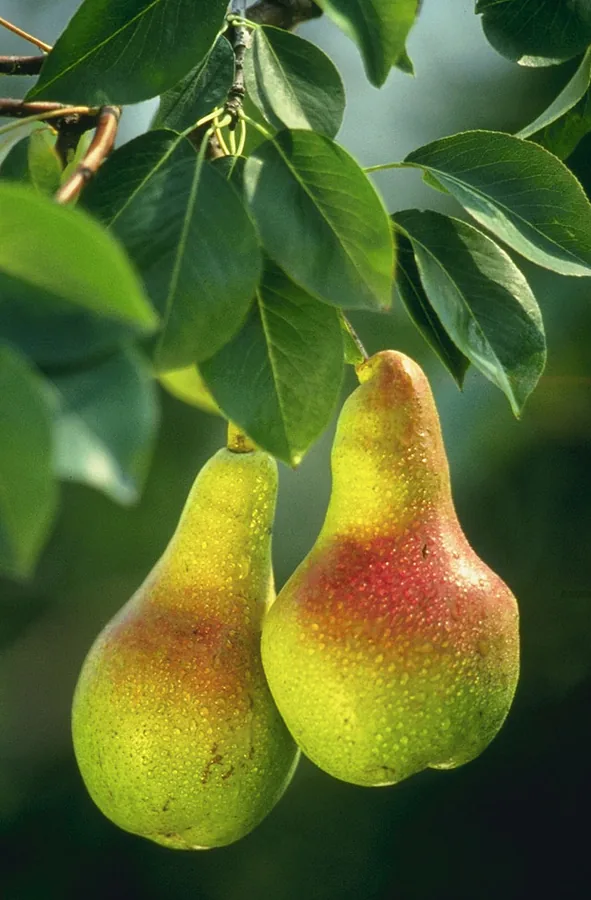
A pear is a long-lived deciduous tree rather than a seasonal crop. Pyrus communis belongs to the rose family, the group that also contains apples, cherries, and plums, and a well-sited specimen attains 40 to 50 feet (12 to 15 m) in height and persists for generations. It flowers in white masses in spring, after which it sets the familiar bell-shaped fruit.
Most pears set a poor crop in isolation because they are largely self-unfruitful, which is why they depend on cross-pollination. Planting a second compatible cultivar that flowers at the same time provides the pollen, and insects transfer it. Seed does not reproduce a named variety either, since the offspring segregate, so nursery trees are grafted onto a selected rootstock, either a full-size pear seedling or a dwarfing quince.
The point that most often catches new growers is ripening physiology. European pears complete ripening off the tree rather than on it, so fruit is picked mature but firm and finished to buttery texture in storage, because fruit left hanging accumulates stone cells and turns gritty. Harvest at the right stage, provide a pollinizer, and manage fire blight, and the tree needs little further intervention.
Care
The short version: give it full sun, deep loam with sharp drainage, and a compatible pollinizer within bee range. Keep young trees evenly moist, prune during winter dormancy to a single central leader, and limit nitrogen so fire blight gains no foothold.
Light
Pears fruit best in full sun, since at least six hours of direct light a day supplies the energy for flower initiation and fruit set. Light afternoon shade is tolerated, but sustained shade limits photosynthesis and yields weak growth and a sparse crop.
Water
Supply roughly 1 inch of water a week, keeping young trees consistently moist while the root system develops. Established pears draw on deeper roots and withstand dry spells well. Apply water at the soil, not over the canopy, because prolonged leaf wetness favors disease infection.
Soil
Pears perform best in deep, fertile, well-drained loam, and they tolerate clay or sand provided drainage keeps the root zone from staying saturated. A pH of 6.0 to 7.5, on the slightly acidic to neutral side, keeps nutrients available.
Temperature
Pears are cold-hardy across USDA zones 4 through 8, tolerating about -20°F to 95°F (-29°C to 35°C). The winter cold is functional rather than incidental, since the buds must accumulate chilling before they will break dormancy in spring.
Humidity
Ambient outdoor humidity around 40% to 70% is adequate, so humidity itself is seldom limiting. Canopy airflow matters more, because still, humid air prolongs leaf wetness and creates the conditions under which fire blight and scab establish.
Feeding
Apply a balanced N-P-K fertilizer in early spring before bud break, about once a season. Restrain the nitrogen, since excess nitrogen drives soft, succulent growth that is highly susceptible to fire blight infection.
Pruning
Prune in late winter while the tree is dormant, developing a young tree to a single central leader and removing crossing, dead, or diseased wood to improve structure and light. Where fire blight appears, cut 8 to 12 inches below the visible canker and disinfect tools between cuts to avoid moving the bacterium.
Repotting
Pears are rarely container grown, but a dwarf tree in a large pot benefits from annual top-dressing and repotting every 2 to 3 years. Renewing the medium at that interval restores structure and nutrient supply as the roots fill the container.
Size & spacing
A standard pear reaches 40 to 50 feet (12 to 15 m) tall and 25 to 35 feet (7.5 to 10.5 m) wide, so site it on open ground clear of buildings and power lines. Even a cross-pollinating pair needs spacing sufficient for air to move through both canopies.
When to plant
A pear is planted bare and dormant so the roots establish before the demand of leaf-out. Set it out in early spring, or in fall where winters are mild, and it will flower white in early to mid spring. Fruit develops through the season and is harvested firm from late summer into fall, then ripened off the tree.
Northern hemisphere
Southern hemisphere
Typical months for a temperate climate: start earlier in warm zones, later where spring frosts linger.
- Plant: Early spring while dormant, or fall in mild-winter regions
- Harvest: Blooms early to mid spring; European pears are harvested mature but still firm in late summer to fall and ripened off the tree
Hardiness
USDA hardiness zones: 4–8
Temperature: down to -34°C
Troubleshooting
A pear faces a compact set of recurring problems, and fire blight is by a clear margin the most serious. Inspect the new growth in spring and the fruit through summer, since those tissues show the earliest signs. Identify the disorder below, then intervene before it advances through the tree.
Shoot tips wilt and blacken, curling to form a shepherd's crook
These symptoms indicate fire blight, caused by the bacterium Erwinia amylovora. Infection enters through open blossoms in warm, wet spring weather, then advances internally down the shoot, which is why the tip dies and hooks over into the shepherd's crook while scorched leaves stay fused to the wood and cankers weep bacterial ooze. Because the pathogen moves ahead of the visible margin, excise infected wood 8 to 12 inches below the damage during dry conditions, and disinfect tools between cuts so the blade does not carry bacteria into healthy tissue.
Fix:
- Prune out infected wood 8 to 12 inches below visible symptoms during dry weather
- Disinfect pruning tools between every cut and remove and destroy prunings
Honeydew-glazed leaves with sooty black mold and curled margins
The sticky film and dark coating trace back to pear psylla, small insects that feed on foliage and shoots and excrete honeydew, on which black sooty mold then colonizes. Confirm the diagnosis by examining the new growth for the small nymphs sitting within those honeydew droplets. Since the pest overwinters as adults, a dormant horticultural oil applied before bud break suppresses the population at its most vulnerable stage, and an insecticide is warranted only once monitoring indicates the numbers exceed threshold.
Fix:
- Apply dormant horticultural oil before bud break
- Use recommended insecticides only if monitoring thresholds are exceeded
Fruit bored through with frass-filled galleries, dropping prematurely
Fruit riddled with frass-filled tunnels marks codling moth, whose larvae bore into the developing fruit and feed toward the core, packing their galleries with frass. Sectioning a damaged pear reveals the larval track and confirms the pest. Because damage begins at egg hatch, remove infested and dropped fruit promptly to interrupt the life cycle, and deploy pheromone traps to detect adult flight so any control is timed to the vulnerable window.
Fix:
- Remove and destroy infested and dropped fruit
- Use pheromone traps to time controls
Velvety olive-black lesions on foliage with scabby, cracked fruit
Velvety lesions on foliage and corky patches on fruit point to pear scab, the fungus Venturia pyrina. Wet spring weather favors spore germination and infection, producing olive-to-black lesions on leaves and cracked, scabby fruit. Because the fungus overwinters in fallen leaves, raking and destroying that litter removes the primary inoculum, while pruning to open the canopy shortens leaf wetness and resistant cultivars lower susceptibility. A fungicide applied through the infection period supplements these measures in a high-pressure season.
Fix:
- Rake and destroy fallen leaves
- Apply fungicides during the infection period if needed
Toxicity
The ripe flesh of a pear is a wholesome fruit for people and harmless to most pets in small amounts. The hazard resides in the seeds, bark, and wilting leaves, which contain cyanogenic compounds characteristic of the rose family and capable of releasing cyanide. Collect fallen fruit and prunings, and keep seed-bearing cores and wilted foliage away from horses, livestock, and grazing pets.
Toxic to
Cats · Dogs · Horses · Rabbits · Livestock · Birds
Safe for
People
Cats Caution
Ripe flesh in a small lick poses no hazard to a cat; the risk lies in the seeds and wilting leaves, where amygdalin concentrates. A few chewed seeds or some wilted foliage can irritate the stomach, and a genuine cyanide response, though uncommon, presents as drooling and labored breathing.
Dogs Caution
A dog tolerates a little ripe pear without issue, so the concern is the core rather than the flesh. Crunching the seeds or grazing wilted leaves may cause gastric upset, and a large quantity can produce weakness and panting as the cyanogenic compounds release cyanide.
Horses Caution
Horses warrant the closest attention because they consume windfall fruit by the mouthful. A large intake of fallen fruit, seeds, and wilted leaves can provoke colic, and in severe cases cyanide poisoning marked by trembling and gasping.
Rabbits Caution
A small portion of ripe pear suits a rabbit, but the seeds and wilted greens belong outside the hutch. Given their small body mass, even a modest dose of the cyanogenic parts can disrupt digestion.
Livestock Caution
Cattle, sheep, and goats readily consume dropped fruit and the wilting leaves of pruned or storm-damaged branches. Wilted foliage carries the highest cyanogenic load, and a large feeding risks staggering, rapid breathing, and collapse.
Birds Caution
Chickens and other backyard birds consume ripe pear flesh without harm. The seeds are the hazard, since they hold the cyanogenic compound, so remove the cores before offering any.
People Ripe fruit safe
Ripe pear is a wholesome fruit and safe to eat. Simply avoid habitually swallowing the seeds, which contain the same cyanogenic compound found throughout the rose family.
Pets nibbling a little ripe pear flesh are unlikely to be harmed, but discard cores and seeds. The main real-world concern is horses and livestock eating large quantities of fallen fruit and seeds or wilted foliage.
Helpline numbers

United States
ASPCA Animal Poison Control: (888) 426-4435 (fee applies)
Poison Control: (800) 222-1222



Canada
Poison Centres: 1-844-764-7669
Varieties
A handful of European pear cultivars recur at the market and the nursery and are worth recognizing. Those below are the standards, and most require a compatible pollinizer to crop.
Bartlett (Williams)
As the most widely grown European pear, it carries a classic bell shape that transitions from green to yellow with ripeness and performs well both fresh and canned.
Bosc
Identified by its long tapering neck and russeted cinnamon-brown skin, its firm, dense flesh retains structure under heat, making it well suited to cooking.
Anjou (D'Anjou)
Egg-shaped, with green skin, or red in Red Anjou, that retains its color at ripeness, so maturity is judged by softening at the neck rather than by a color change.
Comice
Known as the Christmas pear, this rounded greenish-yellow fruit is valued for its sweet, juicy, buttery flesh.
How to propagate
Pears are propagated by grafting rather than by cuttings or seed, because a named variety retains its identity only when grafted onto a rootstock.
GraftingModerate
Whip-and-tongue bench graft in late winter while dormant, or chip/T-bud in summer · Grafted trees typically begin bearing in about 3 to 6 years
Because named cultivars do not reproduce true from seed, they are perpetuated clonally by grafting onto a rootstock. The standard method is a whip-and-tongue bench graft in late winter while the wood is dormant, with chip or T-budding used in summer. Pear seedling rootstock produces a full-size tree and quince induces dwarfing, though some cultivars are graft-incompatible with quince and require an interstem to unite. A grafted tree generally begins bearing in about 3 to 6 years.
SeedModerate
Sow after 60 to 90 days of cold, moist stratification in spring · Several years
Seed propagation serves breeding and nursery rootstock production rather than reproducing a chosen tree. Sow in spring after 60 to 90 days of cold, moist stratification, which satisfies the embryo's dormancy requirement. The resulting seedlings need several years to develop and segregate away from the parent, so they function as rootstock or breeding material.
Myths
Pears ripen properly only if left hanging on the tree, as apples do.
European cultivars such as Bartlett, Bosc, Anjou, and Comice behave differently from apples in this respect. Harvest them mature but still firm and ripen them off the tree, because fruit left on the branch ripens from the inside out and develops the stone cells that give a mealy, gritty texture. Asian pears are the exception and do ripen on the branch.
A solitary pear will produce a full crop without a pollen partner.
Self-fertility is limited in most pears. A second compatible cultivar blooming concurrently is needed for cross-pollination to set a full crop, so a compatible pollinizer should be planted alongside.